


No. 269 October 2026
- INTERVIEW: JANUSZ SIKORA • J.SIKORA ⸜ founder, designer » POLAND
- KRAKOW SONIC SOCIETY № 156: HISAO NATSUME • Sakuraphon » JAPAN → POLAND
- TEST: MORE AUDIO C200 ⸜ integrated amplifier » POLAND
- TEST: NO VIBRATION Duo 110 BMZ ⸜ anti-vibration feet » POLAND
- TEST: SOYATON The Meister RCA ⸜ analog interconnect RCA » POLAND
- TEST: THUNDER MELODY Brown Noise Wall ⸜ AC power filter » POLAND
- TEST: WK AUDIO The One Interconnect RCA ⸜ analog interconnect RCA » POLAND
 |
 |
 |
 |

|

|
|
A HISTORY OF DISAPPEARANCE 
The same might be said about man's creations used to make music, and starting from the end of 19th century also to record it and later to reproduce it. Over time the importance of music in man's life grew until at some point having an instrument, and later a device to reproduce music in a living room became a symbol of man's position, of his social status. 
Kowalscy Man wasn't always fully aware of what he had. Being aware means knowing who and why made the thing man possesses. The world of sounds is no exception here – usually man knows nothing or very little about man's furniture designers – one of the very basic things each man has in his home. Sometimes man calls a piece of furniture by its name without even realizing that he's using the name of its creator/designer. If you want to learn more about it you should read a recently released book Meble Kowalskich. It was written by a son of two designers, Bogusława and Jacek Kowalscy. It describes a fascinating story of one of the most popular pieces of furniture in People's Republic Poland, so called „meblościanka Kowalskich” (Kowalski Cabinets). 
Most people used this name but only few realized that the name actually came from the family name of its creators - Kowalski: Kowalski furniture accompanied millions of Poles for three decades – some use them still today. This name described probably the most popular cabinets available at the time in People's Republic of Poland. Today only few remember those, but, surprisingly, a similar trend seems to emerge today again. At their time they were a symbols of a very modern furniture, today they became a „modernistic antique”. There are some who collect them, there are also some who start to write about them. But most Poles already forgot about Kowalski cabinets, or simply think that the name „Kowalski” was used because it was the most popular name in our country so it was good for communistic propaganda – something like „furniture for Kowalski” meaning “for anybody”. Name Kowalski was as popular in Poland as „Smith” in England or , „Durand” in France or „Schmidt” in Germany. But the truth is that they were named after their designers, Mr and Ms Kowalski, Bogusława and Czesław. Looking at images in this book I couldn't resist thinking that they were an illustration of a certain state of mind or of some hierarchy of values. Namely what one can see on shelves, but also on shop windows and exhibitions caught on images are books, pottery, TV sets, but also audio devices like old radios and reel-to-reel tape recorders. 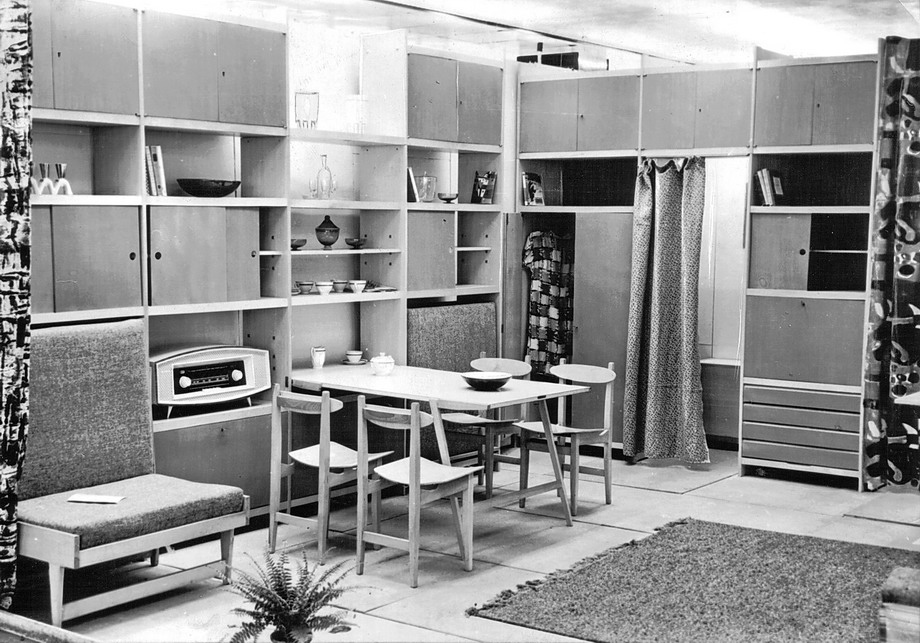
Do you remember the Polish TV series Czterdziestolatek directed by Jerzy Gruza (1974-1979)? What about Karol Stelmach, a friend of a main character, played by Leon Pietraszak? If your answer to both questions is “yes” then you might also remember Karol's apartment. In this series he played a doctor, an educated, intelligent man. Among other things he had an audio system he used to listen to classical music, which was sort of a “confirmation” of his social status. His system included a turntable, tuner, reel-to-reel, loudspeakers and headphones. |
Disappearing Interestingly, in present times, say since 2000, audio systems disappeared from interior magazines and catalogs This reflects and important trend of modern society – computer games and Internet are today's way of spending free time, not music anymore. Thus audio systems disappear not only from shelves but also from people's minds. 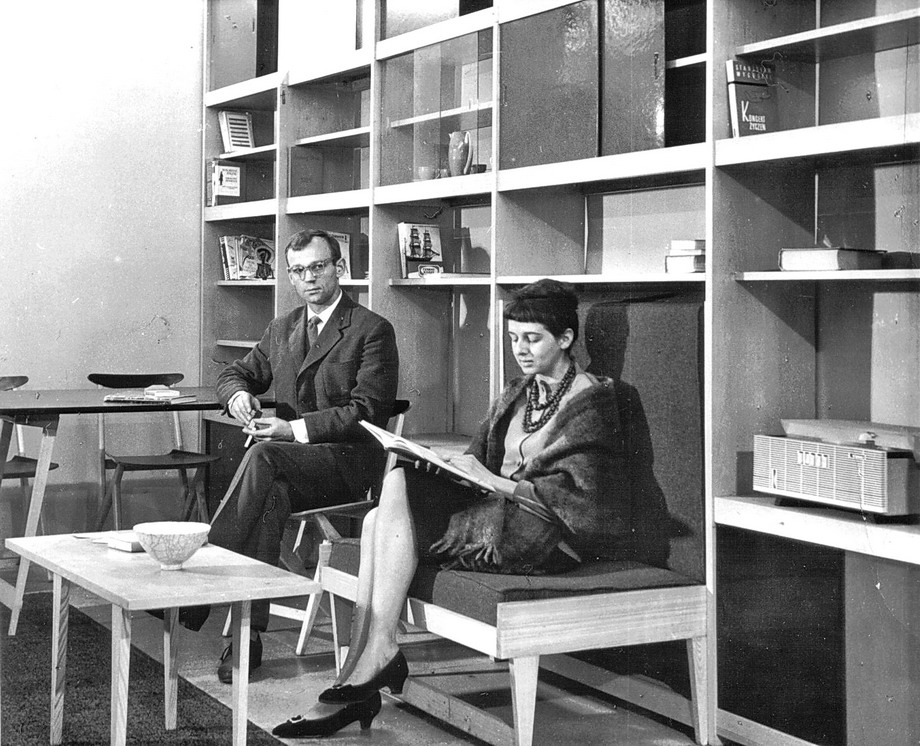
A book by Witold Rybczyński, Dom. Krótka historia idei (A house. Short history of an idea), illustrates this fact nicely. This wonderful book is about „idea, and not a particular reality of a house” and it describes in very persuasive way multi-directional changes in man's understanding of a house that happened over centuries, focusing especially on an evolution of our understanding of comfort. The author, Canadian-American architect and university teacher born in Edinburgh in Polish family presents changes in furniture that people used over centuries, in particularly what chairs and other technical equipment were used. Even him, declaring that „«homey» does not mean impeccable” and while commenting on Le Corbusier's choices, saying that „what the impeccable rooms lack are signs of human presence” totally omits this part of “home environment” that relates to music – in his book you won't find even slightest information related to one of the man's biggest fascinations. When he mentions a “turntable” it is meant only a “household appliance”: In Podręcznik mieszkania […] Le Corbusier offers some advice to future owner of the house. It is surprising how little he has to say about technical aspects of each house. He doesn't mention heating. He barely mentions ventilation. In fact his key suggestion is a necessity of having windows that open in every room. […] As for house appliances he suggested a vacuum cleaner and a turntable – hardly a revolutionary solutions for a new house. Witold Rybczyński by reversing these proportions in his work removes music from man's life for good. 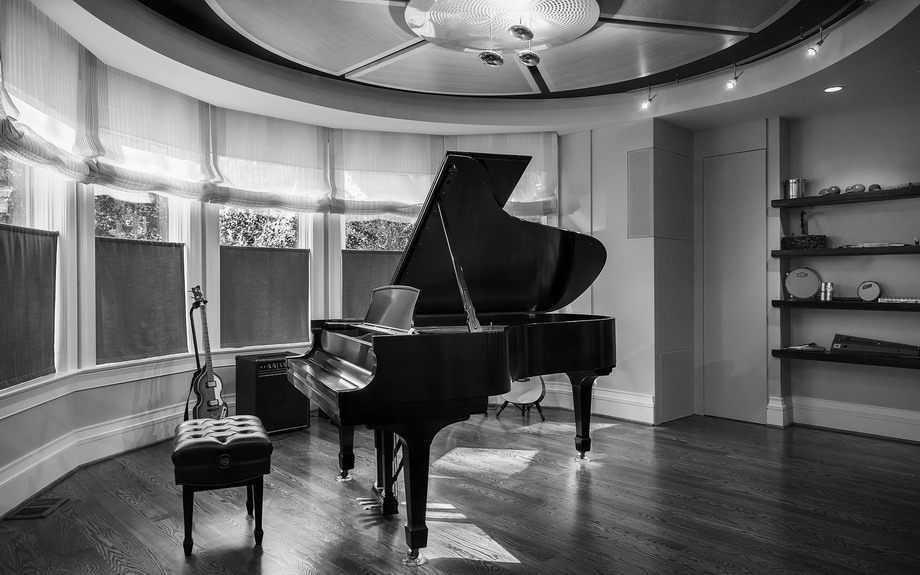
Times when audio system meant for everyone a whole stack of products from one manufacturer, so called “towers” are gone and won't be coming back. But it doesn't mean that music is also gone. Quite on contrary – due to almost unlimited, common access to it via smartphones and computers, more people listen to more music then in any other moment in humankind history. What changed is how men “consume” music today. Today music players fit small pockets, and large speakers are often replaced with headphones. The Change But it should be also a good start to re-introduce audio systems to people's homes. For it to work two conditions must be met: men have to be able to include audio systems in their own, home space, and secondly specialized interior magazine have to notice also this area of man's life. 
It seems that the biggest obstacle is a complete lack of any knowledge about audio systems on the side of journalists writing for interior magazines. While describing interiors they name manufacturers and brands of all kinds of furniture and additional elements, while ignoring completely audio components and loudspeakers even if the text specifies that users of particular apartment/house listen to a lot of music and one can also see shelves full of CDs or vinyls. Somehow what these people use to play these recordings never makes it to photographs or to the text. For such a text to be complete and having actual, full value for readers, authors would have to educate themselves a bit also on audio systems. Without this part we, readers, receive incomplete description and are, in fact, cheated because author usually claims that he/she included everything in his text. Wojciech Pacuła |
 e live among things, this is obvious for everybody. Even the greatest ascetes that we could imagine, still have to use some things – cloths, something to eat, a place to live. So in fact history of a mankind is also a history of things man uses.
 |
 |
 |
 |
About Us |
We cooperate |
Patrons |
|
Our reviewers regularly contribute to “Enjoy the Music.com”, “Positive-Feedback.com”, “HiFiStatement.net” and “Hi-Fi Choice & Home Cinema. Edycja Polska” . "High Fidelity" is a monthly magazine dedicated to high quality sound. It has been published since May 1st, 2004. Up until October 2008, the magazine was called "High Fidelity OnLine", but since November 2008 it has been registered under the new title. "High Fidelity" is an online magazine, i.e. it is only published on the web. For the last few years it has been published both in Polish and in English. Thanks to our English section, the magazine has now a worldwide reach - statistics show that we have readers from almost every country in the world. Once a year, we prepare a printed edition of one of reviews published online. This unique, limited collector's edition is given to the visitors of the Audio Show in Warsaw, Poland, held in November of each year. For years, "High Fidelity" has been cooperating with other audio magazines, including “Enjoy the Music.com” and “Positive-Feedback.com” in the U.S. and “HiFiStatement.net” in Germany. Our reviews have also been published by “6moons.com”. You can contact any of our contributors by clicking his email address on our CONTACT page. |
 


|
  |