


|
ANALOG INTERCONNECT RCA SOYATON
Manufacturer: SOYATON |

 |
 |
 |
|
Review
text by WOJCIECH PACUŁA |

|
No 269 October 1, 2026 |
|
˻ PREMIERE TEST ˼
A LOT HAS CHANGED since I last tested Soyaton cables - the Benchmark RCA IC interconnect (2021, → HERE) and the Benchmark mk2 power cable (2013, review → HERE). One thing hasn’t changed: Julian’s - the founder, CEO, and designer - passion for the color green. If you’ve had the chance to take a look at any of the meetings of the Krakow Sonic Society, which took place at Julian Soja’s home - he’s the one who designs these cables - you’ll see an interior dominated by that color; more → HERE ˻PL˺. 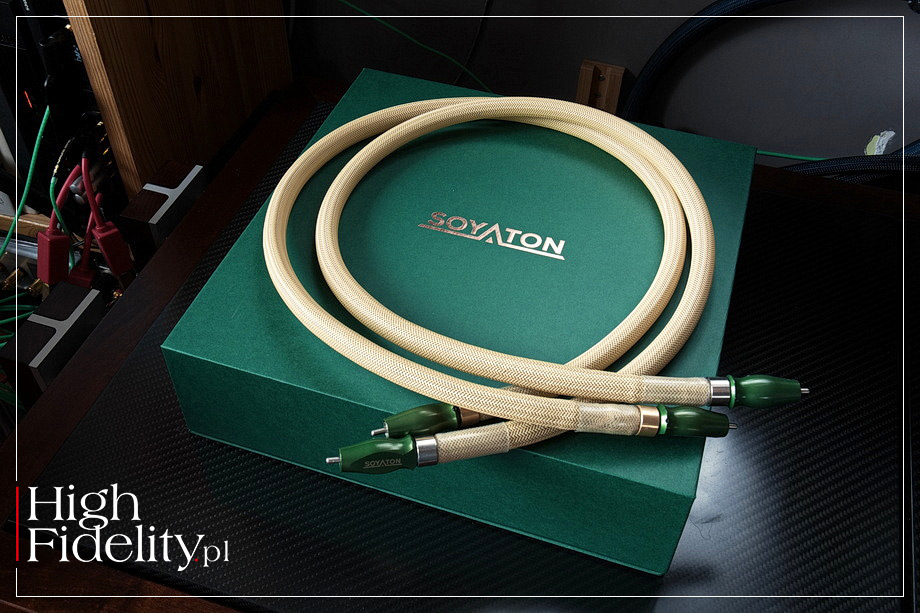
What’s more, when Julian was introducing changes to his reference setup, for some inexplicable reason, those components also had the color of hope. This was the case with the J.Sikora Reference turntable (more → HERE), the Thöress Phono Entzerrer Mk III phono preamp (more → HERE), and his latest acquisition, the Kasoto OnWaTi Custom Edition speakers. Soyaton’s latest, top-of-the-line cable series, The Meister, is also integrated into his setup. ▲ A few simple words… JULIAN SOJA ON SEPTEMBER 2 OF THIS YEAR, it will be exactly seven years since Soyaton officially began operations. Over the years, the company’s product line has gradually expanded to include new types of cables, and individual cables have evolved into the revised and improved mk2 version; nevertheless, they all belong to The Benchmark series. This series was conceived as a sort of benchmark - both for me as a designer and manufacturer, and for my customers. 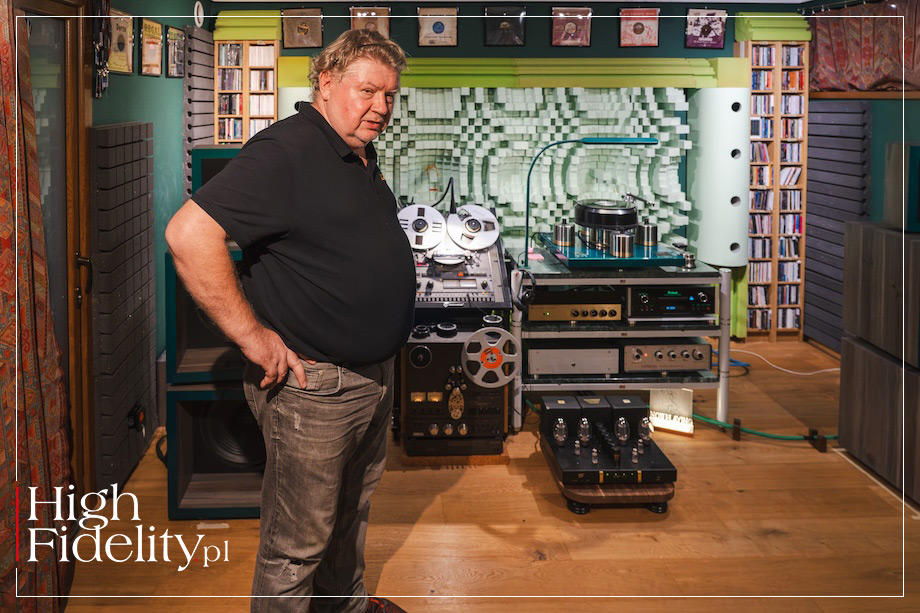
‖ Julian Soja at the 156th Meeting of the Krakow Sonic Society • photo by Andrzej Grochowalski When I started the company and launched my first product line, I didn’t yet know which direction its future growth would take - to put it colloquially, whether it would be upward (the premium segment) or downward (the more affordable segment). Today I know that if I want to preserve the company’s boutique and personal character, and the path forward leads only upward. It turned out, however, that improving on something that’s already really good (which the Benchmark series turned out to be) is very difficult. Especially since I didn’t want to offer customers something that was just a little better; I was looking for a solution that would be clearly better right from the start. After more than two years of intensive work, the first cable from the new line is ready. 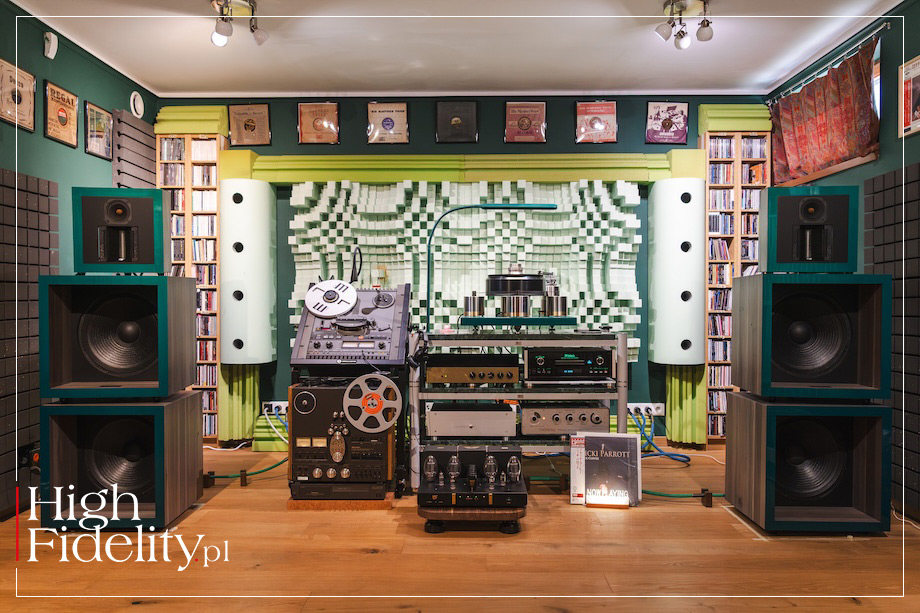
‖ Julian Soja’s reference system, including the latest addition, Kasoto OnWaTi Custom Edition loudspeakers • photo by Andrzej Grochowalski I named the new line “The Meister,” which means master or foreman. It refers to a Master who spent many years learning and working - first as an apprentice, then as a journeyman - before finally passing the master’s exam, creating his “masterpiece”, and being recognized as a Master. My grandfather (also named Julian) followed this very path of education and instilled in me a respect for true masters of their craft - those who not only ensure the high quality of their products but also think inventively and develop new solutions. 
‖ The latest exhibition in Krakow - it’s obviously a coincidence (unless there are no such things as coincidences) That’s why this new line is also a tribute and an expression of appreciation for my grandfather. And that’s why, to indicate the colors, I used rings made from his favorite materials - kajner (as we called stainless steel at home) and brass. The rest of the exterior design, including in particular the beautiful and original shape of the plugs, was created by the artist Małgorzata Karp-Soja, who is also my wife. You can check out her work at her gallery → HERE. ‖ JS MAŁGORZATA KARP-SOJA I LISTEN TO A LOT OF MUSIC, and I have my own audio system in my painting studio, so when my husband asked me to design the connectors for his new, high-end line of cables, I agreed without hesitation. The decision on the colors was obvious - anyone who has ever visited Soyaton’s listening room knows that green is the owner’s favorite color. 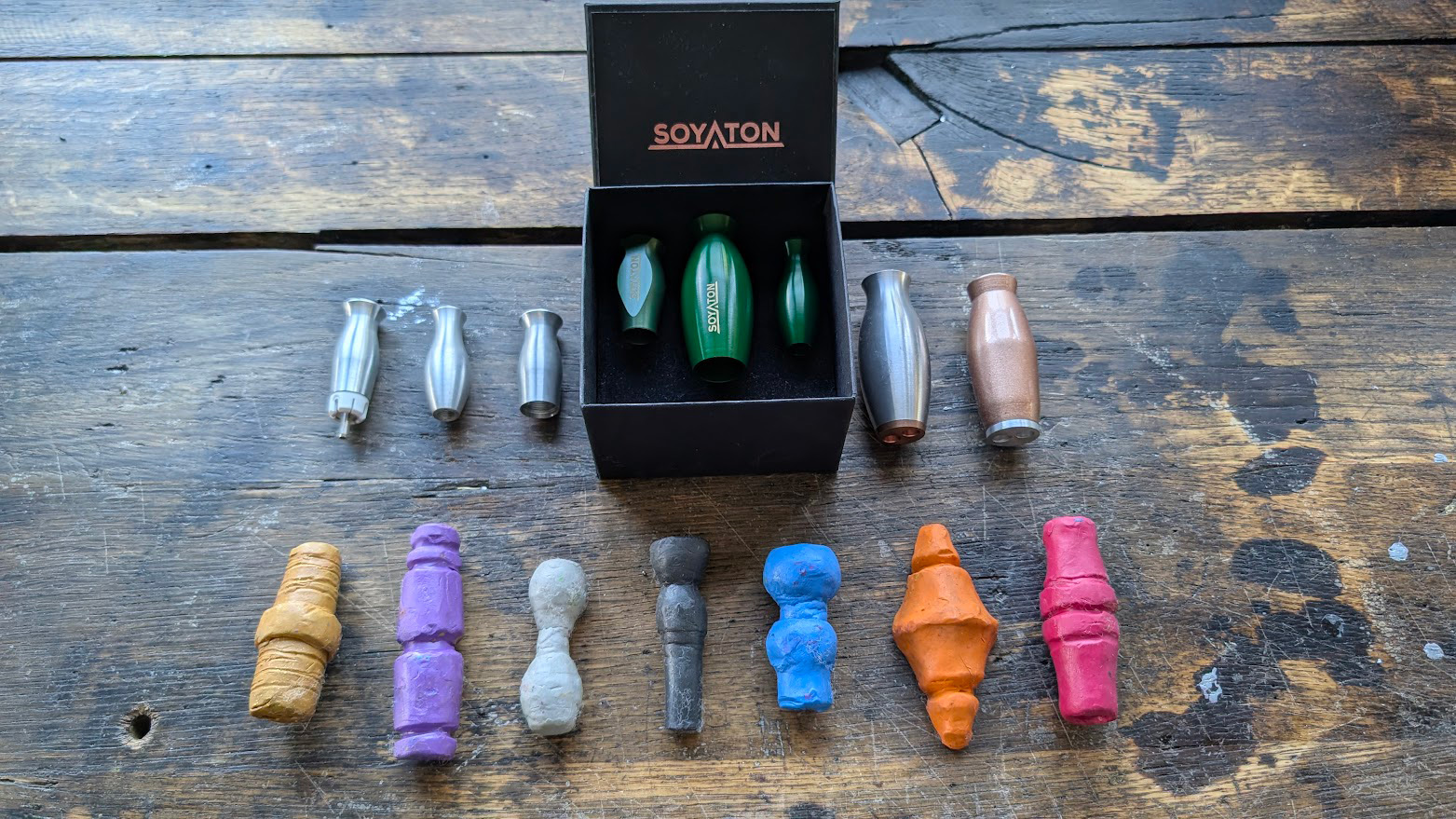
‖ Prototypes of plug bodies from various stages of prototyping, ranging from the first ones handmade by Małgorzata Karp-Soja out of modeling clay to the final versions anodized in green • photo courtesy of Soyaton The shape of the bodies definitely required a lot more work. As I first sketched them out in my mind and then modeled them in plasticine, I thought they had to be something different and original - something that would clearly and unambiguously identify and distinguish these cables. The plugs also serve as visual jewelry, which defines their luxurious character. I associate the flow of current or signal in an audio system with water, flow, circulation, or simply with flowing, which is why I thought the plugs should take the form of a fish, with a distinct body and tail (which will also make it easier to plug the cable in and out). Besides, what other shape would be more fitting since its creator’s name is Karp? (karp is Polish word for carp - ed.) ‖ MKS ▒ The Meister RCA IC SOYATON CABLES ARE Julian’s original designs. As we’ve already mentioned, through a process of trials, listening tests, and measurements at AGH University of Science and Technology in Kraków, he selected the materials and braiding patterns, which he later “refined” by choosing the appropriate connectors. The core of his cables is copper wire, which is purchased in Japan through an American intermediary - Soyaton is too small a company to buy directly. 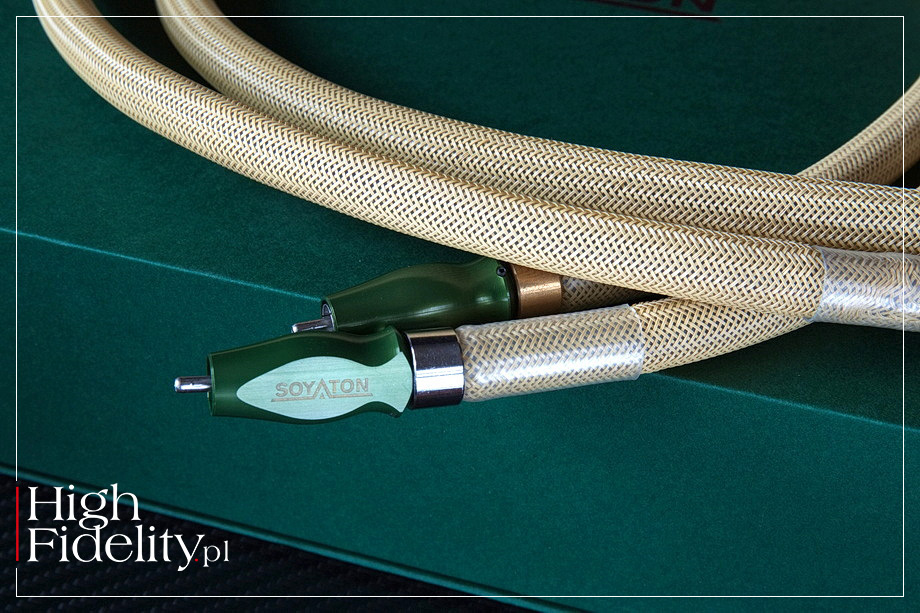
This is OCC copper - that is, mono-crystalline copper - used in most cables from the Land of the Rising Sun; however, in Julian’s cables, it is gold-plated (in the U.S.) with 24-karat gold. This is an idea perfected by the designer, rarely used by other companies; Nordost uses the same combination in its top-of-the-line Odin Gold series. The Meister is constructed similarly, using wires made of the same material as The Benchmark. The manufacturer, as he writes, decided to do this in order to “maintain sonic consistency and the characteristic features of Soyaton cables.” Apart from that, the design of both lines differs significantly in several key aspects. The Meister features an asymmetrical design, meaning the hot and cold conductors are different. The hot conductor uses nearly five times as many wires as the Benchmark IC. Furthermore, the new interconnect uses wires of four different diameters, whereas in The Benchmark, all wires have the same diameter. Julian points out that he used higher-quality materials in the design than before. The inner tubes, for example, were previously made of polyurethane but have been replaced with Teflon ones, and the outer tubes are made of thicker silicone, which is intended to help dampen vibrations. The cables are quite thick, but surprisingly flexible. They’re exceptionally well-made, and the plugs, in particular, catch the eye. Designed by Małgosia (we know each other, hence the informal “you”), they possess an elegance that most other connectors lack. These plugs used by Soyaton inspire confidence, and they’re simply beautiful. They have a “fish” shape, but with one side flattened. As Julian explains, the idea was to make it easy to plug them in even where the RCA jacks are close together. 
Their contacts are made of solid silver. The left and right channels are marked with small rings in silver (stainless steel) and yellow (brass). The cables are directional. The labels on the plugs indicate the correct connection - out through “S” and in through “n.” To be honest, I’d prefer it if this were more clearly marked with arrows. To avoid going overboard with green, the mesh is flesh-colored. But the box itself, made of stiff cardboard, is green. Inside, you’ll find the cable in - of course - a green velvet pouch, along with a card filled out by hand by the manufacturer, featuring a logo designed by Małgosia - it includes the user manual, though without any information about the cable’s directivity. It bears the designer’s signature and the “nameplate” for that particular unit, written in a marker of the color… Well, you probably already know which one. |
▓ SOUND HOW WE LISTENED • The test of the Soyaton interconnect was conducted in the “High Fidelity” reference system and took the form of listening tests and AAA/BBB/AAA and BBB/AAA/BBB comparisons, with A and B being known. 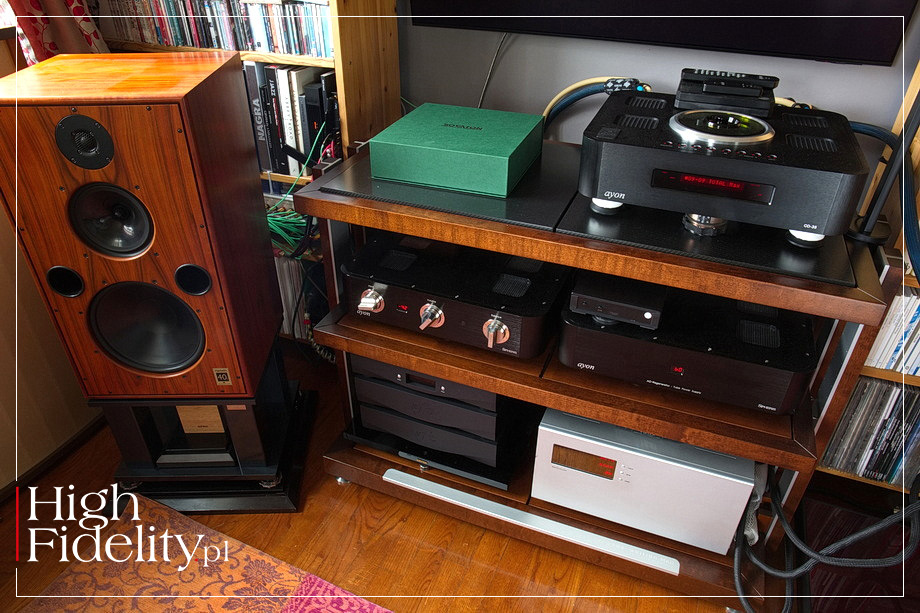
The references were two top-of-the-line interconnects: the Siltech Triple Crown, made of pure, mono-crystalline silver (20,000 euros/1 m), and the Crystal Cable Absolute Dream, which uses an alloy of mono-crystalline silver and gold (9,900 euros/1 m). The interconnects transmitted the signal from the Ayon Audio CD-35 HF Edition SACD player (WBT Nextgen RCA jacks) to the Ayon Audio Spheris Evo preamplifier (WBT Nextgen RCA jacks). 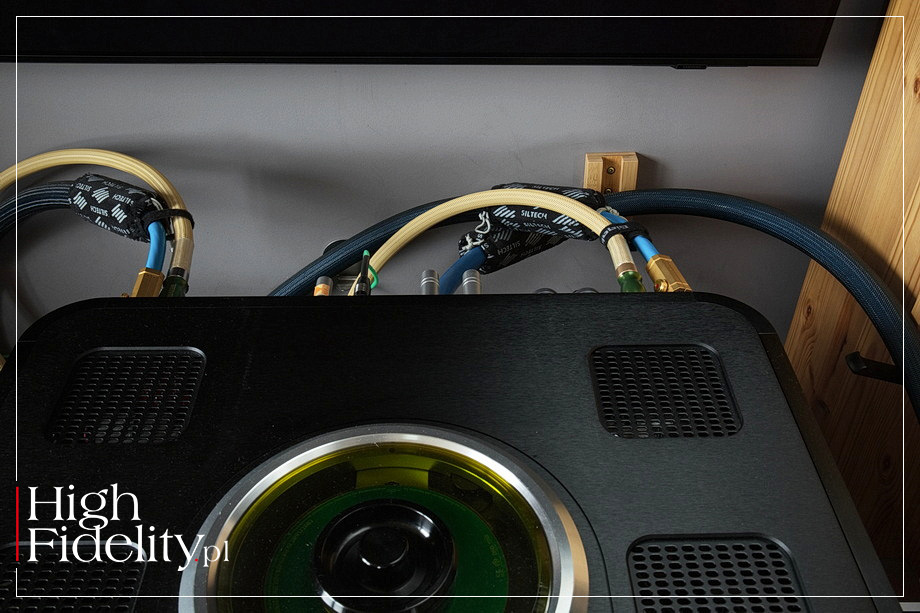
» RECORDINGS USED FOR THE TEST ⸜ a selection
• SUZANNE VEGA, Solitude Standing, A&M Records CD 5136, CD ⸜1987. WHEN I DON’T KNOW WHAT TO EXPECT from a given product, I reach for my trusted albums, and they help me get my bearings at first. I have such a shelf with „trusted” CDs or two - or maybe even three - just like probably every audiophile. These are recordings with proven sound quality, featuring music we like and know “inside and out.” I choose one of these albums, confident that I’ll immediately know which direction to take in the next steps. However, there are also products that, in some subconscious way, point me toward yet another shelf. 
This is the shelf with releases from labels such as ECM, ACT, or Naim. Not that they’re any worse than those on the shelves I mentioned earlier - obviously that’s not the case. It’s just that they’re so different and so distinctive in the producers’ sonic choices that they aren’t entirely universal. I choose them so that I can immediately enter the “world” of the product under review, moving beyond the sonic layer to the musical one. That’s exactly how it was with Julek Soja’s cable. Listening to CHRIS ANDERSON’s piano and CHARLIE HADEN’s double bass from the None But The Lonely Heart released by Naim, particularly in ˻ 1 ˺ The Night That We Called it a Day track, while comparing The Meister cable to my reference cables, I quickly - almost immediately - heard exactly what this interconnect is and what it doesn’t try to be. First and foremost, this is an exceptionally “musical” interconnect. Sounds flow through the system with it, coalescing into solid sound sources and, when needed, diffusing into a beautiful soundstage. These cables also bring out large phantom images. So, on the one hand, there are distinct sound sources - clear and powerful -and on the other, they are situated in a large space, making them somewhat “ethereal.” The recordings by Ken Christianson, Naim’s regular sound engineer, were made using two microphones; more → HERE. They are characterized by a large number of reflections and a sound that isn’t particularly “tangible”. At the same time, however, they are incredibly authentic. Their micro-dynamics are stunning, and the coherence of the sound is unbelievable. The Soyaton interconnect captured this beautifully. It’s a cable with a dark sonic signature and a sharply defined crossover between the bass and midrange. Yet it isn’t intrusive in this regard. In the sense that it doesn’t bring the sound sources closer to us or merge them into a dense “carpet.” It’s a complete and multidimensional presentation. It doesn’t “sparkle” at the top end of the frequency range as Siltech does, and its sound is closer to that of Crystal Cable and Hijiri cables than to Siltech or Nordost. It leans more toward fullness and richness than toward ultimate selectivity. But, interestingly, this isn’t a move toward muddiness. The bass is excellent with this cable - it’s rich and, as a result, convincing. Anderson’s piano, therefore, had both a nice three-dimensional presence and superbly rendered dynamics, even though it was heard from a certain distance. Julian’s cable doesn’t try to deepen the bass; the one with the Siltech in the reference system seemed to go lower. It was also slightly better defined at its extremes. Interestingly, when I listened to the same tracks with the “Master,” it didn’t result in any less engagement. I’d even say that it’s easier to immerse yourself in the musical world of a given album in a short amount of time. Cables like the Siltech Triple Crown require more time to acclimate to. That’s why it immediately struck me that the cable under review sounds more like the Siltech Master Crown than the Triple Crown. It isn’t quite as detailed or as remarkably free of limitations as the Dutch manufacturer’s top-of-the-line cable, but its tonal character leans in that direction and provides nearly as much listening pleasure. I didn’t feel like anything was “missing” at all, even though The Meister costs only a fraction of the price of the top Dutch “Crown.” It is clear that, upon careful comparison of short pieces of tracks, the reference cables demonstrated their superiority, particularly in areas such as resolution and definition. These differences were not very significant. As a result, they were actually quite easy to overlook - or, more accurately, to ignore - unless I was comparing the cables side by side. That is why I listened with such dedication to nearly the entire album by PATRICK NOLAND titled Peace. This recording was created as a tribute to Julian Vereker, the founder of Naim, who had passed away shortly before; it was the first album on which Christianson, rather than Vereker, served as producer. The piano is recorded up close and intimately here. It’s also intense. The tested cable presented it on a large soundstage, but above all as a tangible sound. The deepening of the upper bass range that comes with it is a wonderful way to add depth to the sound, but it often carries the risk of slowing it down. The Meister avoids this neatly, as it doesn’t produce a closed-off sound at the top end, even though it doesn’t emphasize it. Yes, it adds a bit of punch to the sound, but it does so in a refined way. With ultra-purist recordings, such as the ones I mentioned above, this tends to fill them out and anchor them on a denser foundation. It doesn’t close off their sound or muffle it - absolutely not. It simply “polishes” them. 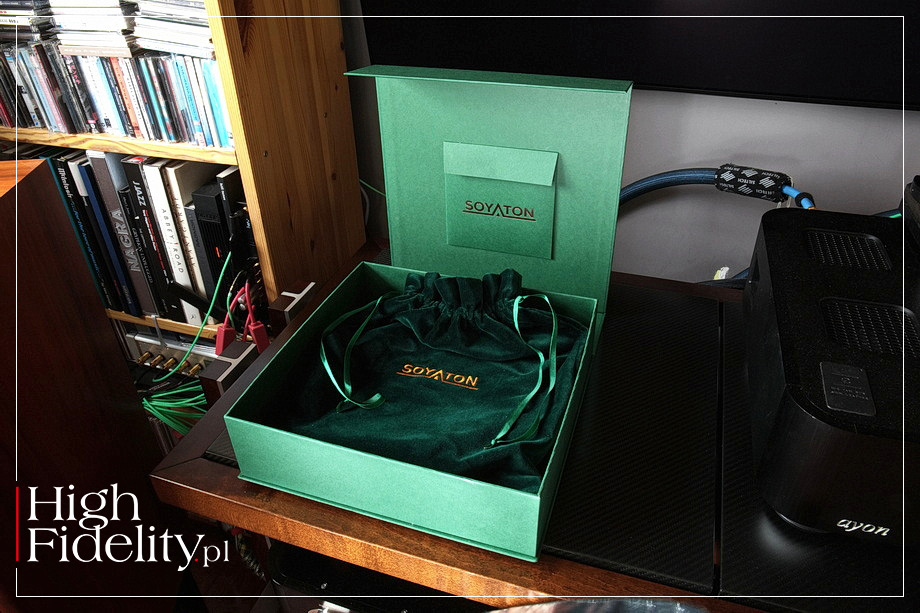
On the other hand, the Soyaton interconnect really shines with recordings that can be problematic. This was the case, for example, with SUZANNE VEGA’s album Solitude Standing. While on vacation in Antwerp, I bought its first American CD release, dating back to 1987, at one of the ubiquitous used record stores. The Meister immediately demonstrated its class - right from the first bars of the synthesizer emulating the sound of a marimba, and then in the more subdued acoustic guitar that followed. First and foremost, it added a touch of warmth. Yes, this is one of those cables that warms the sound without muffling it. That’s why the bright character of the master of this release wasn’t lost, which in turn speaks well to the dynamic range offered by the interconnect. Secondly, however, it didn’t bring the instruments closer to create the impression that they were larger. Their volume was the same as with the reference cables, including the Siltech. And yet it sounded better and more pleasant to listen to. It doesn’t even have to be an album that’s bright by nature, because the Soyaton, in a way, adjusts everything so that you can listen to the music for hours on end. It does this without limiting the dynamics and without drowning the sound in liquid gold, but rather through high resolution, excellent definition, and incredible dynamics. It may not be on the level of top-tier cables from top-tier manufacturers, but the difference isn’t nearly as great as the price difference would suggest. Just turn up the volume - I mean play it really loud - on the ART BLAKEY AND THE JAZZ MESSENGERS album First Flight To Tokyo: The Lost 1961 Recordings, and within the very first second of the ˻ 1 ˺ Now's The Time you’ll hear that powerful, surprising crash on the cymbals, with (apparently) an edited beginning. But it is precisely this edit that brought out the power and energy from the instrument, which, after all, wasn’t recorded very well. It may well be that this is the “secret ingredient” of The Meister cable’s sound: energy transfer. I listened to this album, and then to others, whether by GEORGE MICHAEL or PANTERA, with growing fascination. Mainly because it was a complete sound and somehow “well-taken-care-of”. It had everything, because even the background noise heard in the Blakey’s ˻ 2 ˺ Moanin’ had its place in this puzzle. You could hear it quite clearly, in fact, as the cable filled that frequency range, but it was there as an accompaniment, not as interference. ▒ Summary I THINK THAT JULIAN SOJA’S CABLE is one of the most interesting interconnects available on the market. On the one hand, it’s expensive, by no means cheap, and on the other, it leaves other manufacturers’ cables in the dust as their prices gallop ever farther into the realm of the absurd. Often, there’s no other way to implement cutting-edge technologies, and you have to pay for them. The Meister, however, offers much of the same, in an exceptionally well-balanced way, but at a fraction of the price. 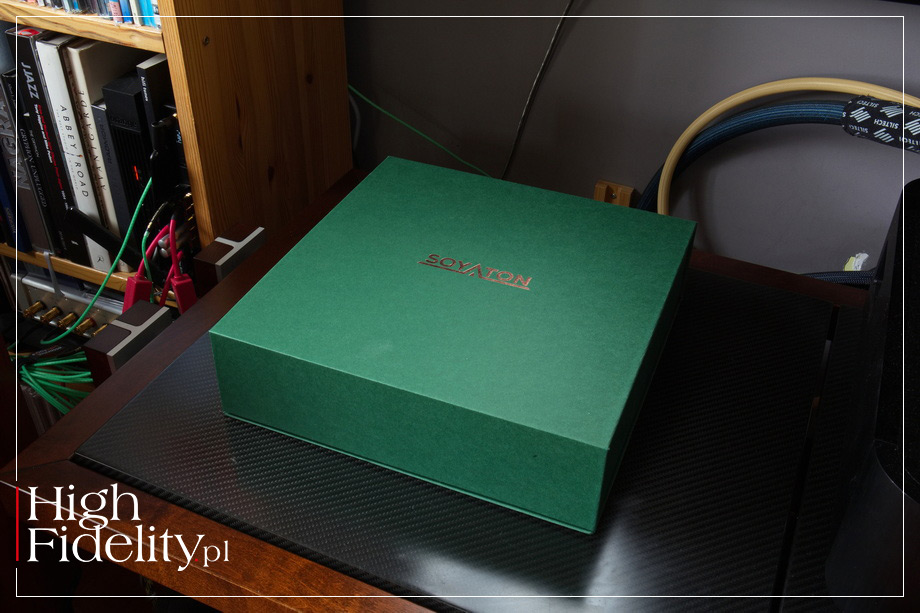
I mentioned at the beginning the albums I reach for when I don’t know what to expect. Now I know. With the Soyaton The Meister interconnect, expect explosiveness combined with a certain gentleness in handling sharp edges or simply bright recordings. It will handle the “polished” ones professionally, but it will bring the poorly recorded ones to a place where they’ll sound great. It is really The Meister of its trade. Therefore, from us, a well-deserved GOLD ‖ FINGERPRINT. ‖ WP » W tekście znalazł się afiliowany link do sklepu internetowego → CD JAPAN. |
 |
|
Reference system 2026 |
|
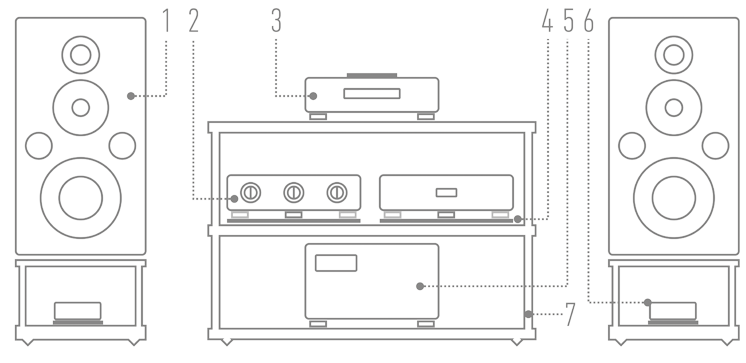 1) Loudspeakers: HARBETH M40.1 |REVIEW| 2) Line preamplifier: AYON AUDIO Spheris III Linestage |REVIEW| 3) Super Audio CD Player: AYON AUDIO CD-35 HF Edition No. 01/50 |REVIEW| 4) Stands (loudspeakers): ACOUSTIC REVIVE (custom) |ABOUT| 5) Power amplifier: SOULUTION 710 6) Loudspeaker filter: SPEC REAL-SOUND PROCESSOR RSP-AZ9EX (prototype) |REVIEW| 7) Hi-Fi rack: Hi-Fi rack: finite elemente MASTER REFERENCE PAGODE EDITION Mk II, more → HERE |
|
|
Cables Analog interconnect SACD Player - Line preamplifier: SILTECH Triple Crown (1 m) |ABOUT|» ANALOG INTERCONNECT Line preamplifier → Power amplifier: Siltech ROYAL SINLGE CROWN RCA; review → HERE Speaker cable: SILTECH Triple Crown (2.5 m) |ABOUT| |

|
AC Power Power cable | Mains Power Distribution Block - SACD Player: SILTECH Triple CrownPower (2 m) |ARTICLE| » POWER CABLE Mains Power Distribution Block → Line preamplifier: Acoustic Revive ABSOLUTE-POWER CORD, review → HERE » POWER CABLE Mains Power Distribution Block → Power amplifier: Acoustic Revive ABSOLUTE-POWER CORD, review → HERE Power cable | Power Receptacle - Mains Power Distribution Block: ACROLINK Mexcel 7N-PC9500 (2 m) |ARTICLE| Power Receptacle: Acoustic Revive RTP-4eu ULTIMATE |REVIEW| » ANTI-VIBRATION PLATFORM under Acoustic Revive RTP-4eu ULTIMATE: Graphite Audio CLASSIC 100 ULTRA, review → HERE Power Supply Conditioner: Acoustic Revive RPC-1 |REVIEW| Power Supply Conditioner: Acoustic Revive RAS-14 Triple-C |REVIEW| Passive filter EMI/RFI: VERICTUM Block |REVIEW| |

|
Anti-vibration Speaker stands: ACOUSTIC REVIVE (custom)Hi-Fi rack: finite elemente MASTER REFERENCE PAGODE EDITION Mk II, more → HERE Anti-vibration platforms: ACOUSTIC REVIVE RAF-48H |ARTICLE| » ANTI-VIBRATIONAL FEET: |

|
Analogue Phono preamplifier: Phono cartridges:
Clamp: PATHE WINGS Titanium PW-Ti 770 | Limited Edition Record mats:
|

|
Headphones » HEADPHONE AMPLIFIER: Leben CS-600X, review → HEREHeadphones: Headphone Cables: Forza AudioWorks NOIR HYBRID HPC |