


|
INTEGRATED AMPLIFIER WESTMINSTERLAB
Manufacturer: WESTMINSTERLAB Ltd. |

 |
 |
 |
|
Review
text by WOJCIECH PACUŁA |

|
No 270 November 1, 2026 |
WESTMINSTERLAB DOESN'T TRY TO BE FALSELY MODEST, and the description of its new amplifier on its website begins with the statement: “A new standard in the field of compact audio systems with high-quality sound.” Interestingly, seeing this and knowing its products, I don’t smile ironically at all. For a company that started out manufacturing cables, it took relatively little time to reach where it is today, and the results are stunning. 
Let’s recall that Wesminsterlab (the company stylizes its name as ‘WesminsterLab’) was founded in 2007. For many years, its best-known products were audio cables. For example, it was one of the first companies in the world to offer high-end USB cables of its own design. Mr. Leung made a name for himself among a wider circle of audiophiles by designing cables for Lumin that connected their file players to external power supplies. Today, I wouldn’t be so sure that this company is primarily a cable manufacturer that also offers amplifiers. I get the impression that the focus has shifted toward the latter and that this is now the core of its product lineup. Although its first product of this type was the Unum power amplifier from 2015, to date it has offered only three new devices - the Monologue and Rei monoblocks, as well as the Quest line-level preamplifier. The Omne, the integrated amplifier we’re reviewing, is therefore only the sixth product of this type in Westminsterlab’s lineup. ▲ A few simple words… ANGUS LEUNG OMNE BEGAN with a practical question: can a full Class A reference system live in one chassis, without the usual rack of separate boxes? 
‖ Angus Leung, founder and designer • photo courtesy of Westminsterlab Our work has long been built around separates - Quest as preamplifier, Rei as monoblock - because a short signal path and clean separation between stages matter. But many listeners do not want, or cannot accommodate, three large enclosures. The integrated amplifier is the natural answer, yet most ask you to accept a compromise: less current, less isolation, less of the engineering that makes Class A worth pursuing. Omne was designed to refuse that trade. At WestminsterLab we aim for playback that stays natural - music as you would expect it to sound, with the system out of the way. We work from first principles: each stage must earn its place, and we do not add parts simply because convention expects them. The same thinking runs through Omne - and through how it is shaped. We follow a Bauhaus approach: honesty of form, economy of means, beauty that follows function. The chassis is compact because the circuit and the room required it, not to make a statement. Where a control can leave the signal path, it does. Where complexity can stay inside the metal rather than on the front panel, it does. The display and six-button remote are there for daily use - clear when needed, quiet otherwise. 
‖ The amplifier’s main PSB, fixed to the main element of the chassis – you can see the power supply below • image courtesy of Westminsterlab The challenge was packing. Omne is, in essence, a preamplifier and two monoblocks sharing one body - under eleven centimeters tall, fully balanced, Pure Class A throughout. Every millimeter was a negotiation between thermal path, EMI interference, magnetic isolation, and signal integrity. In a compact Class A design, heat is part of the architecture, not an afterthought. Each heat-sink is machined from a single billet of aluminum, shaped by simulation and verified in listening, so the chassis can run stably without excess bulk or noise. Inside, the same priorities that define Quest and Rei are carried forward. The audio controller inherits Quest's short path and 6 dB gain. Volume is a bespoke 99-step control developed in-house - not a borrowed attenuator. The software running on the microprocessor was coded to reduce operating noise: the dot-matrix display refreshes at variable rates, indistinguishable to the eye, so there is no fixed-frequency noise spike. When the display sleeps, the processor follows. These details rarely appear on a specification sheet, but they matter when the goal is to keep the path clean. 
‖ The rear panel, still without any output connectors • image courtesy of Westminsterlab Four O-core transformers feed eighteen independent voltage rails; even the microprocessor and display sit on their own supply, so digital housekeeping never draws from the analog stages. Output transistors are matched within 1% across multiple working points, then stress-tested under load. The result is more than 11 amps of continuous current, with 50 watts per channel into 8 ohms - 100 into 4, 200 into 2 - delivered with control rather than forced dynamics. Omne was also designed for real rooms, not only the listening bench. The same chassis runs as a full integrated, switches to preamp-only mode, pairs with external Rei monoblocks for horizontal bi-amping, or passes home-theater signal on a chosen input. Two rear expansion slots accept the same modules as Quest - MC/MM phono, DS Audio equaliser, RCA input - so the system can grow without becoming something else. 
‖ An almost complete amplifier, before the side panels and top panel were added • Photo courtesy of Westminsterlab What we set out to prove is that a smaller footprint need not mean a smaller ambition - the same reference thinking, simply concentrated. Omne is handmade in Hong Kong - roughly 320 hours of machining, 50 hours of assembly, 920 components - with the realistic, three-dimensional imaging and naturalness typical of WestminsterLab. For us, the achievement is straightforward: one calm body that can complete the system — Class A reference, without the rack. ‖ AL ▓ Omne THE WESTMINSTERLAB OMNE is an integrated amplifier operating in Class A. It features a (fully) dual-mono design and delivers a maximum output power of 50 W per channel into an 8 Ω load, 100 watts at 4 ohms, and 200 watts at 2 ohms, with a peak output current of 11 A. In short, every time the load is halved, its power output increases by 100%. This indicates a highly efficient power supply and thus the device’s ability to deliver fast impulses to a difficult load. FEATURES • The device’s aesthetics are quite unassuming. Which doesn’t mean it’s simple. It’s a large, surprisingly heavy, low-profile block devoid of any controls, in the style - as Angus emphasized - of the Bauhaus school. The manufacturer emphasizes this design aspect because it allows the amplifier to be discreetly placed almost anywhere. Whether this has to do with the fact that Angus lives in Hong Kong, where every square meter counts, or simply stems from his aesthetic preferences - it’s likely a combination of both. This is an important aspect of this device:
True high-end audio can be more accessible without sacrificing performance. The Omne is an all-in-one solution that redefines integrated amplification by delivering reference-level performance in a compact, elegant package with just a height of less than 11 cm.
⸜ OMNE. A New Benchmark in compact High-Fidelity Audio, → www.WESTMINSTERLAB.com, accessed: 35.08.2026. In its basic configuration, the amplifier offers only three line inputs. And that’s it. All the inputs are balanced, as the device features not only a symmetrical but also a balanced design, from input to output. However, the rear panel also features two slots. Actually, three - the smallest of them features a built-in LED indicating that the power cable is connected, and two 12 V trigger jacks. These work with Westminsterlab power amplifiers. 
The unit can be expanded with one or two expansion cards: one with a stereo RCA input, one with an MM/MC phono preamp - you can choose between RCA or XLR inputs - and one with a preamp module for optical cartridges, such as DS Audio (Reed also offers its own model, the SF). The manufacturer states that when the modules are not connected, their power supply enters a sleep mode so as not to interfere with the line preamp section, with which they share the power transformer. To complete the setup, let’s note a balanced preamp output with XLR connectors, as well as a pair of speaker terminals - WBT 0707 from the Nextgen series - per channel. Thanks to the new audio controller, developed by Westminsterlab specifically for the Quest preamplifier, the company offers us several interesting additional features that - as stated - enhance the user experience. The display offers various operating modes with brightness adjustment and an auto-off feature, as well as - for the first time in this company’s product history - the option to select one of five inputs as a home theater bypass. This allows the Omne to be integrated into home theater systems, where it will function as a power amplifier for the front channels. The device can be controlled only with the remote control. It is a small unit made of aluminum, and surprisingly functional. We can use it to select the input, adjust the volume, mute the output, and switch to standby mode. The display is large and easy to read, even though it consists of just two characters formed by a matrix of white LEDs. The LEDs shine through the grid on the front panel, giving it a look that’s part retro, part futuristic - in short: retro-futuristic. 
TECHNOLOGY • As we mentioned, the amplifier features a dual-mono, balanced design. Its construction incorporates solutions that large companies are unable to implement due to cost considerations. For example - matching output transistors with a tolerance of 1% and pairing them to cover multiple operating points along the characteristic curve. This is crucial for minimizing distortion in such a simple circuit with a short gain path, distortion that results from using transistors connected in parallel and operating in a push-pull configuration. We read:
To ensure utmost reliability and performance, these matched transistors are rigorously stress-tested for hours under extensive loads. This meticulous testing and matching methodology is one of the key reasons why the Omne amplifier can deliver an astounding 50 watts of Class A power in such a compact package. (Ibidem)
The preamp section in the Omne is modeled, as Angus says, on the Quest preamp. It uses the same architecture and circuits as its larger counterpart. The unit offers 99-step volume control, ranging from 0 to -63 dB: 0–32 in 1-dB increments and 33–99 in 0.5-dB increments. This circuit is implemented as a discrete design using resistors switched by relays; the inputs are also switched by the same type of relays. According to the manufacturer, thanks to a gain of just 6 dB and an even smaller number of components in the signal path, the signal is supposed to remain “as faithful to the original as possible.” Through the Omne preamplifier’s output, you can connect to an additional pair of Rei amplifiers to enable bi-amping. This ensures scalability and the ability to expand the system in the future. |
When we discussed the amplifier’s power, we touched on the power supply. It is unique and is largely responsible for the device’s weight. It is separated from the electronics by a thick aluminum plate. It is based on four large transformers with O-core cores, which are designed to guarantee a “clean and stable power supply.” The manufacturer emphasizes this aspect of the transformers’ construction, avoiding the term “toroidal.” Although they look almost identical from the outside, they are not the same:
The appearance of O core transformer looks like a ring, and the cross section of O core transformer is round, this is different from toroidal transformer. O core has no sharp corners, that means less flux leakage compared to toroidal transformer. The MLT of O core transformer is short and it is copper-saving.
In some aspects, I think O core transformer has the advantages of both toroidal transformer and R core transformer. An O core transformer can bring dramatic improvement for your audio system. ⸜ O core transformer, → JAMESTRANSFORMER.com, accessed: 25.08.2026. And there are as many as four of these transformers: two large ones for the power amplifiers, one for the preamp, and one for the logic circuitry. The interior of the unit is teeming with small capacitors that suppress mains ripple. The manufacturer mentions eighteen separate power rails with independent linear power supplies for each section. Even the control microprocessor and the display have their own dedicated linear power supplies, which helps minimize interference. 
All of this is mounted in aluminum housings milled from what the company calls “aircraft-grade” aluminum. The output transistor heat sinks are also made of custom-machined aluminum. The driver transistors have their own, smaller heat sinks as well. Another distinctive feature of this amplifier is its very rigid, resonance-resistant chassis. It is made of aluminum and carbon fiber, which is intended to ensure “both durability and an elegant appearance.” And indeed, the amplifier looks intriguing. The top and bottom panels are made of woven composite panels. This material provides excellent shielding against RF radiation but does not accumulate energy. And it is not metal. At Esoteric’s mastering studio, they unscrew the top panels and place them on spacers to keep them slightly farther from the electronics - here, that isn’t necessary. Inside as well, in every possible configuration, the same method has been applied. The amplifier is mounted on three hemispheres made of gold-anodized aluminum - two in the front and one in the back - which stand out nicely against the device’s black components. We should also note that the Omne is available in silver or black, though the carbon-fiber components will always be black. ▓ Sound quality HOW WE LISTENED• The Westminsterlab Omne integrated amplifier was tested in the “High Fidelity” reference system. I compared it to a system consisting of the Ayon Audio Spheris Neo preamplifier and the Soulution 710 transistor power amplifier. During the test, I used the Ayon Audio CD-35 HF Edition SACD player and the Sforzato file player with an external clock as sources. 
In this test, the signal between the players and the amplifier was transmitted via an Acoustic Revive Absolute XLR interconnect, and the signal to the speakers was delivered via a Crystal Cable Da Vinci speaker cable. The amplifier drove Harbeth M40.1 speakers. During the test, the amplifier was placed on Acoustic Revive SPU-8 stands. » RECORDINGS USED FOR THE TEST ⸜ a selection
• Nagra: 70th Anniversary Collection CD, 2xHD 2XHDFT-C1223, CD ⸜ 2023. LATELY, WE’VE BEEN SEEING a steady stream of new, high-end, truly expensive integrated amplifiers. It’s as if manufacturers have realized that audiophiles don’t necessarily want to expand their systems to gargantuan proportions and - more importantly - have gained confidence in their ability to develop such a product. Thanks to this confidence, we’ve been treated to wonderful integrated amplifiers from SPEC, Accuphase, Dan D’Agostino, Ypsilon, Dartzeel, and Vinnierossi - to which we can also add Kondo’s Ongaku and the powerful units from Soulution. I always listen to them with great curiosity, because they are a microcosm in which a given designer strives to encapsulate all their knowledge while contending with the limitations imposed by the size of the chassis. And each one emerges from this challenge in its own way - each one differently. And that’s another thing that fascinates me about this type of integrated equipment. With the same building blocks and similar approaches at their disposal, they often arrive at extremely different solutions. The same is true of the Westminsterlab amplifier under review. I’m sitting in front of the speakers, listening to music, and I fully understand what its designer was aiming for. On the one hand, the sound is reminiscent of the tonal character of devices such as → SPEC RPA-MG1000 or → DAN D’AGOSTINO PENDULUM ˻PL˺, and on the other - in terms of dynamics and resolution - to what devices like the → ACCUPHASE A-800S ˻PL˺ and → YPSILON PHAETON NEO. To some extent, it’s a combination of these characteristics, though without pushing them quite as hard in that direction as the aforementioned devices do. The Omne is an amplifier that sounds remarkably similar to… my Harbeth M40.1 speakers. I get the impression that they were designed by the same group of engineers. With the BBC monitors, everything is based on incredible speed and resolution, combined with a dark tonal character. That’s exactly how the amplifier in this review sounds. I listen to more tracks from the Nagra compilation Nagra: 70th Anniversary Collection CD, released by 2 x HD to mark its 70th anniversary (I also have it on tape), and I instantly relax - that’s the effect this kind of sound has on me. It has everything you need and what we usually lack: from the top treble - let’s listen to the chimes, which help create the atmosphere in ˻ 4 ˺ Dinah by SHIRLEY HORN, and right after that, that incredible double bass in the PATCH AND DAVIS’ ˻ 2 ˺ Horizontal Blue - and you’ll know exactly what I’m talking about. On both ends of the frequency spectrum, there’s sparkle, energy, and fantastic sound definition. 
That said, the last thing you’d say about this amplifier is that it’s “aggressive” or “technical.” This device is in a league of its own. It’s incredibly soft, warm, and rich. To tell the truth - in this respect, it’s very similar to what another great integrated amp offers: the Dartzeel CTH-8550 Mk II. As I said, its sound is also nearly identical to that of the Harbeth M40.1. And yet it’s remarkably nuanced. Each track on the album was presented differently, in its own unique way. Yes, they shared the characteristics I mentioned, yet those characteristics were used to bring out the inner “language” of each piece, its “flow,” and its expressiveness. So when LOUIS ARMSTRONG plays the trumpet in ˻ 5 ˺ C’est si bon, it’s bright and biting. But it’s also perfectly integrated into the rest of the mix. In turn, when MARLENE VERPLANG sings on ˻ 6 ˺ Deep in a Dream, when a very low “pop” sounds in her voice from time to time, and when, three minutes in, a long muted trumpet solo rings out from far back in the mix, then I, in turn, experience intimacy and beauty. Angus Leung’s amplifier sounds exactly like that - beautifully. It captivates us most desirably, bringing out the best in the recordings. It doesn’t strive to present the sound’s attack in a hyper-precise way; it “lets up” a bit, for example, in terms of selectivity. It does this in the name of the larger musical composition, in the name of coherence. For regardless of what kind of music we listen to with it, the listening experience will be exceptionally comfortable. Not only because it’s so “pleasant,” but also because it so perfectly captures what’s most important for a given album. In the „Dwutygodnik” magazine - a mainstream, respected cultural publication - an article by Piotr Weltrowski titled Curator in His Own Museum. The Story of Thomas Gabriel; more → HERE was published recently. It deals with death metal music ˻PL˺. So I couldn’t resist and reached for a few albums I bought last year in Oslo, primarily Høstmørke by the band ISENGARD; more about my trip to Oslo → HERE ˻PL˺. These are recordings that sound like demo material, on which Gylve “Fenriz” Nagell played all the instruments. This is the kind of music that’s rarely associated with audiophiles (except for the presentations during the Audio Video Show, which I host with Adam Bielak), and yet - man, did it sound good!!! Powerful, loud, and aggressive. But even in the wildest moments, everything in this performance remained clear and perfectly organized. The amplifier, in tandem with the Harbeths, never for a moment lost sight of what’s most important in this particular music: energy transfer, almost atavistic, deeply chthonic. Knowing all this, and feeling the energy that Omne conveys, I wasn’t surprised, then, that when I listened right after to the ˻ 1 ˺ Jesus to a Child from GEORGE MICHAEL’s album Older, I didn’t feel any sense of incongruity or incompatibility - whether in the music itself or in the way these two seemingly so extremely different genres of music were performed. Both forms of expression seemed “right at home” to me and equally captivating. On Michael’s track, I heard both deep bass and long - very long - high-frequency reverberations on the lead singer’s vocals (he loved them). The amplifier sounds warm and rich - that’s for sure. It doesn’t exaggerate these elements from the albums; it simply opens up the sound to reveal what’s actually recorded on a given album. That’s why those prolonged “s” and “t” sounds, resonating deep into the soundstage, weren’t muffled. I’d even say that, thanks to the device’s high resolution, they were rendered all the way to the very end, to the limits of the signal. Let’s also say a few words about the device’s current output, as this is one of its most important capabilities, both as advertised and as heard. The device drove the M40.1 speakers perfectly. And that doesn’t happen often. It has a power output of just fifty watts per channel, yet it sounds like a device several times larger, thanks to its control and power. We mentioned this in the section on technical specifications: this tends to happen with devices that have high energy transfer efficiency - that is, they can draw current from the power supply quickly and release it just as quickly. However, it’s important to note that the amplifier from Hong Kong is not a selective device. In the sense that it tends to mask the attack of the sound rather than highlight it. Its priority is smoothness, which I’ve already heard from Dan D’Agostino’s Pendulum and Hervé Delétraz’s amplifier, and once from Kondo’s Ongaku. However, while the American device saturates everything with dense bass and mass, the Omne renders everything a bit more lightly. It is rich in bass - and, incidentally, differentiates and controls it wonderfully, preventing it from becoming muddled. It does so, however, without deepening the upper bass, which results in the sound having slightly less balance. Everything that matters most about this device unfolds right before our eyes, almost within arm’s reach. The stereoscopic effect is superb; we get both close-ups and wide-angle views of the soundstage, and there are sounds all around us - provided the producers intended it that way or the recording allowed for it. Still, what matters most is the intimate soundstage right in front of us. It’s a soundstage that’s rich and dense with sound, if I may say so. The cymbals have excellent weight, while the bass guitar and the bass drum possess speed and agility. Everything happens “here and now.” ▒ Summary COLORS, TONES, DYNAMICS, AND TANGIBILITY - that’s the shortest description of the sound of the Wesminsterlab Omne amplifier. The device plays heavy, dark rock music in a just as passionate and almost frenzied manner as it does the delicate ballads from JOHN COLTRANE’s album of the same name. It doesn’t pick and choose; rather, it’s a sort of transmission belt whose speed, incline, and size change depending on the material it’s carrying. 
At the same time, the amplifier has its own “sound.” It isn’t as expressive as amplifiers from Ypsilon or Accuphase ranges. It’s more impressive - that is, it delivers everything from within, from the depths. So we get an incredibly beautiful sound with a gentle attack and outstanding insight into the recording. In this case, gentleness does not mean “letting up,” because even bass sounds as low, deep, and “round” as those in ˻ 4 ˺ Spinning The Wheel are rendered in an organized and disciplined manner. But softly and warmly. This is a device for long listening sessions lasting deep into the night, for chilling out on a warm afternoon, for filling the home with warmth during long winter afternoons - not just because it operates in Class A :) It doesn’t rush or hurry anything, and yet we glide along with it briskly, switching records depending on whatever’s playing in our hearts at the moment. From us, a fully deserved GOLD‖FINGERPRINT. ‖ WP ▒ Technical specifications (according to the manufacturer)
Nominal output: |
 |



|
Reference system 2026 |
|
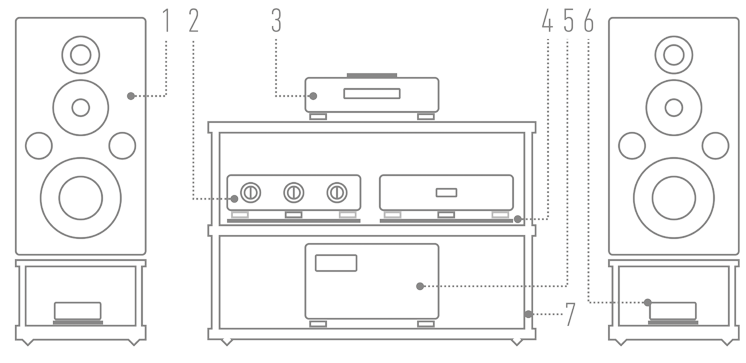 1) Loudspeakers: HARBETH M40.1 |REVIEW| 2) Line preamplifier: AYON AUDIO Spheris III Linestage |REVIEW| 3) Super Audio CD Player: AYON AUDIO CD-35 HF Edition No. 01/50 |REVIEW| 4) Stands (loudspeakers): ACOUSTIC REVIVE (custom) |ABOUT| 5) Power amplifier: SOULUTION 710 6) Loudspeaker filter: SPEC REAL-SOUND PROCESSOR RSP-AZ9EX (prototype) |REVIEW| 7) Hi-Fi rack: Hi-Fi rack: finite elemente MASTER REFERENCE PAGODE EDITION Mk II, more → HERE |
|

|
Cables Analog interconnect SACD Player - Line preamplifier: SILTECH Triple Crown (1 m) |ABOUT|» ANALOG INTERCONNECT Line preamplifier → Power amplifier: Siltech ROYAL SINLGE CROWN RCA; review → HERE Speaker cable: SILTECH Triple Crown (2.5 m) |ABOUT| |

|
AC Power Power cable | Mains Power Distribution Block - SACD Player: SILTECH Triple CrownPower (2 m) |ARTICLE| » POWER CABLE Mains Power Distribution Block → Line preamplifier: Acoustic Revive ABSOLUTE-POWER CORD, review → HERE » POWER CABLE Mains Power Distribution Block → Power amplifier: Acoustic Revive ABSOLUTE-POWER CORD, review → HERE Power cable | Power Receptacle - Mains Power Distribution Block: ACROLINK Mexcel 7N-PC9500 (2 m) |ARTICLE| Power Receptacle: Acoustic Revive RTP-4eu ULTIMATE |REVIEW| » ANTI-VIBRATION PLATFORM under Acoustic Revive RTP-4eu ULTIMATE: Graphite Audio CLASSIC 100 ULTRA, review → HERE Power Supply Conditioner: Acoustic Revive RPC-1 |REVIEW| Power Supply Conditioner: Acoustic Revive RAS-14 Triple-C |REVIEW| Passive filter EMI/RFI: VERICTUM Block |REVIEW| |

|
Anti-vibration Speaker stands: ACOUSTIC REVIVE (custom)Hi-Fi rack: finite elemente MASTER REFERENCE PAGODE EDITION Mk II, more → HERE Anti-vibration platforms: ACOUSTIC REVIVE RAF-48H |ARTICLE| » ANTI-VIBRATIONAL FEET: |

|
Analogue Phono preamplifier: Phono cartridges:
Clamp: PATHE WINGS Titanium PW-Ti 770 | Limited Edition Record mats:
|

|
Headphones » HEADPHONE AMPLIFIER: Leben CS-600X, review → HEREHeadphones: Headphone Cables: Forza AudioWorks NOIR HYBRID HPC |