

|
SACD/MQA-CD/FILE PLAYER WADAX
Manufacturer: WADAX S.A. |

 |
 |
 |
|
Review
text by WOJCIECH PACUŁA |

|
No 262 March 1, 2026 |
WHEN LOOKING AT WADAX'S OFFER and reading about its first product, it is easy to experience cognitive dissonance. Let me explain. Currently, in two series, it offers SACD and file players with optional external clocks and power supplies (i.e., → DIGITAL), and it started in 2011 with the Pre1 Phono phono preamplifier (i.e., → ANALOG). In the traditional world of audio, these are two opposite “destinations.” 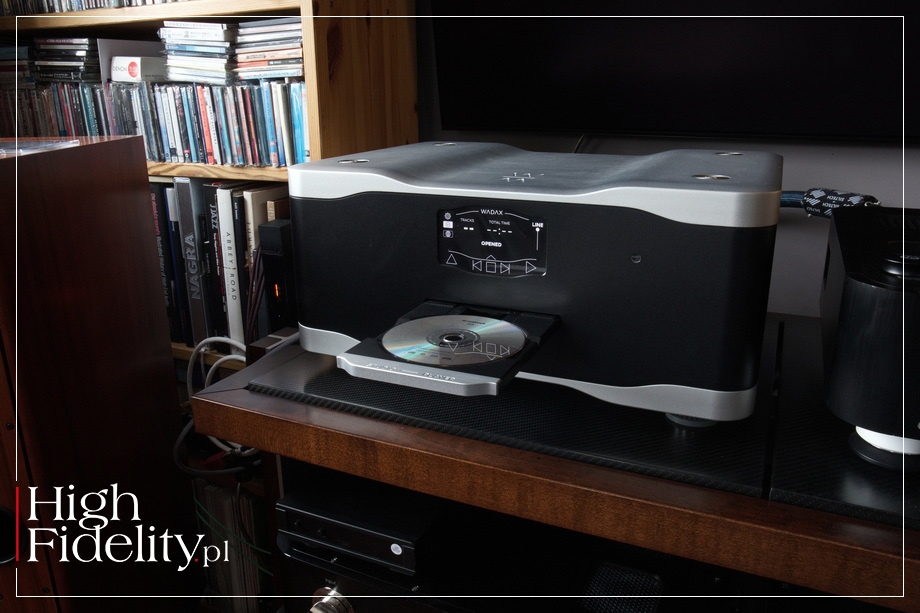
However, for anyone who knows both, they are not as distant as audiophile mythology would suggest. Although we have not mentioned it yet, Angel Guadalajara, the father of Wadax's founder, who has been distributing high-end music reproduction equipment in Spain since 1958, was an “analog” man. He was also a multidisciplinary engineer and inventor, and his research focused on error correction systems. In the official biography of the brand, it reads that he was succeeded by his son, Javier. And further:
The result of this research was the development of not only ten core technologies in the fields of acoustics and signal processing, shared with his son, Javier Guadalajara, but also the creation of an equally holistic approach to that single goal. One of those core technologies was based on feedforward analog processing.
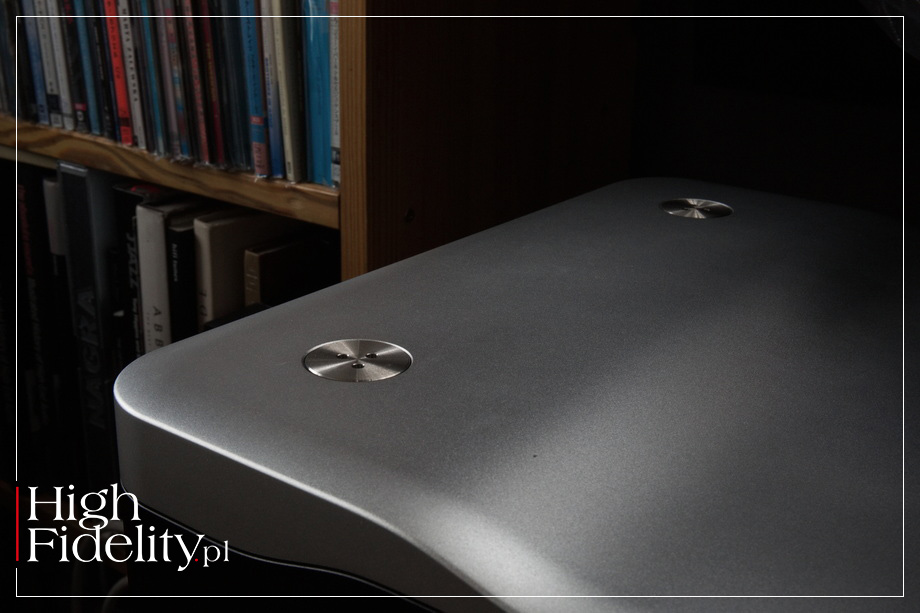
⸜ Wadax, the company, → WADAX.eu, accessed: 29.12.2025. And it was his son who transferred these experiences to the digital domain. He started traditionally, with analog technology, but the endpoint was related to binary coding. This is how the Wadax company was born. ▓ Studio Player STUDIO PLAYER is a complex product (the company stylizes its name as Studio • Player). Its basis is something that can be called an SACD player – it is a full-fledged device of this type. However, it is also a CD and MQA-CD player. All three functions are interrelated, yet require a different approach. However, Studio Player is more than that – it is also a file player. So, in one chassis, we get two products. With it, we can play SACD discs and files, and we will also be able to play music from two other formats – CD and MQA-CD. This is really cool and is not about saving space. As we will see in a moment, the Studio Player can be expanded into a large “tower.” The player belongs to the lower of the two series from this manufacturer, Studio. However, its basic circuits are derived from the reference Atlantis series. Its components were first shown in 2017 at the Munich High End Show: Atlantis DAC, Atlantis Server, and Atlantis Transport. These were the first products from this company to feature the musIC chip. This is the latest version of a chip developed back in 2004 (the year our magazine was founded – coincidence?...) musIC • MUSIC IS AN FPGA (i.e., programmable) chip that performs calculations to predict errors and nonlinearities occurring under load. To eliminate them, the algorithm generates an inverse signal (the exact opposite of the predicted error) to the input stream before it reaches the DAC. 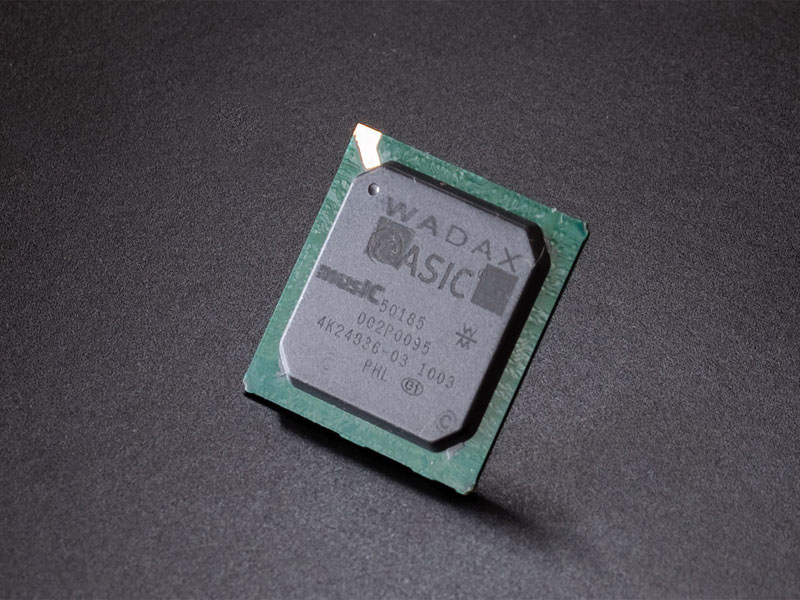
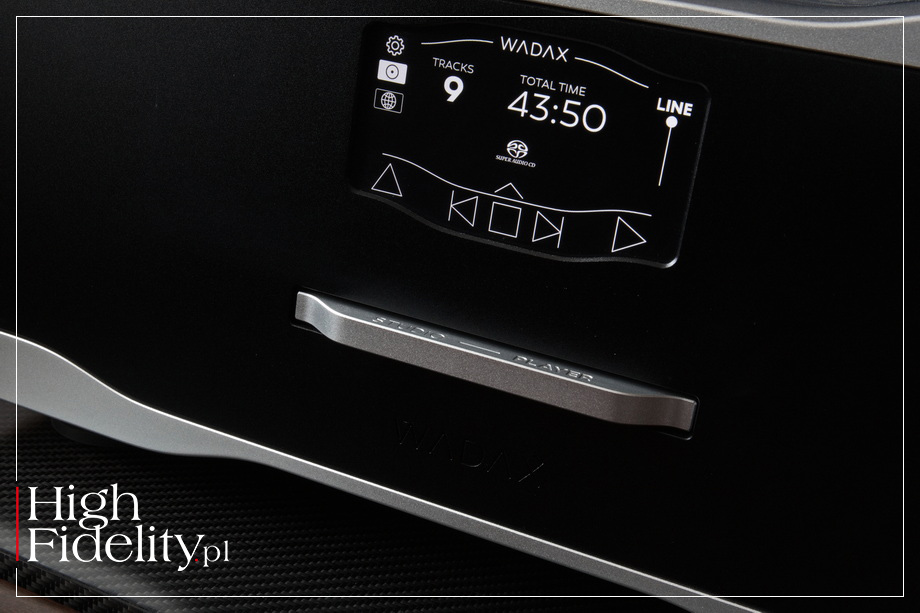
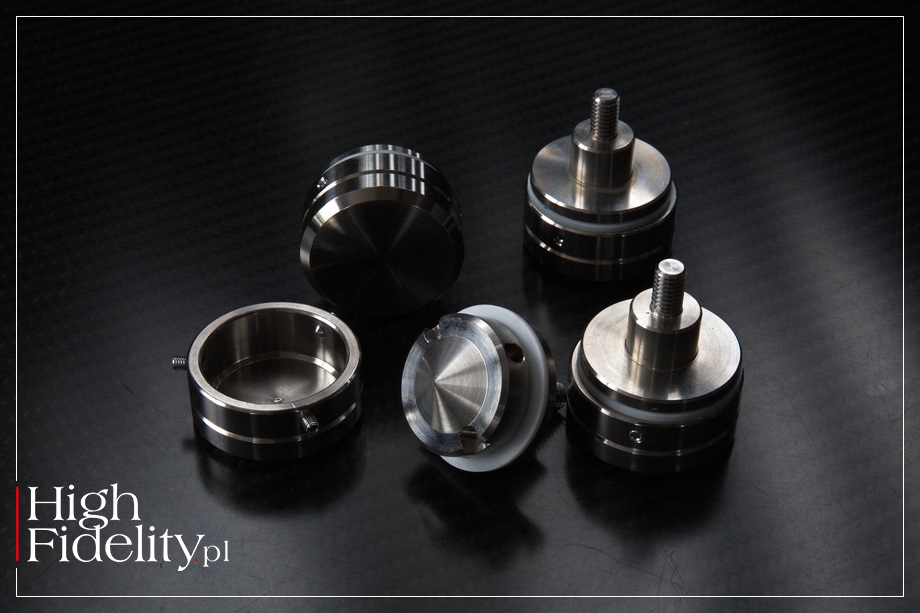
‖ First-generation Music chip (or ‘musIC’, as the company calls it) • photo by Wadax The compensation in question occurs in real time. This technique is designed to eliminate errors by correcting time and phase distortions, which are the bane of conventional D/A converters, ensuring a “much more accurate and musical signal.” It is similar to Ancient Audio's Digital Speaker Processor, which corrects speaker imperfections. The error elimination process in Wadax products requires a huge number of mathematical operations and a significant data transfer rate of 12.8 GB/s. Processing is performed with an internal resolution of 128 bits in order to, as we read, “precisely render the output data and generate even the smallest feedforward signal corrections.” ● STUDIO PLAYER was first presented in Munich in 2024 and immediately attracted interest. It is a large, solidly built device. It weighs a respectable 32 kg and measures 80 x 500 x 585 mm. Its black body with silver top and bottom panels echoes the lines familiar from the Atlantis series, but in a more ascetic form. It is a combination of form and function, as between the two aluminum plates there is a proper chassis, compressed in a kind of “clamp”. Three devices from the Studio series can be stacked on top of each other, as the top panel features special sockets that are an extension of the feet on the bottom. This type of solution can also be found in devices from CH Precision (internal) and Chord Electronics (external). It looks really good. The design is the work of Ochoa y Diaz-Llanos Studio. Founded in 2002 by Brussels-based Ana Díaz-Llanos and Madrid-based Alberto Ochoa, it has ambitions – as we read – “to become more than just a design studio,” which is why it creates “functional and practical products.” It was the studio that proposed a design for the Atlantic series that references the steering wheel of an F1 car. As we mentioned, the design of the Studio Player is extremely complex, both mechanically and electrically. A total of fourteen different materials and alloys were used to control resonances and “vibration channels” (vibration dissipation paths), and the whole unit stands on anti-vibration feet. These consist of two elements: a base and a cone. They are connected in such a way that they form a functional whole. Yamaha once used a similar solution, and the → TIGLON MZ-GRANDE feet function in a similar way. Each Studio Player chassis consists of (according to the manufacturer): 620 specially machined components, 40 individual printed circuit boards, and over 4,500 subassemblies. Despite its complex role in the system, the player is minimalist in design. This is due to the transfer of all controls and buttons to a 5" color touchscreen with a resolution of 800 x 400 pixels. It is quite large and has very well-chosen typography, font sizes, etc. The track being played and the time are displayed in large font, while the control icons are smaller. On the side, there are “buttons” that allow you to change functions and enter the menu. The sampling frequency is also given, although without the word length. When playing discs, the display is monochrome, which works great, but when playing files, you will see a colorful cover on it. There is also a cool element that I've been talking about for a long time and that hardly anyone uses: below the time display, the logo of the format being played is displayed, whether it's SACD, CD, or MQA-CD. The latter is displayed along with information on whether it is MQA Studio encoding or not; however, no blue or green “dot” color has been added to this. And, to be honest, I miss CD-Text – the display is so large and so legible that it would be a great new feature. 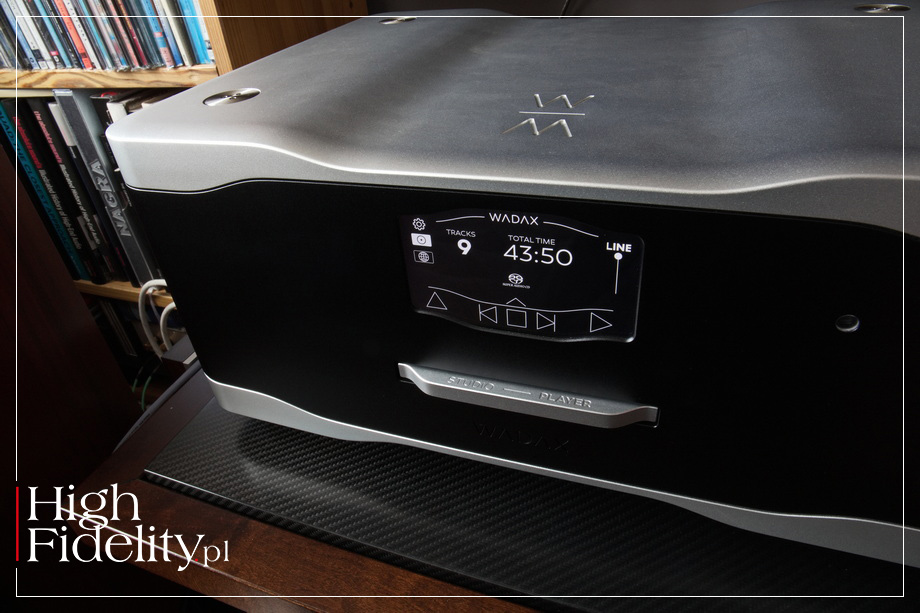
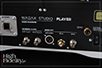
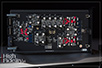
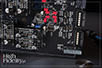
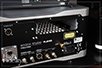
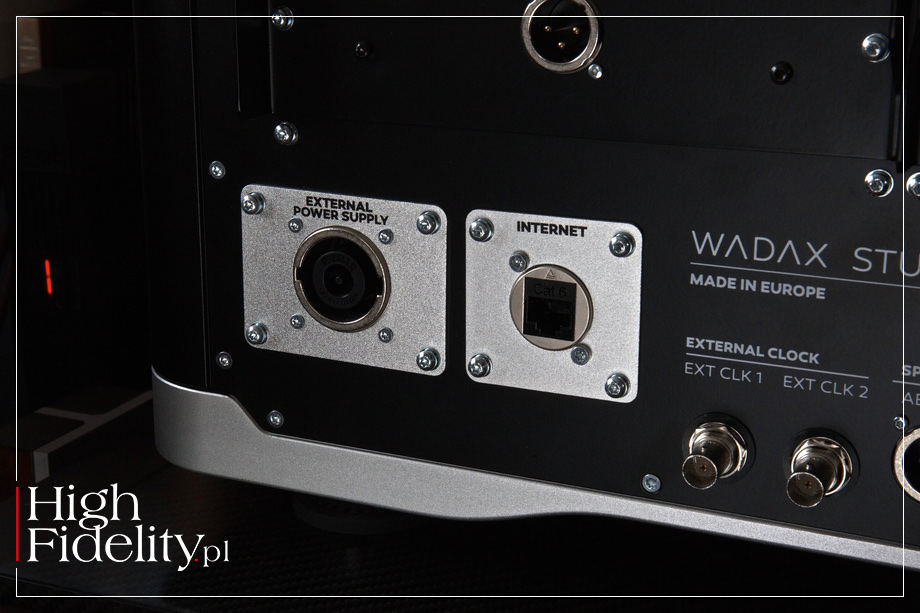
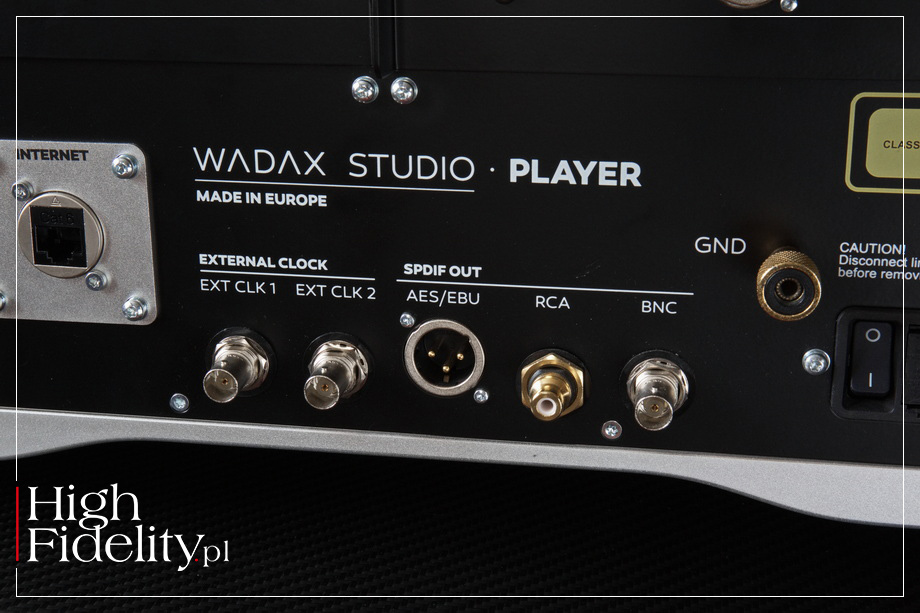
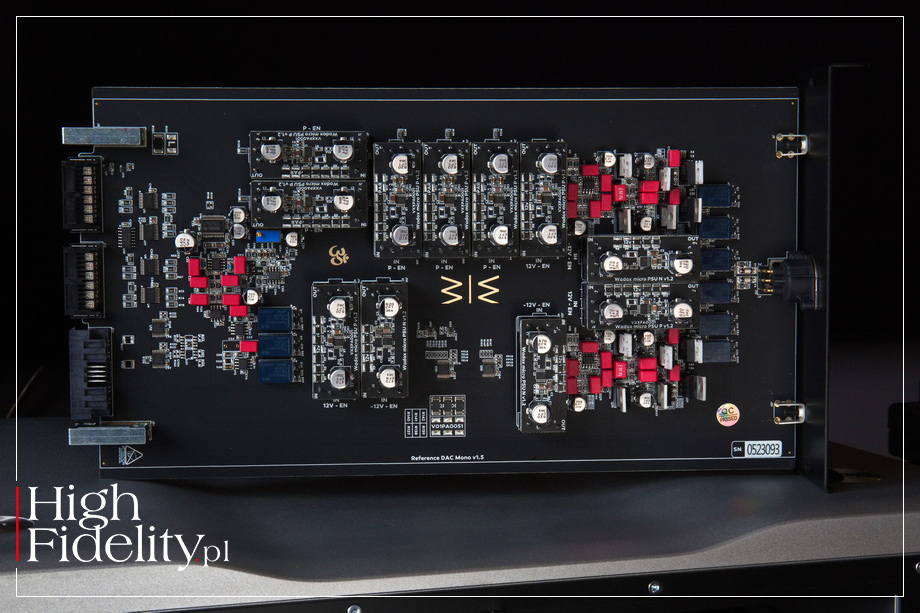
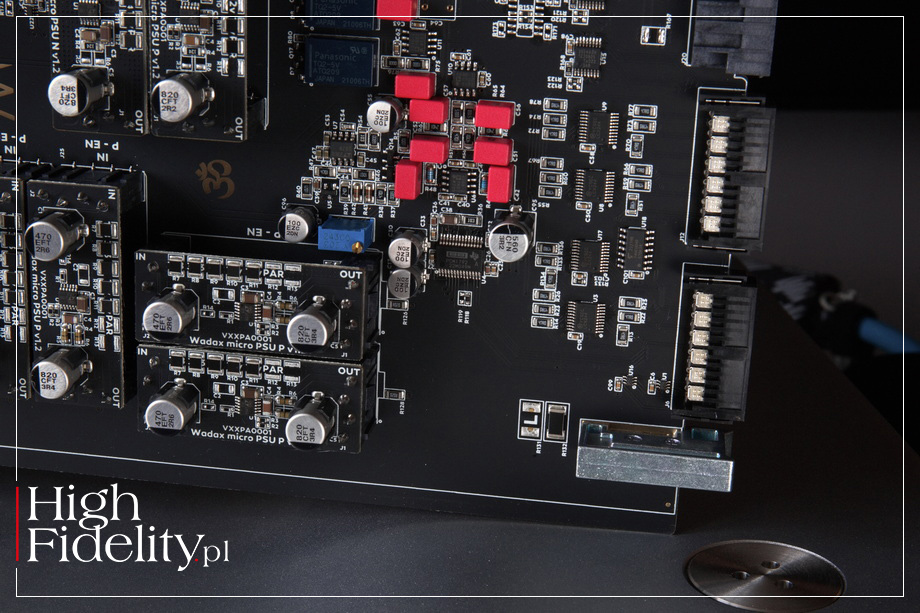
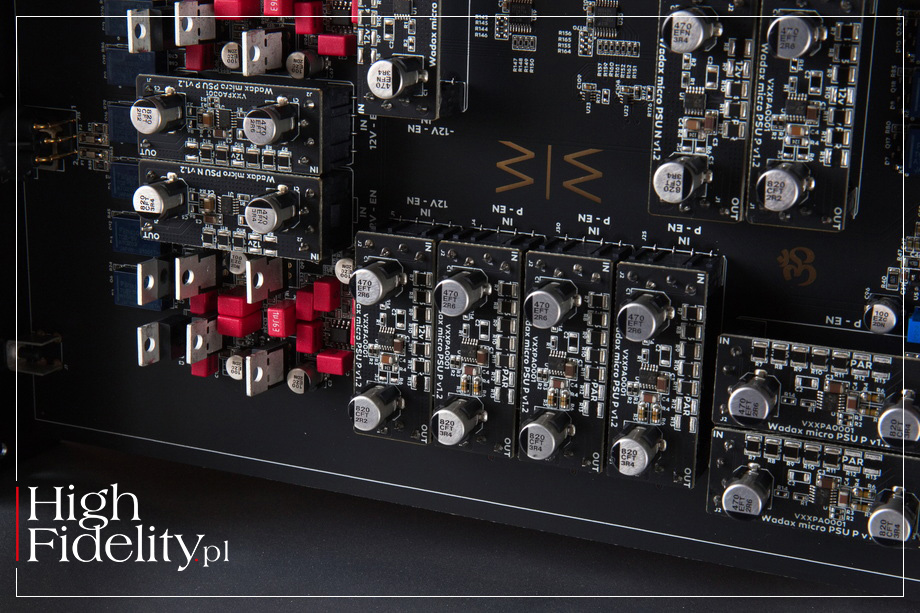
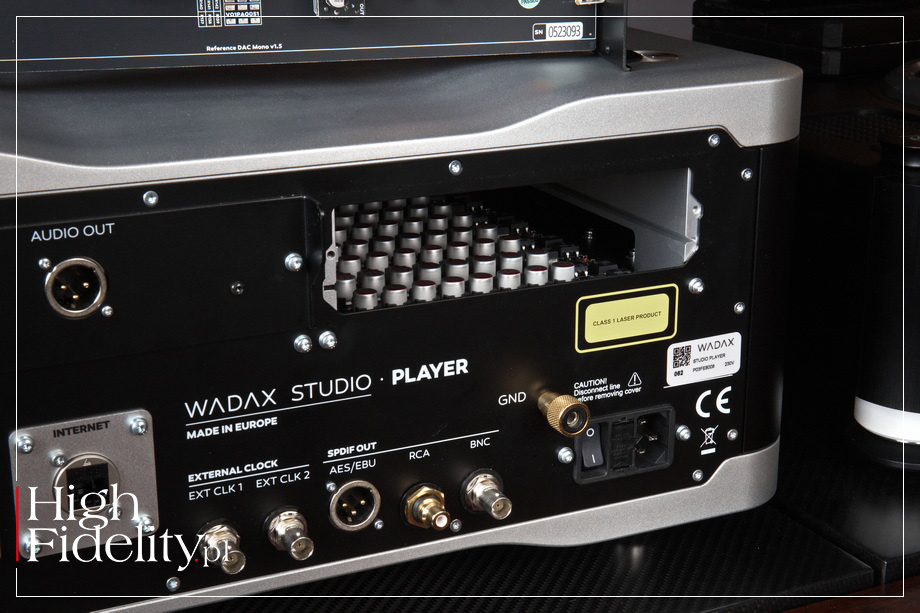
TECHNOLOGY • The front panel features only a touchscreen display and a protruding disc tray cover. The tray operates quietly when ejected, but the drive itself is slightly audible during operation. We also know that this is not the same unit as in the Atlantis transport. There, the mechanics were built from scratch, and they also play Pure Audio Blu-ray discs. Studio Player is based on a different, unmodified mechanism. It appears to be a transport from the Austrian company SUOS (StreamUnlimited) PL-2800 SilverStrike. Its tray is made of aluminum and ABS composite, and steel rods are placed on the sides, which are guided in bearings made of, as the manufacturer assures, “high-quality” POM plastic. This is an assumption, but a reasonable one: the file player module also comes from StreamUnlimited. This company supplies a large part of the audio market, and its modules can be found in many top-of-the-line devices. Wadax plays files from Spotify, Tidal, and Qobuz Connect streaming services, is certified by Audirvana, MQA, and Roon, and can also play files from a local library using the DLNA/UPnP protocol. The signal is supplied and received via sockets on the rear panel. Unusually, contrary to current trends, the player offers no digital audio inputs. The manufacturer seems to be saying that it has everything we need in the digital world. Instead, there are digital outputs – RCA, BNC, and AES/EBU. Of course, there is an Ethernet input (RJ45) for files and analog outputs. These are mounted in removable PCBs and there are only balanced XLR outputs. This is part of the modular design of the device and something that connects it to the reference Wadax series. The slots are fitted with Atlantis Reference D/A converter boards, which can be replaced with a better version in the future (when and if it is developed). The board is mainly populated with small modules (pin boards) with voltage stabilization circuits called Wadac Micro PSU. The conversion of digital to analog signals is handled by Burr-Brown PCM1792 chips. This chip dates back to 2006 and has long been discontinued but is considered a “classic.” It accepts PCM signals of up to 24 bits, 192 kHz, and DSD. In a mono configuration, as here, the upper sampling frequency doubles. This chip is valued primarily for its very good digital filters. It should be added that transistors, not integrated circuits, are used at the chip's output. On the rear panel, there are also sockets for the other two products in the Studio series: the Studio Clock and the Studio PSU power supply; the set also includes a special Akasa DC Studio cable, which connects the Player and the PSU. In terms of circuitry, this is a dual-mono device with complete physical and electrical separation of the left and right channels (digital and analog). The signal is always carried in a balanced form. At its core is the aforementioned error correction circuit, here in the musIC 3 version. The digital section circuits are to be synchronized to within 100 ps, and the total output noise is to be less than 0.5 μV (1 Hz–100 kHz). Wadax reports that the power supply uses thirty local regulation stages and five DC regulation stages. The player allows you to adjust two electrical parameters. In the menu, the user can change the maximum output voltage (1, 2, and 4 V) and output impedance. The user manual states:
Changing the impedance affects the sound characteristics and tone. Available output impedance values are 0, 7.4, 7.5, 8.2, 8.3, 8.7, 8.83, 9.8, 10, 28, 30, 46, 50, 66, 75, and 600 ohms. As the impedance increases from 0 to a higher value, you should hear a transition from a more rhythmic and expressive sound to a softer and smoother sense of rhythm. Careful listening will help you select the optimal impedance setting for your system (p. 11).
We will also change the output to fixed or adjustable the signal is attenuated, as I believe, in the digital domain. We will also set the absolute phase and balance between channels. These latter settings allow you to connect the Wadax directly to a power amplifier or active speakers. However, I advise against this – at this level, skimping on a high-end preamplifier is a big mistake. The device is connected to the Internet not only to play files but also for remote control. According to the manufacturer, this allows for remote servicing and updating the software. I wonder if this applies only to the file player module or also to the Music chip. 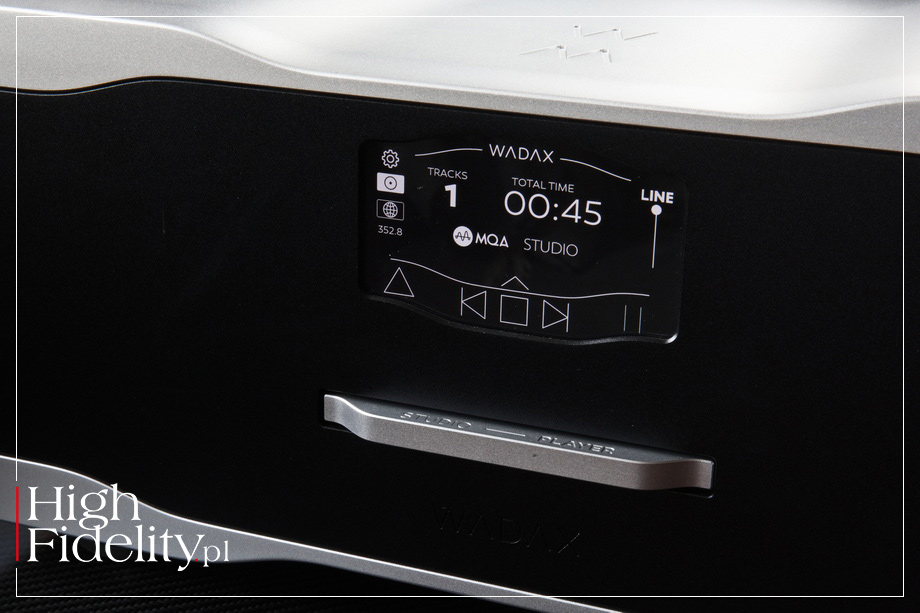
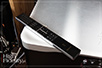
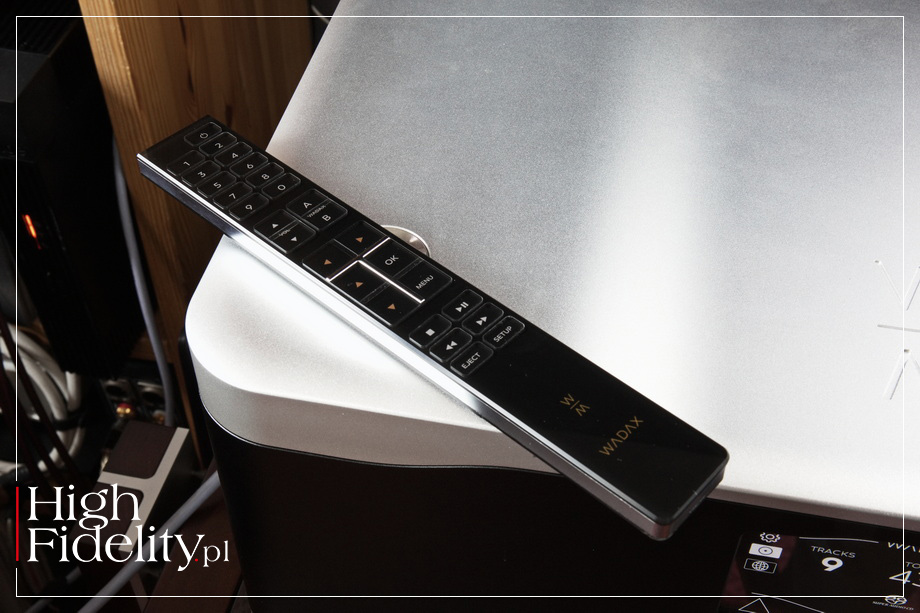
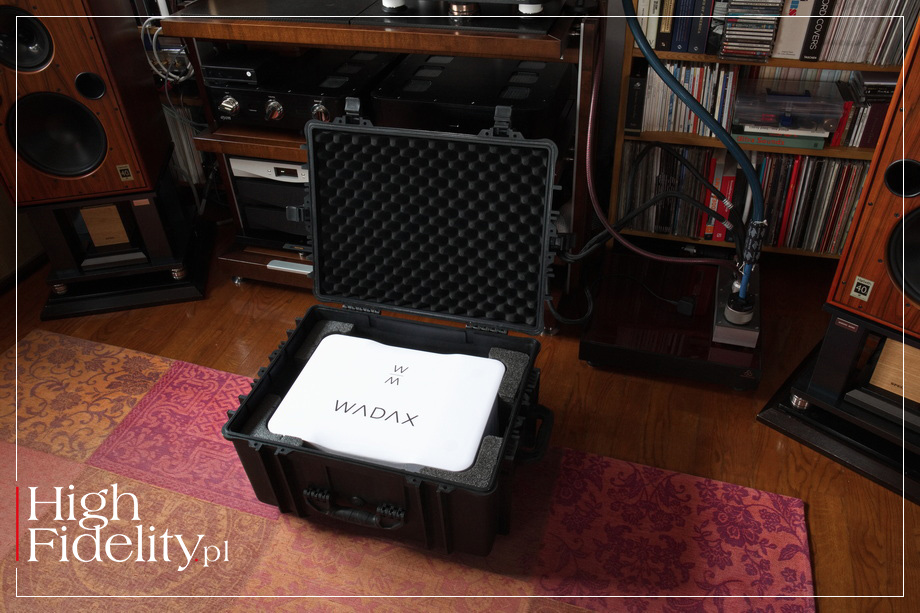
And one more thing – the player comes in a large, sturdy transport case with wheels. Cool. REMOTE CONTROL • The player is controlled via a touchscreen or remote control, which is nice with its acrylic buttons and clear actuation point. It's not super ergonomic, but it's okay. Interestingly, it is not a remote control purchased from one of the specialized suppliers in China. It is manufactured by the Austrian company Ruwido, founded in 1969, and it is almost a work of art. On its website, we read:
Our award-winning remote controls are designed, developed, and manufactured in Austria — using 100% renewable energy; → RUWIDO.com, accessed on December 30, 2025.
The company has twice received the prestigious Red Dot Award for its products, in 2018 and 2025, plus awards for other brands for which it has designed remote controls. ▓ SOUND HOW WE LISTENED • The Studio Player was tested in the HIGH FIDELITY reference system. It was compared to the Ayon Audio CD-35 HF Edition SACD player (SACD and CDs) and the Sforzato DSP-05EX file player with the PMC-05EX clock. 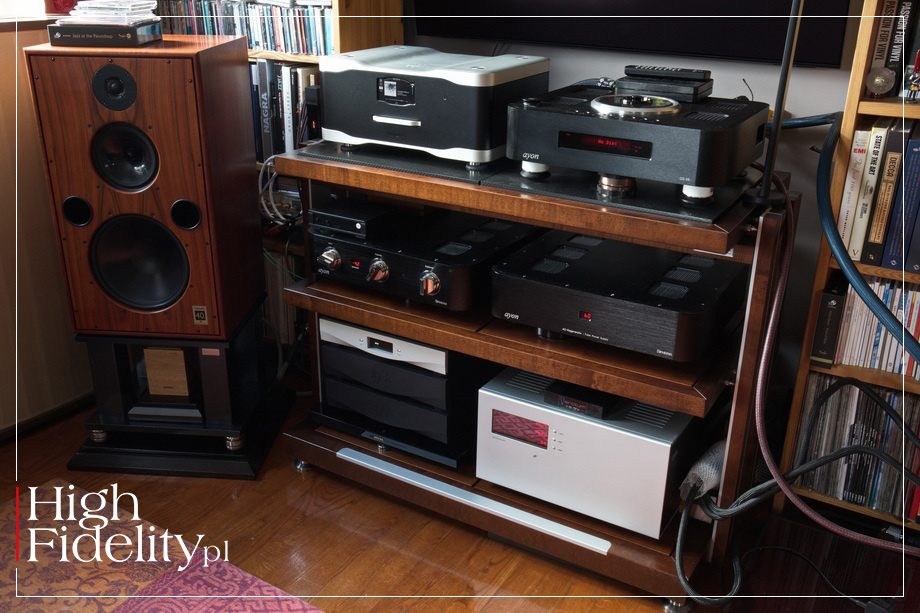
In my system, I only use unbalanced connections, which I consider to be better. However, the reviewed player does not offer them – it only features balanced XLR outputs. Therefore, as an exception, I tested all three players with XLR cables, namely borrowed Siltech Master Crown interconnects. 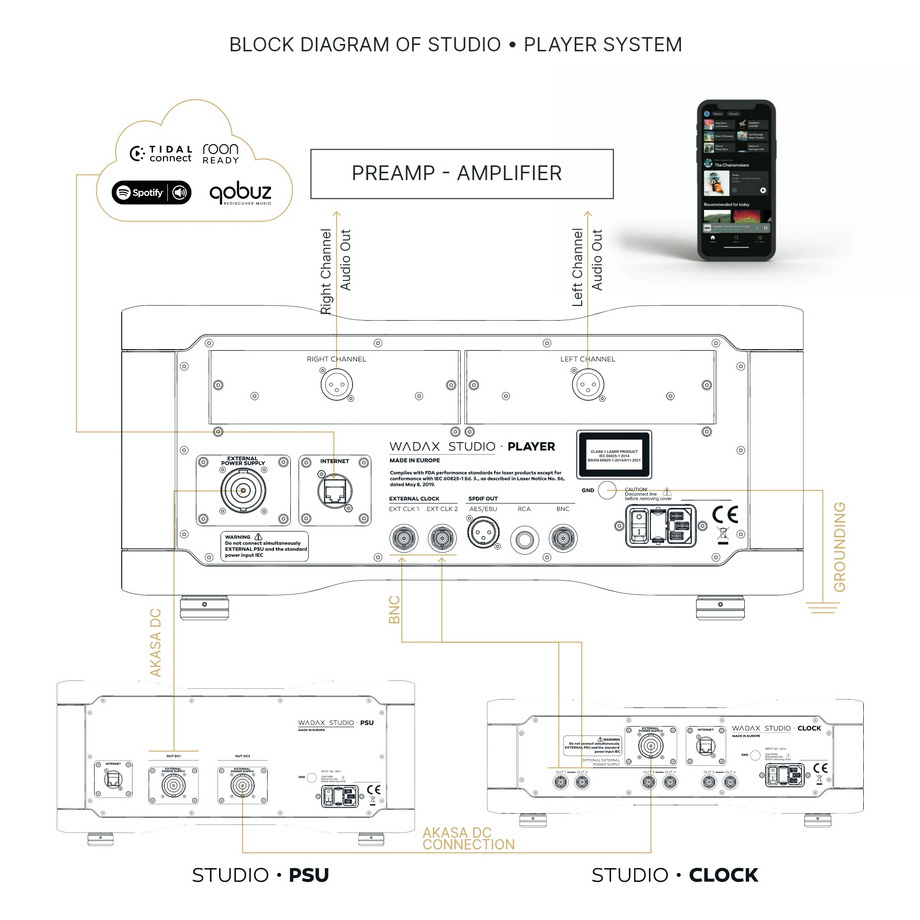
‖ The Studio Player can be expanded with an external power supply and word clock • fig. press material. Wadax |
The player was powered using an Acrolink 8N-PC8100 Performante Nero cable and sent the signal to the Ayon Audio Spheris Evo line preamplifier, then to the Soulution 710 power amplifier and Harbeth M40.1 speakers. The device stood on the top shelf of the Finite Elemente Pagode Edition Mk II rack, next to the Ayon Audio player. In its menu, I set the output voltage to 2 V and the impedance to 0 Ω. » RECORDINGS USED FOR THE TEST ⸜ a selection
→ SACD/CD/MQA-CD SACD/CD/MQA-CD • I waited a very long time for this. I waited for an optical disc player to perform at the same level as my Ayon Audio, and maybe even better. 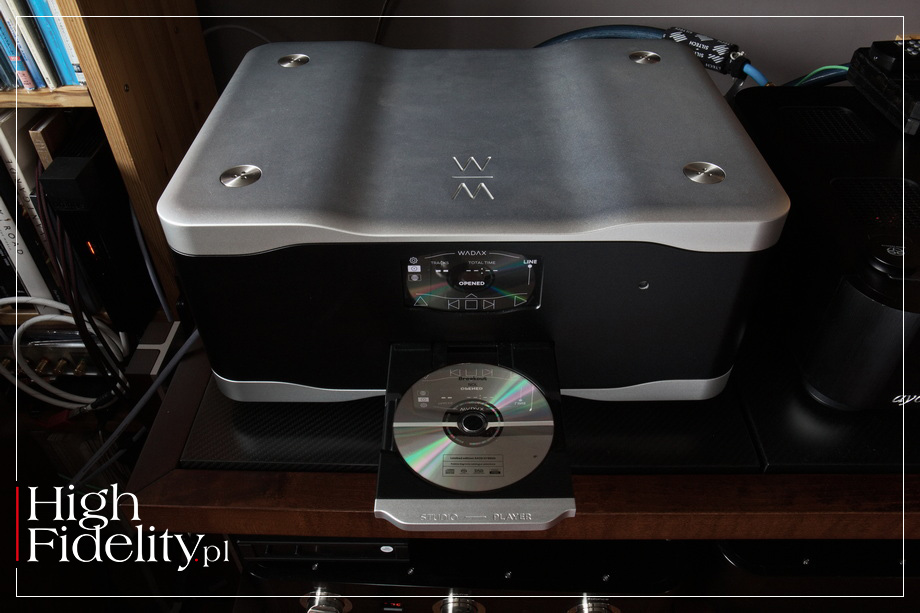
So far, I've only had a few moments of hesitation and reflection while listening to Japanese players → ESOTERIC K-01XD and → ACCUPHASE DC/DP1000 ˻PL˺ and the British → DCS VIVADLI APEX ˻PL˺, and once I simply let myself get immersed in music with pure pleasure when I tested the split player → BRICASTI M19/M11. The Wadax is precisely this type of top-of-the-line device, and what's more, it is closer to the Ayon than all of the above-mentioned devices, except for the Esoteric. Its sound is extremely engaging. While the Ayon does this mainly by playing on emotions, the Spanish player also adds an intellectual component to it. Not at the same level as the Austrian player, but still clearly better than almost anything I've heard at home so far, whether from a file, an optical disc, or a vinyl record. The sound of the Studio Player is open and at the same time, full. Ayon seems to play in an even more “gutsy” way, anointing every detail with weight, which is in harmony with what I heard from the Esoteric player. But the Wadax plays in no less dense a way, adding “width” to it. In the sense that the bandwidth seems wider with it, in both directions. This reduces the emphasis on the lower midrange, which makes the Ayon equivalent to an analog reel-to-reel tape recorder. But this is what makes the Player's sound more lively and vibrant, more reminiscent of Naim's top CD players and, to a large extent, Accuphase's two-box SACD player from the “1000” series. I noticed this with the MQA-CD sampler Jazz Hi-Res CD Sampler, released in Japan in 2018 by Universal Classic & Jazz. That is, with a signal encoded in 24-bit length and 352.8 kHz. MQA is a lossy codec, but experience shows that the digital filters used in it give excellent results in the form of better resolution and openness – and that's exactly what I heard with the player I was testing. Ayon played, obviously, the “CD version,” i.e., 16/44.1, which meant it was an uphill battle for it. However, I know it well enough to say that what was more important was how it all sounded in the end. With the Spanish device, both CANNONBAL ADDERLEY's powerful performance in ˻ 1 ˺ Autumn Leaves and JOÃO GILBERTO's singing in ˻ 3 ˺ The Girl From Ipanema, and then ANITA O’DAY in ˻ 6 ˺ Old Devil Moon, all these songs were connected by a similar treatment of the musical material. That is, delving deep into the sounds, selectively breaking them down, and then immediately putting them back together again. Seamlessly, I might add. This is not Frankenstein – the association comes to mind – but haute couture at its finest. I would say that this is a postmodern approach. In this context, most turntables would sound “baroque,” while the Ayon CD-35 HF Edition would represent dark modernism. Wadax's postmodernism would consist of the fact that the same sounds that Ayon interpreted in a dense and low manner were reproduced by the Spanish player in a broader way, with more breath. Yes, Gilberto's vocals were close to me, as they are presented in this version. Ayon almost squeezed them out of the recording, placing them in front of me. Wadax, on the other hand, created a completely new source, not as saturated, not as intimately accessible, and yet – in some way – more real, cleaner. What I noticed with the MQA-CD sampler was repeated when listening to ARNE DOMNÉRUS's album Jazz at the Pawnshop, just released on Crystal Disc by Audionautes Recordings. This is the first album from this label encoded in MQA, this time as 24/176.4 (Studio). With this album, it was easier to hear that Wadax treats perspective more literally. It does this by placing the instruments a little further away from us, from the listening position, rather in perspective, than at arm's length. It does this perfectly, as its sound is exceptionally resolving. But it also does not generate the kind of “puffiness” in the middle of the band that reel-to-reel tape recorders produce and which Ayon also emulates so well. It's a different aesthetic. The sound of the Wadax is open and selective. But selective, not in terms of the amount of sand thrown at us at once, but in terms of snowflakes in the morning, which fall slowly and are therefore more perceptible than tangible, if you know what I mean. What I mean is that the cymbals in ˻ 2 ˺ Limehous Blues, the leader's alto saxophone, and finally the vibraphone playing in the background were all clear, powerful, and resonated for a long time. But it wasn't intrusive. A bit like the long-awaited visit of someone we've just met and whose visit we're extremely excited about. Ayon, Techdas Air Force One turntable, Spheris Evo Ayon preamplifier, Esoterica SACD player, etc., would be like a visit from a close friend – warm, pleasant, but also a little predictable. Thanks to the openness of the treble, resolution, and excellent – as I hear it – phase coherence. This also came out perfectly in the intro to the ˻ 1 ˺ Taki wiatr, which opens the album NOL by the band BREAKOUT. Ah, what a perfect production and fantastic remaster it is! In my opinion, it is one of the best sounding albums in the entire “Polskie Nagrania Catalogue Selections” series, or one of several. Wadax showed an open, dynamic sound, set low in the bass range, but not overwhelming with it. 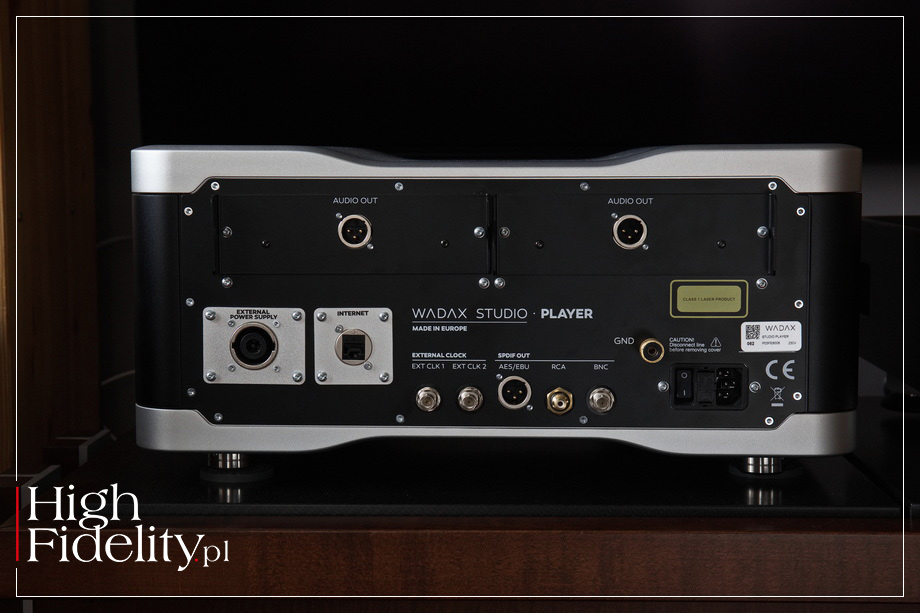
Interestingly, to an outside observer who is not particularly familiar with high-end complexities, the sound produced by Ayon and the Spanish player might seem similar. And to a large extent, it is. Yes, the latter is broader from the top end and has less emphasis in the midrange. But the way the sound is presented, consistent, dense, and balanced, would be very similar for both. However, when we look at the same thing from “above,” that is, from the perspective of experience with the best equipment in the world and live sound reproduction, these differences become quite significant. At no stage of the testing did I reach a point of “either-or” that would exclude either of these devices. Yes, that's probably what it's all about: the Wadax is even more resolving when it comes to dynamic shading – that excellent drum kit! – and the transparency of the soundstage. It does this perfectly, perhaps better than anything else I've heard at home, except for the dCS Vivaldi Apex player. The latter is even more powerful in showing the attack, but at the same time, this attack is less differentiated. With the Wadax, we get a very “informative” sound, if I may say so. It's like a glance in which we see everything at once. And it's not a bright sound, oh no! TOTO, from the excellent SACD version released by Sony Music Labels in Japan in the form of a 7" mini LP, in ˻ 1 ˺ Rosanne, sounded dynamic, powerful, and lively. But also, in a way, smooth. With Wadax, it was easier to hear than with Ayon that this was a transfer with strong compression and without the same excellent insight into texture and attack as with the previously mentioned titles. I had heard something similar before, but it was only with this album, and then with MARK HOLLIS's 1998 solo project, that I realized that the player I was testing did indeed play tangibly and did indeed pull the back of the stage slightly. The thing is, the differentiation in this area is better than with the Ayon, the edges are more clearly visible, as are the attack, including its intensity and tension. This is simply the result of better differentiation. The drums in ˻ 4 ˺ The Gift from the aforementioned album, recorded along with the rest of the instruments using two microphones on a Studer analog tape recorder, were perfectly clear and closer to me. But the sounds in the foreground, such as the tambourine in the left channel, the harmonica playing there, and above all the vocals of the former Talk Talk frontman in the middle, recorded on a Mitsubishi X-800 digital tape recorder, were a little further away. That's why it seemed to me that Wadax shows the sound sources in a more distant perspective. It seems to do so because the foreground is further away, and yet – it does not, because there are a lot of sounds right after that. The Spanish device seems perfectly well controlled in all of this. It is sound without any “pressure” on anything. Even with the dynamic, wonderful ˻ 1 ˺ Day by Day from FRANK SINATRA’S Come swing with me!, it remained stoically calm, beautifully rendering the tuba, usually diminished by devices, placing the vocals exactly in the center, with a clearly marked reverberation characteristic of Capitol Records studios. The album, recorded with an orchestra conducted by Billy May, hit, and exploded, only to let me gently land on the floor in a magnificent ˻ 2 ˺ Sentimental Journey, dim the lights, and listen to Sinatra's rough, mature vocals. FILES • Comparing the same recordings on SACD and CD, as well as those played from files, it is easy to conclude that the file transport module in Wadax is secondary to the optical disc player. It is an honest, warm, smooth sound, but without the resolution I heard with physical discs. However, leaving it at that, without comment, would be ill-advised. The more albums I played through the iPad with Jplay, the more I appreciated what the Madrid-based manufacturers had achieved. Their main concern was coherence. There is no sharpness, brightness, or hard edges in this sound. It worked great, for example, with CHARLY GARCIA's excellent song In The City, featuring Sting. It is based on a driving rhythm laid down mainly by the bass. It is powerful and has a well-defined attack. In the Player version, this instrument was soft and warm, but still perfectly controlled. There was no edge to it; that's not how it was played. Instead, there was an internal balance. Yes, “zen” is probably the best way to describe what I heard. And you don't even need such melancholic and warm songs as JANIS IAN's At Seventeen or HIROMI's Morning Coffee to sit comfortably with a smile on your face, a slight reverie, and something positive spreading through your body. And I'm not talking about coffee or alcohol, for that matter... It's a kind of boost known from tube amplifiers designed for this type of music. Even when the characteristic guitar sounds announcing the song The Chain, here in a cover by WET WET WET, came through the speakers, it wasn't expressive enough to break the illusion of perfect calm. And there is no point in frowning upon the “illusion” because, ultimately, that is exactly what we are dealing with when playing recorded music. That's what we're looking for; I would add. The Studio Player may not be as resolving as the SACD player, but it has everything under control. In this respect, it resembles a turntable. I think this is the best comparison. So we get a “tube” and “analog” sound in one. Obviously, I am talking about stereotypes, but stereotypes in a very good sense. This is sound based on low bass – listen to the bass guitar opening the second part of the song, and you will know what I mean. The high tones are warm and rounded. And this will be the case in every song. The separation between instruments will also be more conventional than distinct. But... that's right – this “but” is necessary and unavoidable at this point. These are all “external” characteristics of this sound. When we sit in front of the speakers and forget that we are audiophiles, we smoothly switch to music lover mode. That's how pleasant the sound is. ▒ Summary The WADAX STUDIO PLAYER is one of those devices that you enjoy thinking about and reminiscing about their sound. It's the kind of sound I like and consider to be “right.” This is how I imagine top-quality sound in a home environment. I am talking about refinement, calmness, order, and “control” over everything. The optical disc player section is a fundamental component of this device, as it gives it its purpose. The player offers excellent resolution and smooth operation. The differences between SACD and CDs are clearly audible, yet the latter are not “worse” in themselves, although I always end up choosing the SACD version of a any given title. MQA-CDs also played perfectly, and I can admit that I spent most of my time with them. I can't wait for more titles from Audionautes Recordings encoded in this way. With Studio Player in my system, I would also look for Japanese releases of titles on MQA-CD. 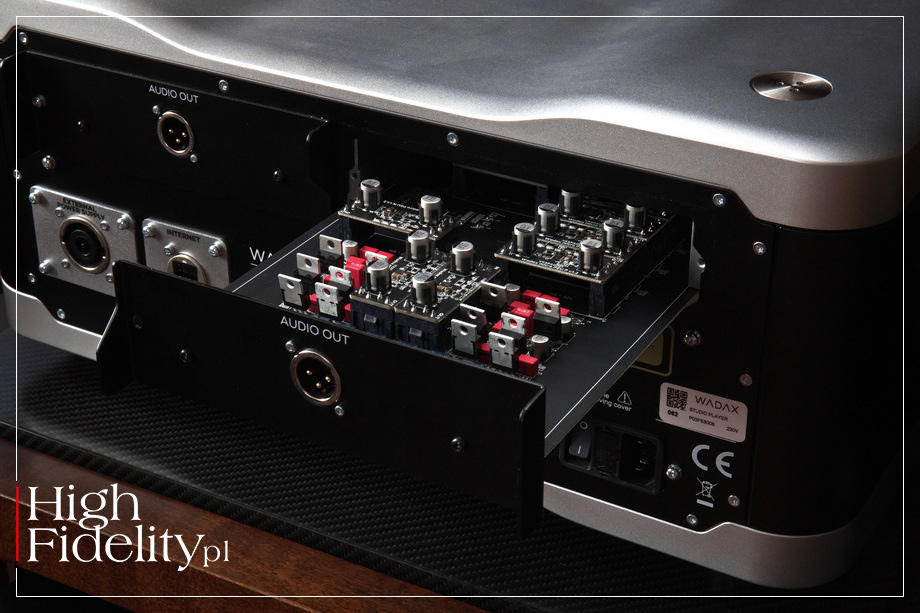
The file player is really enjoyable. It does not have the same resolution and selectivity as a disc player, nor does it have the clear treble that the latter excels at. But it does offer a strong, meaty bass. It delivers a smooth, warm playback that allows you to play any album from some streaming service with peace of mind and pleasure. Without audiophile pretensions, but rather with a focus on music. Most importantly, it is a professional device of the highest quality, and perfectly made. I could use it in my reference system. Although it is not as saturated in the midrange as my Ayon Audio, it gives me the energy of higher frequencies and their openness, which I sometimes miss. And the workmanship... It's very, very good. ‖ WP ▓ Technical specifications (acc. to the manufacturer)
Supported discs: Red Book (CD) and Scarlett Book (SACD) 
THIS TEST HAS BEEN DESIGNED ACCORDING TO THE GUIDELINES adopted by the Association of International Audiophile Publications, an international audio press association concerned with ethical and professional standards in our industry, of which HIGH FIDELITY is a founding member. More about the association and its constituent titles → HERE. |
 |



|
Reference system 2026 |
|
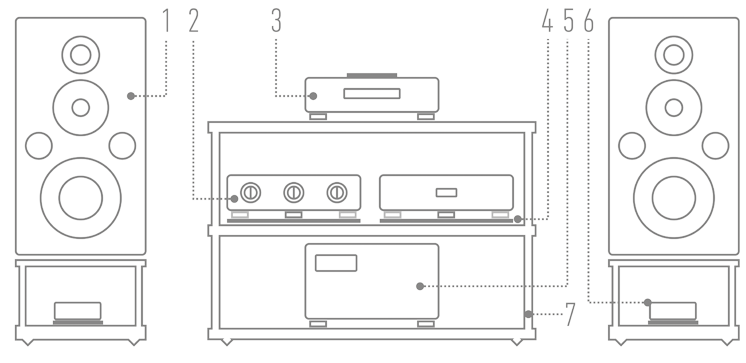 1) Loudspeakers: HARBETH M40.1 |REVIEW| 2) Line preamplifier: AYON AUDIO Spheris III Linestage |REVIEW| 3) Super Audio CD Player: AYON AUDIO CD-35 HF Edition No. 01/50 |REVIEW| 4) Stands (loudspeakers): ACOUSTIC REVIVE (custom) |ABOUT| 5) Power amplifier: SOULUTION 710 6) Loudspeaker filter: SPEC REAL-SOUND PROCESSOR RSP-AZ9EX (prototype) |REVIEW| 7) Hi-Fi rack: Hi-Fi rack: finite elemente MASTER REFERENCE PAGODE EDITION Mk II, more → HERE |
|

|
Cables Analog interconnect SACD Player - Line preamplifier: SILTECH Triple Crown (1 m) |ABOUT|» ANALOG INTERCONNECT Line preamplifier → Power amplifier: Siltech ROYAL SINLGE CROWN RCA; review → HERE Speaker cable: SILTECH Triple Crown (2.5 m) |ABOUT| |

|
AC Power Power cable | Mains Power Distribution Block - SACD Player: SILTECH Triple CrownPower (2 m) |ARTICLE| » POWER CABLE Mains Power Distribution Block → Line preamplifier: Acoustic Revive ABSOLUTE-POWER CORD, review → HERE » POWER CABLE Mains Power Distribution Block → Power amplifier: Acoustic Revive ABSOLUTE-POWER CORD, review → HERE Power cable | Power Receptacle - Mains Power Distribution Block: ACROLINK Mexcel 7N-PC9500 (2 m) |ARTICLE| Power Receptacle: Acoustic Revive RTP-4eu ULTIMATE |REVIEW| » ANTI-VIBRATION PLATFORM under Acoustic Revive RTP-4eu ULTIMATE: Graphite Audio CLASSIC 100 ULTRA, review → HERE Power Supply Conditioner: Acoustic Revive RPC-1 |REVIEW| Power Supply Conditioner: Acoustic Revive RAS-14 Triple-C |REVIEW| Passive filter EMI/RFI: VERICTUM Block |REVIEW| |

|
Anti-vibration Speaker stands: ACOUSTIC REVIVE (custom)Hi-Fi rack: finite elemente MASTER REFERENCE PAGODE EDITION Mk II, more → HERE Anti-vibration platforms: ACOUSTIC REVIVE RAF-48H |ARTICLE| » ANTI-VIBRATIONAL FEET: |

|
Analogue Phono preamplifier: Phono cartridges:
Clamp: PATHE WINGS Titanium PW-Ti 770 | Limited Edition Record mats:
|

|
Headphones » HEADPHONE AMPLIFIER: Leben CS-600X, review → HEREHeadphones: Headphone Cables: Forza AudioWorks NOIR HYBRID HPC |