


|
Turntable TECHDAS
Manufacturer: STELLA Inc. |

 |
 |
 |
|
Test
text by WOJCIECH PACUŁA |

|
No 261 February 1, 2026 |
PEOPLE COME AND GO, but their works remain, one might say, fitting into the trend of pop psychology and pop sociology, were it not for the fact that this is usually not true. Only the works of a few endure. And even if each of us would like our legacy to be “more lasting than bronze,” to quote another well-known saying, only a few fragments will remain, usually unrecognizable after many years. But they will. 
The topic of “legacy” in audio is particularly interesting because we are rarely able to match specific solutions to names, even though we know and respect those solutions. When we dig deeper for a while on the internet, we find clues leading to that “first” – application or use, patent, or idea. Often, we will also be given a specific name related to it. But it will take some effort, and we will need to know what we are looking for. But it is possible. We will then find, for example, information that speakers with a closed cabinet, in which the driver is suspended on an “air cushion,” were the idea of Edgar Villchur (more → HERE ˻PL˺) and that the same man introduced the concept of a decoupled deck to turntable design, which was creatively developed by Linn. Do we remember that in 1967, Bill Hecht obtained the first patent for a soft dome driver? Or that the modern direct-drive turntable is the legacy of Mr. Shuichi Obata, an engineer at Matsushita. There are many more such examples. Not all solutions that we take for granted today can be traced back to a specific product and attributed to a specific person. Usually, the associations are based on how often a company used them, who promoted them, or who refined them. Let's take electrostatic speakers as an example. Edward W. Kellogg obtained a patent for this type of driver in 1929, but the first truly successful commercial electrostatic loudspeaker with a full frequency range was the Quad ESL-57, introduced to the market by Peter Walker and his company Acoustical Manufacturing Co. Ltd. in 1957. The tested turntable is a similar case, particularly the technology used to suck the LP record down to the platter. It is difficult to pinpoint the first example of its use, but it cannot be denied that among the most famous examples of this type of product are those created by Mr. Hideaki Nishikawa, first in turntables bearing the Micro Seiki logo, and now TechDAS. And this is the legacy we associate him with. ▌ Air Force IV THE SOLUTION IN QUESTION, known as a vacuum LP hold down, can be found in all turntables manufactured by TechDAS. As mentioned, it is a “legacy” from Micro Seiki. It is a mass-loader, single-motor, belt-drive design with the aforementioned record suction system; up to three tonearms can be used with the tested “IV.” The TechDAS range has been divided into levels, with models I, II, and III (or → ONE, → TWO, → THREE – these two forms of notation are used interchangeably), followed by their improved variants → PREMIUM and as many as three additional ones: the top-of-the-line Zero (only one form of notation) and two cheaper ones – IV and V. The logic was ironclad because each model down the line cost about half as much as the “senior” model. Model III set the standard used for two cheaper turntables. The manufacturer writes about it:
A new benchmark in analog sound. Driven by TechDAS’ innovative ‘air’ technologies, this turntable realizes our vision of the ultimate analog reproduction. (…) Today, we believe analog sound must evolve beyond its past forms, after more than 30 years of the digital era. Our pursuit of superior analog sound seeks to push the boundaries of sound-to-noise ratio, drawing inspiration from advancements in modern digital audio. TechDAS technologies deliver cutting-edge analog sound, redefining performance with precision and innovation.
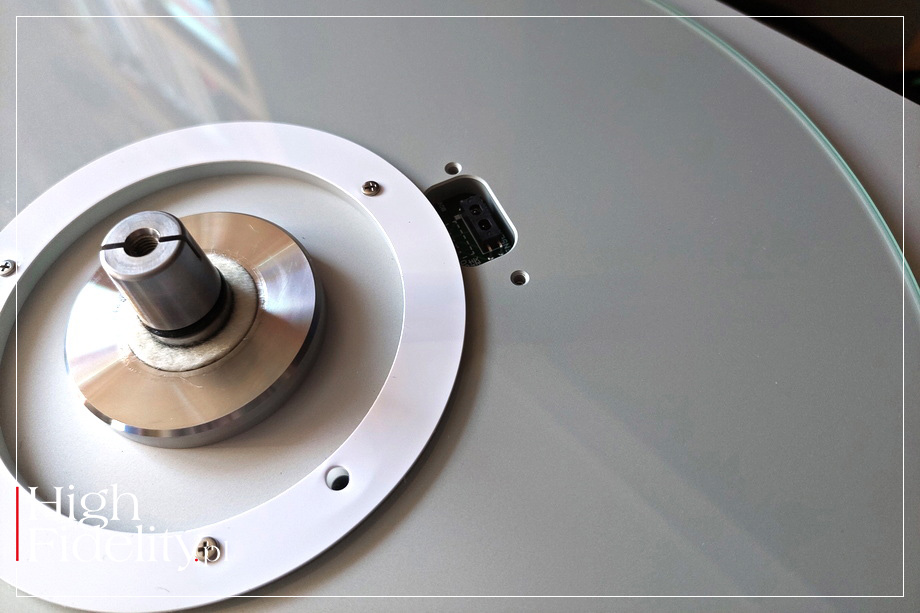
⸜ Air Force IV, → TECHDAS.jp I find the combination of the terms “analog” and ‘digital’ in one sentence interesting. In itself, it may not be that interesting, as companies offering file players and D/A converters advertise their products in this way nowadays. It takes on a new meaning in the context of “digital precision” used here. This is because it is said by a manufacturer associated with analog. In this case, it is not about the sound, which is supposed to be “analog,” but about the precision the device is supposed to work with. And we still associate the highest precision with “digital.” You can see that, right? In the case of this company, the association is turned upside down; we look at it from the inside out. This unusual combination of analog and digital is also “written-in” into the company name: ‘DAS’ in TechDAS stands for “Digital Analog Supremacy”. This is meant to emphasize “the pursuit of perfect sound reproduction by combining digital precision with analog warmth,” as the manufacturer says. In this manufacturer's turntables, digital technology is part of the motor control system. It is powered by an external class AB amplifier that generates a sine wave. Its precision is ensured by a microprocessor chip with a master clock, similar to those found in CD, SACD, and file players. When we remove the platter, we see a sensor on the bottom – this is part of the rotation stabilization system. It is important because the drive belt used in this model is rigid, so it requires precise tension – setting it is part of the start-up procedure. And this is done thanks to the aforementioned system. 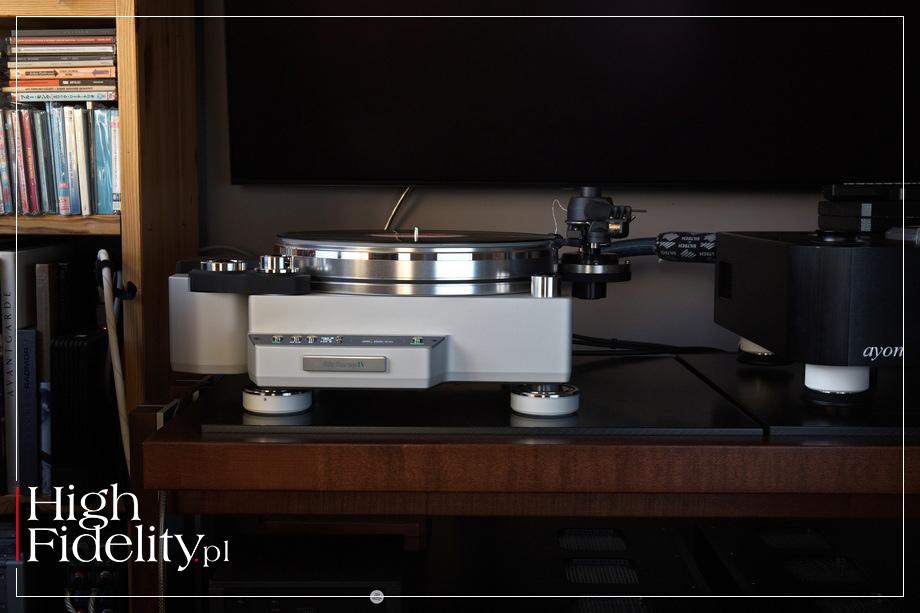
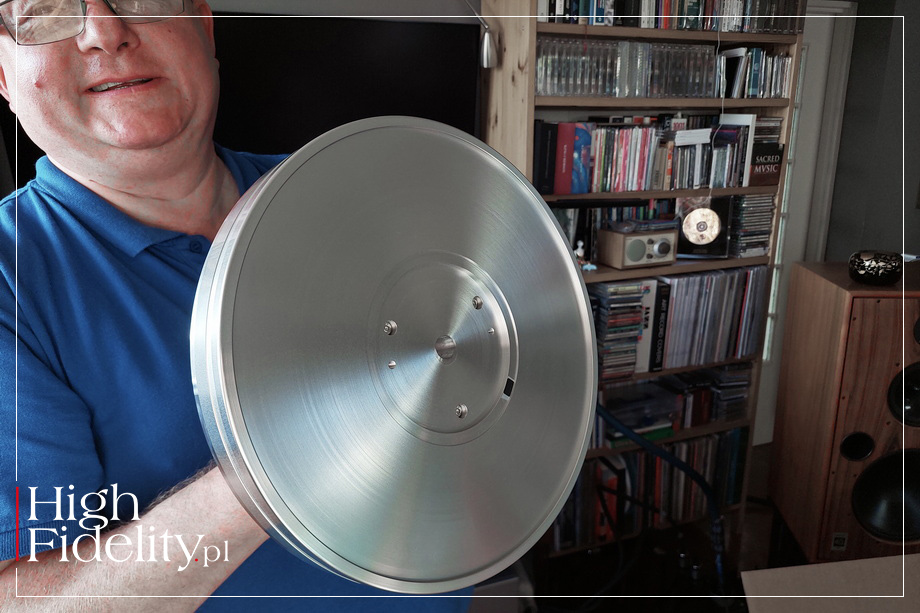
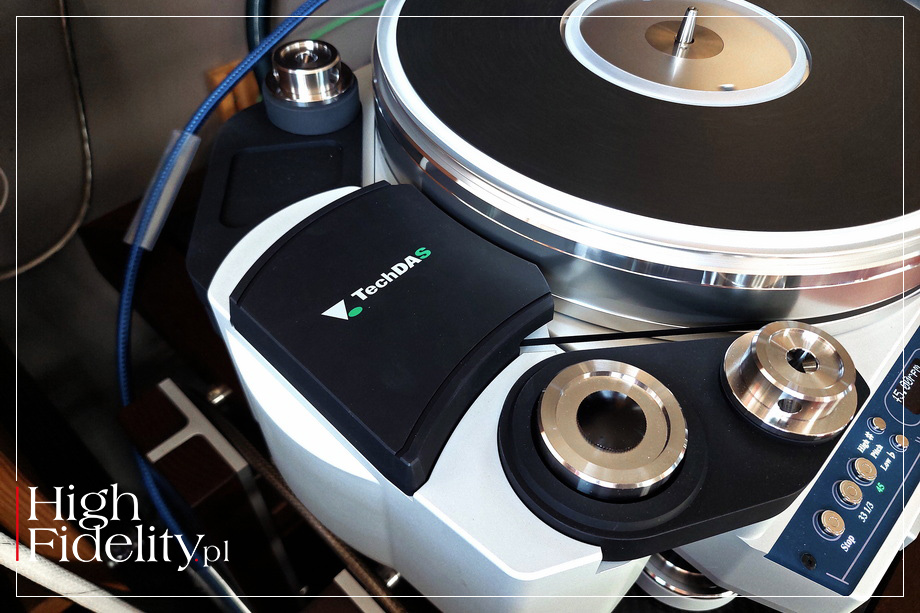
The tested Air Force IV turntable is surprisingly compact. Its dimensions are 420.5 mm (W) × 368 mm (D) × 168 mm (H) (without tonearm base), and it weighs 34.4 kg. This is roughly the same as a medium-sized integrated amplifier. In addition, there is an external pump that creates a vacuum under the turntable, but it is placed separately, usually on the bottom shelf or even behind the system. Solid, weighing 9 kg, featuring decoupled feet, it uses an aluminum housing measuring 350 × 270 × 160 mm. As mentioned, this is a mass-loader, non-decoupled turntable. “Mass-loader” means that it uses a large mass to dampen vibrations, and “non-decoupled” means that the base is a rigid structure and the arm and platter are not separated from the motor by a lossy or elastic material. The turntable itself stands on three feet with an element that decouples the whole unit from whatever it stands on. Interestingly, the Three model did not come with them as standard, but only as an option that had to be paid for separately. The Air Force IV turntable employs a heavyweight one-piece platter machined from solid A5056 aluminum and magnesium alloy, while the entry model, Air Force V Premium, uses a dual platter system. The result is „overall improvement in sound quality”, such as an „extended frequency range” and „noticeably enhanced dynamics.” And further:
Combined with our air bearing system, the 9kg platter allows for an extraordinary low noise floor. Its tapered spindle absorbs any swaying of an off-center LP. A special thin pad made of a damping and antistatic material is applied on top of the platter to protect the records.
⸜ Air Force IV, PDF, → TECHDAS.jp The platters used in Techdas turntables is divided, when viewed from above, into two parts: the center and the outer one. The former has the diameter of an LP label and is where the outlets of the pneumatic system are located, which sucks this part of the vinyl to the actual platter. The outer circle is separated by a silicone gasket; the second one is located on the circumference of the platter. This part is lined with foam. The vinyl is therefore rigidly fixed in the center and contacts the platter on the sides through a lossy element. It should be added that the spindle is not fixed, but movable, and has a conical cross-section. This allows us to fit records with different hole diameters. ▲ Suction 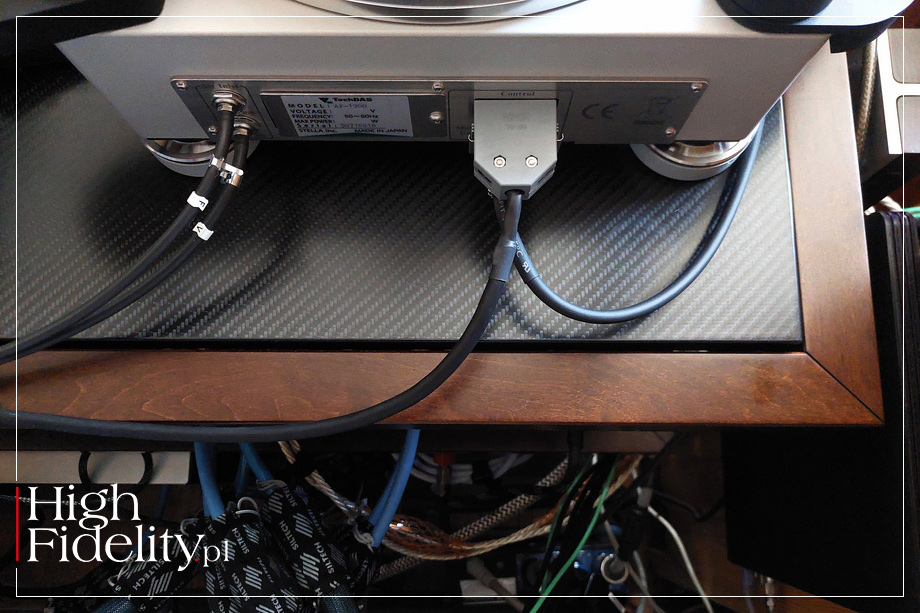
‖ Photo of the rear of the turntable – two tubes protrude from it, one sucking in and one supplying air. There is also a cable supplying power to the motor. A SUCTION, ALSO KNOWN AS A “HOLD-DOWN SYSTEM,” is an LP press-down system in a turntable, usually vacuum-based. It works by creating negative pressure under the vinyl record, which sucks it (presses it) firmly and perfectly flat onto the platter. This eliminates warping of the records, stabilizes them mechanically, prevents unwanted vibrations and resonances, and ensures that, at least in theory, the stylus follows the grooves with greater precision. 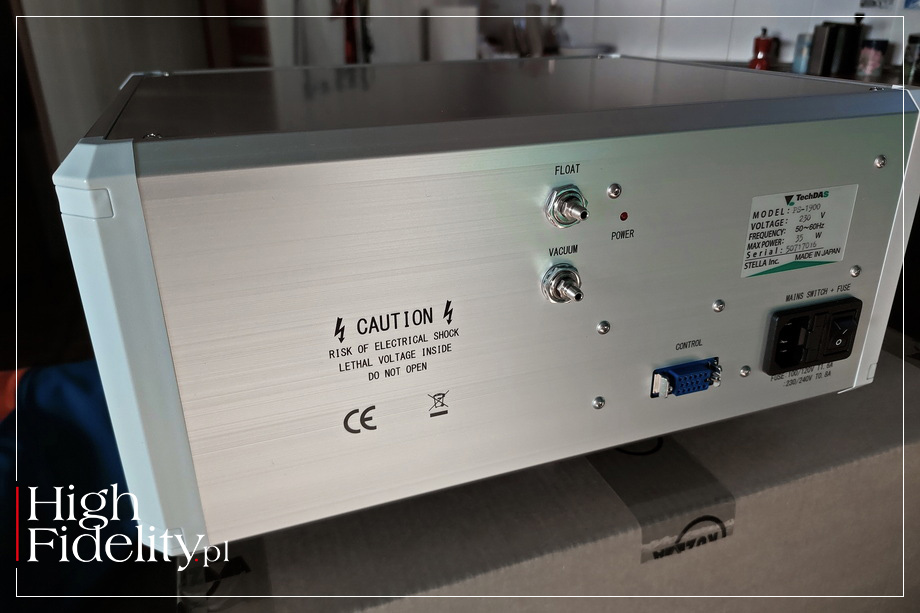
Photo of the rear panel of the pump and power supply in one. Historically, this system is known from turntables manufactured by SOTA (USA), Continuum Caliburn (USA), Walker Audio (USA), Rockport Technologies (USA), Luxman (Japan), Sony (Japan, in professional models), and currently Danish Bergmann, Swedish SAT (Swedish Analog Technologies), American Basis Audio, and – the subject of this test – Japanese manufacturer TechDAS. ● ALL OF THESE FEATURES ARE FAMILIAR from higher-end models, as is the convenient “control panel” with buttons for speed changing, activating suction, and displaying the precisely selected speed. However, the difference is visible to the naked eye: the motor in the IV model is screwed to the base, while in the III model it was placed separately. In the tested turntable, it “hangs” on two solid metal elements. Its housing is made of A5052 aluminum alloy (high chromium and magnesium content); the whole thing weighs 4.1 kg. The manufacturer says that it is a 2-phase 4-pole synchronous AC motor, which is separated and isolated from the base, similar to higher-end models. The drive belt is 4 mm wide and is also the same as in higher-end models. Made of polished polyester fiber, it is designed to ensure “stable rotation” and “quickly accelerate the heavy platter to its rated speed.” As we read further, “by driving the platter with a separate motor, it achieves an exceptionally high signal-to-noise ratio.” And, we might add, very low wow and flutter, below 0.03%. 
Along with the deck, we get one tonearm base that fits both the rear right and front right positions (with a hole for the selected tonearm). We can also purchase additional bases, but it is important to remember that the rear left position requires a different version than the other two. Interestingly, the set does not include a record clamp, so if you want to use one, you will have to buy it separately. It is a perfectly made tool, as I see it, for playing LP records. The record suction works phenomenally, although we cannot listen to 10“ and 7” records with it. The appearance is very technical, but you can see the spirit of the creator, or rather his heart, in it. This is how all high-end products should be made. ▌ SOUND HOW WE LISTENED • The TechDAS Air Force IV turntable was placed in exactly the same spot where the Three Premium had stood, and before that, the One and Two. As with the latter, I used the Kuzma 4Point 9 tonearm, but with a different cartridge – previously I used Madake from the Japanese company Miyajima Laboratory, and this time – Destiny; more → HERE. 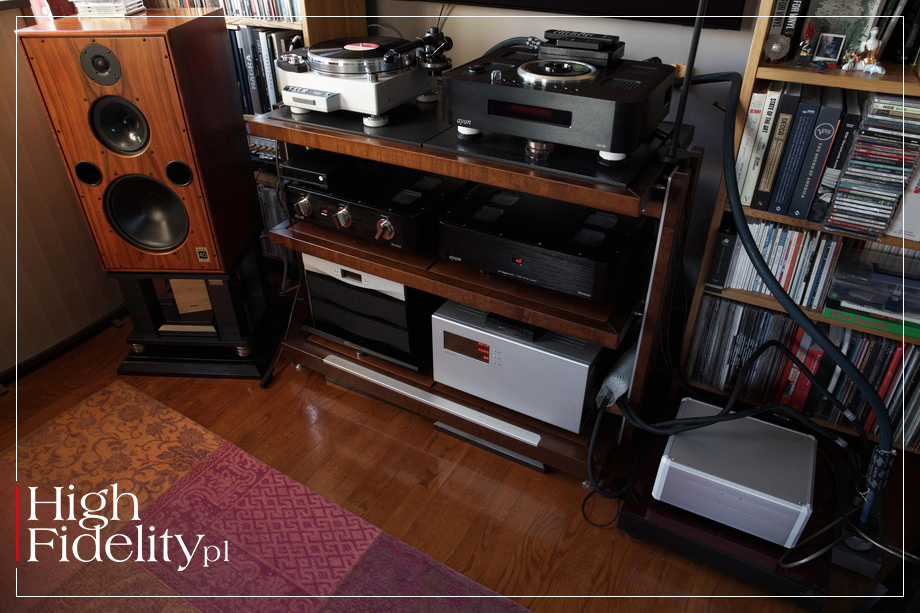
The turntable fed signal to the RCM Audio Sensor Prelude IC preamplifier, which I had been using for many years, via a Furutech interconnect. From there, the signal went to the Ayon Audio Spheris Evo line preamplifier and then to the Soulution 710 power amplifier. The speakers were Harbeth M40.1, and the cabling was Siltech Triple Crown and Acoustic Revive Absolute Power Cable-K. Before playback, the records were cleaned in an ultrasonic cleaner → Audiodesksysteme Gläss Vinyl-Cleaner ˻PL˺ 
» RECORDS USED FOR THE TEST ⸜a selection
⸜ KITTY, DAISY & LEWIS, Kitty, Daisy & Lewis, Sunday Best SBEST25, 180 g LP ⸜ 2008. I HOPE THAT WHEN READING the technical description of this turntable, you did not translate the “digital precision,” directly to the sound. Although it may be easy to do so in your mind, please do not. These are two different things, related to each other, but different nonetheless. The manufacturer points out that the precision of rotation, achieved, among other things, thanks to a digital control system, translates into an even better, even more analog sound. And that is indeed the case. |
All turntables from this manufacturer, except for the model Two (no longer in production...), offer exceptional bass extension. In the sense that regardless of which tonearm we combine them with, which cartridge we choose, the element that will break through the cosmos of sounds will be fullness and the wonderful ability to remain on the full side of the spectrum. You can brighten it, sharpen it, contour it – it depends on your choices. But regardless of what they are and what tone you achieve, the basis for it will be the exceptional fullness. Yes, I use different terms interchangeably to describe the same phenomenon. Starting with the Air Force One model test in 2014, I compared all other designs – in terms of emotions – to what I heard then. Model IV does not offer all of these features to the same degree of refinement, but it is not as far from this point of reference as one might expect. Mainly because it plays in a saturated and low way. 
The album by KITTY, DAISY & LEWIS entitled Kitty, Daisy & Lewis, recorded in the publisher's back room on vintage equipment, including old stereo tape recorders, with lacquer cut on site on an even older machine, sounded amazing. In the sense that all the distortions introduced by the microphones and the rest of the system were audible, but as distortions of the system, not of the sound. It's hard to explain until you hear it. And it's because we know what is music and what is not. We are not distracted by the problems of the recording and our system, and we relate what we hear to the experience of live music, not to other reproductions. All the more so because the immediacy of this sound, its absolute non-mechanical nature, was simply wonderful with the Model IV. It was as if a pseudo-transparent filter had been removed from the presentation, under which the performance is the same, but not quite the same. At the same time, the Japanese turntable with a Kuzma tonearm and Miyajima Labs cartridge sounds warm. Warm, but not too warm. Or maybe, after all, just natural. Neither the deck nor the tonearm is romantic in itself, and the cartridge alone does not change that much. However, the sound is organic and lacks brightness, not to mention sharpness. Interesting, but although I started with this element, it is the last one, apart from the spatial aspect, which we will come to in a moment, that could attract attention. Since the test took place in the week before Christmas, to get into the festive spirit, I listened to ˻ A-1 ˺ White Christmas by BING CROSBY. The song, recorded by him on March 19, 1947, well before Christmas, is the version we know best. That same year, Crosby recorded a pilot of his radio show on tape and then invested in the invention. Thanks to him – and his money – Ampex built its first reel-to-reel tape recorder, changing the history of music; more → HERE. But we are still in the world of lacquer discs as master recordings, and therefore masters with crack&pops. This version, a re-recording of the 1942 hit, was made as a lacquer disc recording. The crack that remained on the lacquer were reproduced by the Japanese turntable without any particular attenuation. That is, they were not annoying, nor did I pay any special attention to them, but they were there. The turntable itself dampens this type of interference very nicely, preventing the cracks from developing into a pop. But it must also be said that the more expensive, heavier models from this company do it even better. More importantly, however, these are secondary elements, separated from the music. Crosby's wonderful voice, perfectly captured in ˻ A-4 ˺ Blue Skyes, exceptionally deep and tangible, was presented so. This was also helped by the fact that this particular TechDAS model slightly boosts the midrange and bass, emphasizing the range between 400 and 600 Hz. This gives the density and fullness that all music listeners are looking for, even if they don't know it and are chasing “details.” But it also modifies the signal to ensure clarity. And the Air Force IV is not focused on details. And it’s a great thing that it isn’t! Instead, it is exceptionally resolving. This is something I also hear in J.Sikora turntables, which are also mass-loaders and microprocessor-controlled, but which the Tokyo-based company has taken to an extremely high level. It is this resolution that makes WES MONTGOMERY's guitar in the ˻ A-2 ˺ If You Could See Me Now from the album entitled Smokin' At The Half Note, recorded with the WYNTON KELLY TRIO, the first side of which is a live recording, sounded remarkably dense, remarkably tangible, and with a remarkable character of its own. Philly Joe Jones' drums pounding in the right channel sounded fierce. There was a lot of attack and nerve in the cymbals’ sound. But they were not sharp. Similarly, Paul Chambers' double bass, which is not particularly powerful or clear, was legible and rhythmic in this reproduction. It also had a slightly boosted part of the frequency range corresponding to the “body.” This is a characteristic of this turntable and, as I hear it, of this set. But it's a nice feature, a good feature, an extremely pleasant feature. Because without prolonging the decay of the sound, I finally got the bass foundation that is rarely heard on this album. And yet the sound was open and lively. Warm? Yes. Sweet? Well, of course! But it wasn't too warm or too sweet, it didn't overwhelm me with a wave of caramel, it didn't enclose e in a cozy “blanketed” space. Now and then, one of the instruments would offer the intensity and tangibility of a live sound. This was aided by the outstanding, I repeat: outstanding dynamics. This was evident not only with the albums I started with, but also with the albums recorded with digital reel-to-reel tape recorders from the late 1970s and early 1980s, which were amazing in this respect. For example, the 1978 album FLIM AND THE BB’S, recorded on a prototype 3M tape recorder, or one of the most famous recordings of this type, made on a fully-fledged, complete system from the same company, namely DONALD FAGEN’s The Nightfly (the second would be ABBA’s The Visitors). Both sounded low and dense, as these albums sound on LP, but also with excellent sound attack. This is particularly noticeable on the first of the two albums mentioned. The bass drum beat was a slam with a proper weight, and the snare drum was just a dry shot. The “Four” demonstrated this feature of digital recordings perfectly, as it did not tame the leading edge or round it off; you can read more about the 3M Digital Audio Mastering System in the same issue of HIGH FIDELITY. Perfect reproduction of the attack of percussion elements is a common feature of all turntables from this company, along with a increasingly clear transition to a higher level. But even the most affordable of those I tested (I am not familiar with the V Premium model) is better in this respect than most other designs, which are usually much more expensive. 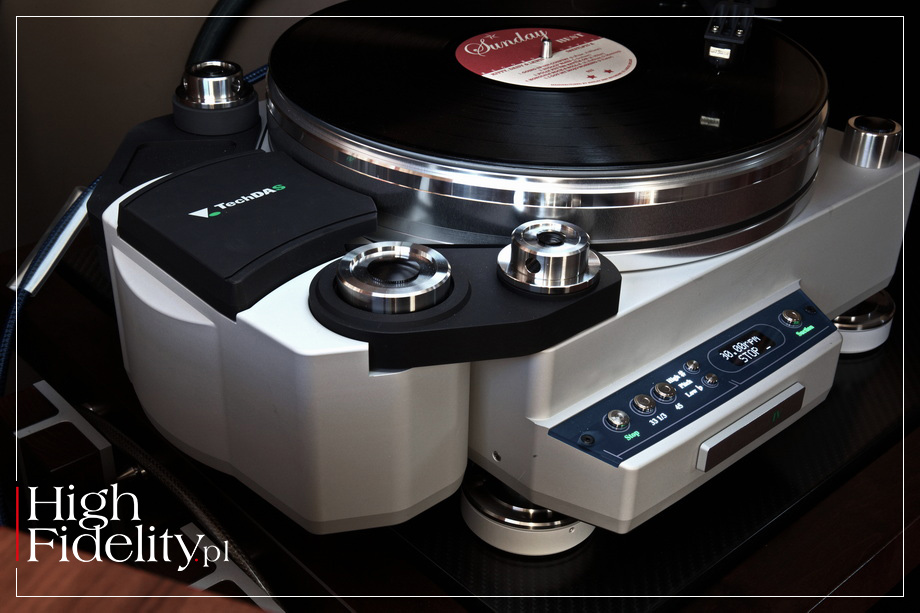
Somehow, I haven't mentioned spatial aspect of the presentation yet. It came to mind as soon as I played the album by the RUDŹ & PAUSZEK duo entitled Panta Rhei. I had to think for a moment why this was the case. It is not as obvious as one might assume. It is not that we sit in front of the speakers and the turntable ‘holographs’ the space in front of us. If I interpret what I hear correctly, my lack of attention to this aspect of playback was the result of the fact that it merged with my room, became one with it, and did not draw attention to itself. Whenever it was deeper on the record – it was also deeper in front of me, whenever it was supposed to be presented close to me, like with Montgomery – the guitar appeared within reach. And with the R&P album, everything was deep and wide, but it was the first time that I heard, that this was how it had been done. Because that was probably the intention of the creators of this album, to surround us with sound in the best possible way, even if it comes from the front. This surrounding would consist of an almost physical pressure on the air, as if it were a thick membrane, a springy object with considerable mass, rather than molecules in which dust particles are suspended. There was a real mass pushing against me. It was also immediately apparent that the turntable handles bass perfectly, that the bass is low, full, and fast. This was also noticeable with Fagen and BB's, but digital systems from that period do not fill the low frequencies as well as the best analog and modern digital systems. The album Panta Rhei is very well recorded, and this was clearly evident. Buy it, and you will be enchanted. And then, if your budget allows, get one of the newer recordings by TSUYOSHI YAMAMOTO TRIO, Blues For K, released by Audionautes Recordings. The thing is, that this pianist's new releases bore me. In my opinion, they are derivative and the production is lacking, i.e., there are no cuts, edits from different takes. And that's always good for music. But this album is different. It is also derivative, but in a deliberate, somewhat thoughtful way. It is retro in expression, but it also has the energy we remember from this musician's recordings, first for TBM and then for Winston Ma's First Impression Music label. I played a 1-Step release test pressing, but the 1-Step album itself is also excellent. And the Air Force IV played it with verve, saturation, dense bass, and a beautifully illuminated, natural treble. ▲ Microtest ACOUSTIC REVIVE PS-DBLP Price: 1150 EUR 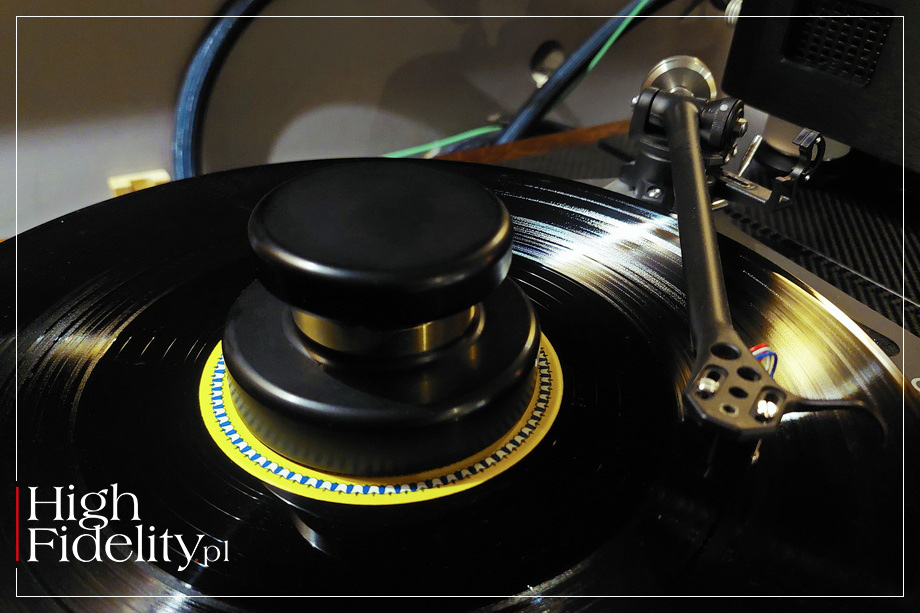
THE ACOUSTIC REVIVE record clamp is made of duralumin and brass, metals selected for their unique resonant properties. The bottom features “precisely designed” geometric grooves, which, according to the manufacturer, “disperse vibrations across the entire surface.” The same grooves can be found in its RKI-5005 pads. Three “resonators” made of smoky quartz are glued to the bottom. Inside, there is a “proprietary” mixture of minerals. I tested the PS-DBLP clamp with both the Air Force IV and Rega P8 turntables. The spindle of the former is conical and narrower than usual, so the clamp was not perfectly centered. However, thanks to its excellent control, this did not have a negative impact on the sound. In general, however, the PS-DBLP should be used with standard diameter spindles. Having said that, I would like to add that in both cases, the clamp changed the sound. It brings order to the sound. If a given turntable already offers an orderly sound, with Acoustic Revive it will be even greater. Although I did not feel that anything was missing in either turntable without it, placing it on the platter clearly improved the separation of instruments, making them more distinct. But also denser. Although it would seem that these two elements are mutually exclusive, this time they were not. And this was clear without much of an effort on my side. 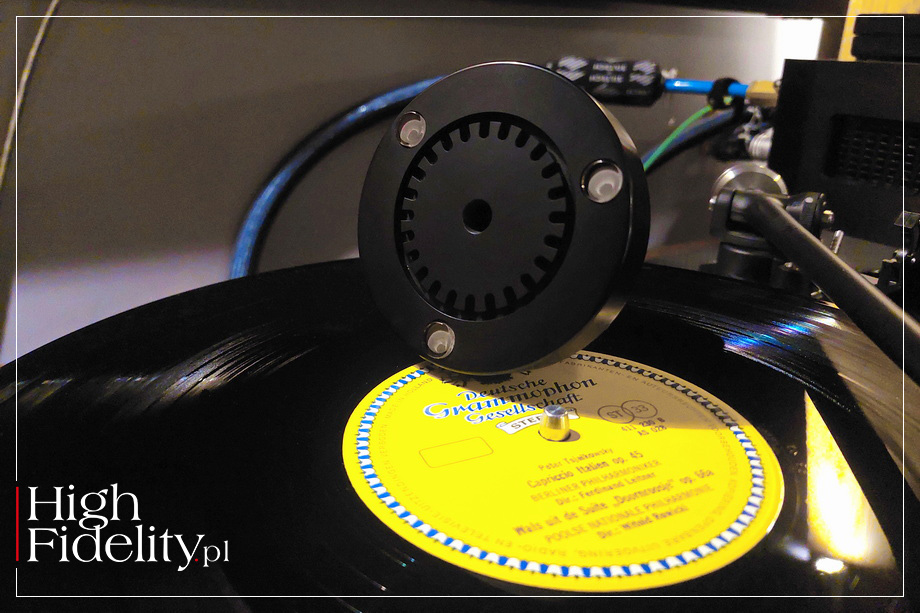
The change consisted of better separation of instruments to make them even more round and “visible.” At the same time, the treble seemed more distinct because they were rich internally, somehow more lively. At first glance, it may seem that something about it warms up the sound, but this is not the case. It enriches it, making it seem even more natural. The vibraphone and cymbals on the Jazz At The Pawnshop, also from Audionautes Recordings, also in the 1-Step version, and also from the test pressing, sounded cleaner and purer with it, but at the same time in a less intrusive way. Again, it's about higher resolution, but also dynamics. The clamp improves both. And it does so in a very organic way, which is not always the case with record clamps. It's a very cool gadget that looks beautiful, is designed with passion, and fits any system and turntable. And it’s limited to only 100 units! ● ▌ Summary TECHDAS TURNTABLES have never been and are unlikely to ever be cheap. Even the most basic model in its range, the V Premium, costs PLN 76,000. The reason for this pricing is the technologies used in them, including the record press-down system, as well as the materials and other technical solutions. All this comes at a price, especially in this version. And yet, the Air Force IV seems particularly well priced. Especially since it sounds great. Its sound combines weight with separation, warmth with resolution, and dynamics with inner calm. It offers top quality playback, in the sense that we play one record after another and, although we know that the turntable plays them in its own way, we can still hear all the details. The IV does not discriminate against poorly recorded albums. You can hear it immediately, that's clear. However, it is not a cry of despair, but a gracious glance. 
It is a wonderful musical tool, confirming Mr. Hideaki Nishikawa's choices and introducing us to the world of high-class sound. And all those warped records, where the ups and downs caused sound distortion, will finally play as they should. A very, very good turntable. Plus, it is a super-compact design. ● ▌ Technical specifications (acc. to the manufacturer)
‖ DECK Polish Distributor
RCM 
THIS TEST HAS BEEN DESIGNED ACCORDING TO THE GUIDELINES adopted by the Association of International Audiophile Publications, an international audio press association concerned with ethical and professional standards in our industry, of which HIGH FIDELITY is a founding member. More about the association and its constituent titles → HERE. |
 |







|
Reference system 2026 |
|
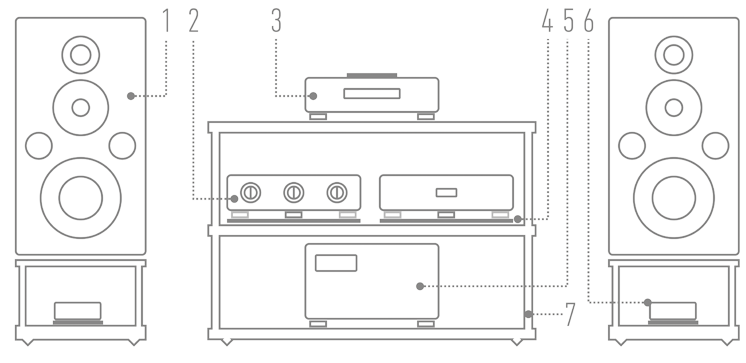 1) Loudspeakers: HARBETH M40.1 |REVIEW| 2) Line preamplifier: AYON AUDIO Spheris III Linestage |REVIEW| 3) Super Audio CD Player: AYON AUDIO CD-35 HF Edition No. 01/50 |REVIEW| 4) Stands (loudspeakers): ACOUSTIC REVIVE (custom) |ABOUT| 5) Power amplifier: SOULUTION 710 6) Loudspeaker filter: SPEC REAL-SOUND PROCESSOR RSP-AZ9EX (prototype) |REVIEW| 7) Hi-Fi rack: Hi-Fi rack: finite elemente MASTER REFERENCE PAGODE EDITION Mk II, more → HERE |
|

|
Cables Analog interconnect SACD Player - Line preamplifier: SILTECH Triple Crown (1 m) |ABOUT|» ANALOG INTERCONNECT Line preamplifier → Power amplifier: Siltech ROYAL SINLGE CROWN RCA; review → HERE Speaker cable: SILTECH Triple Crown (2.5 m) |ABOUT| |

|
AC Power Power cable | Mains Power Distribution Block - SACD Player: SILTECH Triple CrownPower (2 m) |ARTICLE| » POWER CABLE Mains Power Distribution Block → Line preamplifier: Acoustic Revive ABSOLUTE-POWER CORD, review → HERE » POWER CABLE Mains Power Distribution Block → Power amplifier: Acoustic Revive ABSOLUTE-POWER CORD, review → HERE Power cable | Power Receptacle - Mains Power Distribution Block: ACROLINK Mexcel 7N-PC9500 (2 m) |ARTICLE| Power Receptacle: Acoustic Revive RTP-4eu ULTIMATE |REVIEW| » ANTI-VIBRATION PLATFORM under Acoustic Revive RTP-4eu ULTIMATE: Graphite Audio CLASSIC 100 ULTRA, review → HERE Power Supply Conditioner: Acoustic Revive RPC-1 |REVIEW| Power Supply Conditioner: Acoustic Revive RAS-14 Triple-C |REVIEW| Passive filter EMI/RFI: VERICTUM Block |REVIEW| |

|
Anti-vibration Speaker stands: ACOUSTIC REVIVE (custom)Hi-Fi rack: finite elemente MASTER REFERENCE PAGODE EDITION Mk II, more → HERE Anti-vibration platforms: ACOUSTIC REVIVE RAF-48H |ARTICLE| » ANTI-VIBRATIONAL FEET: |

|
Analogue Phono preamplifier: Phono cartridges:
Clamp: PATHE WINGS Titanium PW-Ti 770 | Limited Edition Record mats:
|

|
Headphones » HEADPHONE AMPLIFIER: Leben CS-600X, review → HEREHeadphones: Headphone Cables: Forza AudioWorks NOIR HYBRID HPC |