


|
HEADPHONES ⸜ over-ear, dynamic PALMA
Manufacturer: TAJADA HOUSE S.L.U. |

 |
 |
 |
 |
|
Review
text by WOJCIECH PACUŁA |

|
No 263 April 1, 2026 |
EVERYWHERE YOU LOOK, the story of the Spanish brand Palma is presented in the same way. Here are two friends, Mario and Pascuala, who, after more than three years of development work, created the “world’s first” headphones capable of switching between open and closed modes. Jaume, a sound engineer based at Calma Estudis studio in Mallorca and an “expert with extensive experience” in professional audio, participated in their development and helped design it. 
We do not know the names of these friends, nor any further details about the brand, other than that it belongs to Tejada House, based in Palma de Mallorca in the Balearic Islands. But such a founding myth is understandable. The company is entering a world saturated with headphones like never before in history. In a world where a handful of manufacturers have dominated the professional and consumer markets, including the audiophile sector. Let’s mention brands like Audeze, Hifiman, Sennheiser, and Beyerdynamic, and we’re barely scratching the surface of what’s currently happening. A strong entrance and a bit of mystery are therefore a sensible strategy. ▓ DHS-1 FOR THE FIRST TIME, the DHS-1 headphones (Convertible High-End Headphones) were officially unveiled on September 18, 2024. This is the first and still the only product from the Palma Audio brand. And it’s a high-end one right from the start. We’re talking about an over-ear design with single dynamic drivers. Usually, the third attribute of headphones—after the way they sit on or in the ear and the type of driver—is the driver’s impedance. Here, it’s not that simple. ▲ Open-back closed-back 
‖ The Sennheiser HD800S headphones are a classic example of an open-back design • Photo courtesy of Sennheiser THE MOST COMMON types of headphones are open-back and closed-back designs. Semi-open models are much less common; today, the most notable example is the Beyerdynamic DT-880, while in the past, there were the AKG K240 Sextett and the Fostex T50RP. Even more unique are headphones with a bass-reflex enclosure—here, the DT-770 Pro, again from Beyerdynamic, comes to mind. 
‖ The Audio-Technica ATH-WP900 headphones, on the other hand, are an example of an open-back design • Photo courtesy of Audio-Technica They all differ in the way the back of the diaphragm is loaded. In open-back models, it is only covered by a mesh or thin fabric and is open to the outside world, into which it radiates energy. In closed-back designs, it is damped and—as the name suggests—enclosed. Both approaches have their pros and cons. The first allows for long listening sessions without fatigue. The sound is better decoupled from the head, which is of considerable importance for spatial imaging. However, the bass from such designs usually has less mass, and everyone around us hears what we hear, while we hear what they hear. The closed design frees the listener from the influence of their surroundings, but it also causes discomfort during long listening sessions and reduces the diaphragm’s response speed. 
‖ The rare bass-reflex headphones, Beyerdynamic DT-770 Pro • Photo courtesy of Beyerdynamic The DHS-1 is designed to allow you to listen to music with either open or closed ear cups. A rotating metal cover with cutouts is used to switch between modes. The press materials state:
As soon as we rotate the shutter discs and open up the chambers, we lose 80% of the unwanted waves, creating the sensation that we are in a large space. Thus, as a consequence of this loss, we’ll have clean and more defined waves. This is the reason why most people prefer to listen to their favorite music in open mode. However, this modality isn’t highly recommended when we’re around other people.
⸜ How it works?, → www.PALMA.audio, accessed: 18.02.2026. The manufacturer proudly claims that these are the “world’s first” headphones of this type, which is not entirely true. Let’s recall that as early as October 2014, during the Rocky Mountain Audio Fest, Hifiman unveiled the Edition S model, which also allowed users to select a listening mode. This was achieved using a metal cover plate attached with magnets to close the ear cups when necessary; you can find High Fidelity’s review → HERE ˻PL˺. As the diaphragm load changes, so do the measurable parameters of the DSH-1. The frequency response shifts from 2 to 35,000 Hz in open mode to 10–30,000 Hz in closed mode, suggesting a wider bandwidth in the former. In closed-back mode, however, sensitivity is higher, at 109 dB/1 mW, decreasing to 107 dB/1 mW in open-back mode. Their low impedance of 32 Ω suggests that they are also intended for use with portable devices. 
The DHS-1 weighs 490 g, making it moderately heavy. For comparison, the Sennheiser HD800 weighs 330 g, and the Audeze LCD-3 weighs 550 g. DRIVERS • According to the company’s materials, at the heart of the Palma model is a driver with a neodymium magnet and a 26-mm voice coil, which drives a 50-mm composite diaphragm. This diaphragm is made of two different materials. The large central dome is constructed from pressed rigid cellulose, which is designed to prevent “bending during movement” and “reduce inter-modulation distortion.” In turn, the suspension ring features an ultra-thin polyamide coating to “reduce inertia and minimize mechanical fatigue,” while also enabling it to “handle very high power without saturation.” The manufacturer assures that low impedance, combined with coil inductance below 0.1 mH, guarantees “optimal performance” even with low-damping-factor amplification systems, as is typically the case with integrated amplifiers that use a passive attenuator on the headphone output. EAR CUPS • The drivers are screwed onto a plastic component. It looks as if it were made using a 3D printer, which makes perfect sense. This technology allows for rapid prototyping and small-batch production while keeping costs down. The ear cups, on the other hand, are made of wood. This concept has been around since the very beginning of audio. Today, we most often see them in models from the Romanian company Meze Audio, but the Japanese company Audio-Technica offers equally impressive models. Fostex, Grado, and Erzetich also have them. In the Spanish headphones, they have been milled from sapele wood. Sapele is an African wood prized by luthiers for its acoustic properties and attractive reddish hue. The manufacturer states that its rigidity and density allow for “very precise machining,” which is important for the housing’s special features, and that “it retains these properties throughout its useful life.” And further:
The choice of sapele wood has been based precisely on its musicality, a key element since, unlike other headphones, the DHS-1 enclosures have been designed as acoustic boxes and play a fundamental role in the resulting sound.
⸜ Ibidem. Holes of various diameters have been drilled into the ear cups, matching the corresponding holes in the metal grille. When we turn them, the holes close. When we turn them again, they align with their counterparts, opening the enclosure to a certain extent. The interior of the ear cups, therefore, has a volume specifically designed by the engineers. It is dampened with a layer of synthetic wool, similar to the interior of the speaker cabinets. According to the manufacturer, the starting point for the technical solution they chose was an idea to design the headphones with an emphasis on their internal acoustic chamber, “envisioning the housing design as acoustic boxes that would provide optimal sound in both open and closed modes.” The headband fits snugly against the head and is covered in synthetic leather. The soft parts of the ear cups are made of the same material and contoured so that the drivers are positioned at an angle rather than parallel to the ears. The fit is adjusted by sliding the pins along the guides mounted on the ear cups. Each ear cup is connected by a separate cable with a 2.5 mm mini-jack plug at the end. 
The set includes three cables with 4.4 mm, 3.5 mm, and 6.3 mm plugs. The cables with 3.5 mm and 4.4 mm plugs are 1.2 m long, while the 6.3 mm cable is 2.8 m long. The former are therefore designed for use with portable devices, and the latter for high-end stationary systems. The headphones and cables are stored in soft pouches, which are then placed in a rigid, rectangular case. The tested headphones are truly well built. ▓ SOUND HOW WE LISTENED • I tested the Palma DHS-1 headphones in two systems. The first one was simply the S.M.S.L CD200 CD player (actually an MQA-CD player), which sits to my right and which I use while writing reviews. It features an exceptionally well-designed headphone amplifier with high current output, and it sounds great on its own. The second system consisted of the Ayon Audio CD-35 HF Edition SACD player and a Leben CS-300X Signature Edition amplifier. 
|
My point of reference was the three pairs of headphones I’ve been using for quite some time: the Lime Ears Pneuma in-ear monitors (and, for a short while, the Anima model as well), the HiFiMan HE-1000 v2 magnetostatic headphones, and the Sennheiser HD 800 dynamic headphones: • LIME EARS Pneuma – IEM dynamic design, impedance: 7/9 Ω at 500 Hz (switchable), sensitivity: 115 dB/V SPL, tested → HERE ˻PL˺, I also dug out my oldest headphones, which are over thirty years old: the AKG K271 Studio and the Beyerdynamic DT-990 Pro (600 Ω). 
» RECORDINGS USED FOR THE TEST ⸜ a selection
⸜ DIANA KRALL, This Dream of You, Verve Records/Universal Music Group UCCV-1181, SHM-CD ⸜ 2020. THE SOUND OF SPANISH HEADPHONES is completely different from what we’ve come to expect from Hifiman’s planar designs, Sennheiser’s dynamic models, or Beyerdynamic’s cans. It’s a midrange-focused sound, where after switching from any well-known model—be it the HE-1000 v2, HD-800, or DT-770—we need a moment to reorient and readjust our ears. As I said, these are designs that emphasize the midrange above all else. And we could leave it at that if this were a brief listening session in a store and we had no other tools for comparison. And yet there is a group of products that perfectly fit this description and are just as classic (perhaps even more so) than the models mentioned. These would be the AKG K271 and Beyerdynamic DT-990 Pro (600 Ω) studio headphones. 
I know both quite well, as I’ve been using them for, let’s say, thirty years. I’ve also used them in the studio, though for various reasons. AKG is the “workhorse” of studios worldwide, found both in the control room and in the recording studio, on musicians’ heads. They have a closed-back design and are mechanically durable. They also sound quite good as long as they are correctly driven. Beyerdynamic headphones, on the other hand, are an open-back design and allow for long periods of use—they are used exclusively on the production side of the glass partition. Just a few minutes spent with the Spanish DHS-1s connected either to the Leben CS-300X (Signature Version) tube amplifier or to the solid-state output of the S.M.S.L CD-200 CD player, and I felt as if I were listening again to the Adam Królik guitars recorded for Renata Przemyk’s album Andergrant (1996), where I was an assistant to producer and composer Bolek Rawski, as if I were eavesdropping on an orchestra rehearsal at the Juliusz Słowacki Theater in Kraków before a concert conducted by Krzysztof Penderecki in the second half of the 1990s (also as an assistant). That is why DIANA KRALL’s voice on the This Dream of You was so creamy and effortless. It was an effortlessness stemming not from brightness, but from the full frequency range. The “midrange focus” I’m referring to in this context is not a narrowing of the frequency range, but—paradoxically—its expansion. When we cut out part of the midrange, say at 400 and 600 Hz, we get a “studio” sound—the kind we’re accustomed to when listening to recordings. Let’s set the parametric EQ knobs on the mixing console back to the “flat” position, and the sound will become fuller; and while it won’t be “studio-like” anymore, the sound will gain richness. This, I’ll say it again (but it needs to be said), is a paradox. The people who designed headphones in the last century understood this well, and, from what I hear, the folks at Palm did, too. The sound of this type is highly resolving, let there be no doubt about that. But it is also absolutely non-selective, at least in the way we’ve grown accustomed to. Detailed, because not only the violin in ˻ 6 ˺ Just You, Just Me, a cover of a song composed by Jesse Greer back in 1929 for the musical Marianne, but also CHET BAKER’s vocals from the Chet Baker with Fifty Italian Strings were clearly “different” from the rest of the track. In both cases, it was clear that both the violin and the vocals had been recorded in an isolated room. Hence, the short reverb and the sense of the sound being “enclosed.” But the Spanish headphones didn’t enclose it any further; They did something else—they opened the whole thing up to various interpretations. Because one might think that they established the axis of the recordings. They placed the instrument directly in front of me, since it was positioned on the axis, and the vocals indirectly, since they were assigned to a single channel in the stereo mix. In both cases, the sound was extremely unobtrusive. When I reached for PANTERA’s less “sonically friendly” album Reinventing the Steel, it turned out that these are headphones that need a powerful amplifier, specifically in terms of output voltage rather than current. The same as with the aforementioned AKG and Beyerdynamic models, you can find the story behind the recording of this album in the article on RADAR technology → HERE. Just like those studio classics, the Palma DHS-1 also requires proper amplification. When connected to the headphone output of the S.M.S.L player—a relatively inexpensive device—the headphones under review did not sound sufficiently well-driven. It manifested itself in a flat tonal and dynamic response, and the snare drum hits sounded muffled, as if they were made of plastic. Switching to the Leben—and bam! Everything was back, and the metal bar struck every so often in the left channel in ˻ 1 ˺ Hell Bound had a powerful and resonant attack. The guitars also gained mass and aggression. However, it was a full-bodied sound, meaning without an emphasized treble or upper midrange. And a sound focused on the midrange. Or perhaps it wasn’t even the sound itself, but rather that our attention was directed there. It was as if everything had opened up and as if the extra “drama” introduced by most headphones had been cut out. This “happened” while maintaining high resolution. That is why the very first notes of the synthesizer in ˻ 1 ˺ Synchronicity from THE POLICE’s album of the same title, placed slightly to the left, and the cymbals, slightly to the right, had perfect timbres and were firmly anchored in the soundstage. Once we get used to this sound, everything else will seem superficial. It’s also a bit „screamy," but that’s a secondary issue. With these headphones, we get something deeper and fuller; it’s as if suddenly in ˻ 2 ˺ Walking in Your Footsteps from the same album, we could hear a whole host of new sounds. 
The latest remaster of this album, released in Japan on SHM-CD, sounds quite bright. That’s how the original recording was, and that’s how the new master sounds. But who knows—maybe it was remastered using headphones of this type, namely the AKG K271 and Beyerdynamic DT-990 Pro. Now, with the DHS-1, the balance was perfect, and the earlier brightness turned out to be clarity and precision. The fact is that dark-sounding albums—take the aforementioned Chet Baker, for example—as well as albums with a warm sound will not be limited from the top of the range. With the Spanish headphones, their sound will become full and rich, but it won’t be muffled. This is interesting because, after all, audio products that emphasize the “midrange” are by definition “warm,” right? Well, true, but not always, so it’s more of a half-truth. In this case, you can hear—and hear it perfectly—that other aspects influence the perception of tone, not just the emphasis or attenuation of high and low frequencies. The latter are strong and dense with the DHS-1, but they never draw attention to themselves. Unless that was the engineer’s intention, as in ˻ 2 ˺ Use Mefrom PATRICIA BARBER’s Companion. Nothing is missing from this sound, and we get things that aren’t fully audible with other designs, though—considering what I said about timbre—it should be the other way around. The same goes for the soundstage. These are headphones that place the sound slightly in front of us, without pinning it down in the center of the head. They don’t deceive; rather, they let everything resonate in its own acoustic space without exaggerating it, in a calm, balanced way. With binaural recordings—for example, from the ART TATUM’S album Piano Starts Here, recorded using a Yamaha Disklavier piano with perforated tape—the sound will lack that “boxy” quality; it will be open. However, this isn’t achieved by spreading the sound across the soundstage. The instrument had mass, weight, and “gravity.” It was presented close to me, though without being intrusive. It was a natural, cool sound with a close, natural perspective. OPEN/CLOSED A feature that this manufacturer highlights at every turn is the ability to switch the design of the tested headphones from open to closed. While not a new concept in itself, it is executed very well here. After closing the ear cups, the sound becomes slightly richer and more saturated. But this does not change the tonal character as such. It is more of a change in the volume of instruments and vocals rather than in their bass performance. Reopening the ear cups releases the sound spatially; the sound sources are placed slightly farther away from us. However, this is not a significant change. In both cases—with the ear cups closed and open—the tonal balance is, generally speaking, very similar. The same goes for dynamics. There are differences, but they are subtle. However, since they exist, you can take advantage of them: in “closed” mode, you can really crank up recordings with a lighter tonal balance, and in “open” mode, you can enjoy greater spatial depth. ▒ Summary SPANISH DESIGNS exemplify a different approach to sound than the one that has long prevailed in the audio world. This is a nod to a sound signature developed as early as the 1950s and continued through the 1990s, exemplified by the AKG K271 and Beyerdynamic DT-990 Pro (600 Ω). But also by contemporary designs from the Japanese company Final, particularly the DX6000. The sound is non-mechanical and focused on the midrange. It features both crisp highs and deep lows, but these are not “equalized” or artificially boosted. So you can hear far more nuances with them than with classic models from other companies. They require a powerful amplifier; without it, we won’t get very far. Their most important feature—the change in how they operate—doesn’t alter the sound in any obvious way. It corrects the lower midrange and bass, slightly changes the soundstage, but the overall balance remains unchanged. And that’s probably what the manufacturers intended. 
Give these headphones a listen—they’re truly reference-grade—and there’s a good chance you’ll learn something new. And it’s worth it. This is a completely different take on sound from what is currently mainstream, reminiscent of the sound presentation we get from open-baffle speakers. Relaxed, full, natural, and pleasant. Truly exceptional. ‖ WP ▒ Technical specifications (according to the manufacturer)
Frequency range (open back): 2–35 000 Hz 
THIS TEST HAS BEEN DESIGNED ACCORDING TO THE GUIDELINES adopted by the Association of International Audiophile Publications, an international audio press association concerned with ethical and professional standards in our industry, of which HIGH FIDELITY is a founding member. More about the association and its constituent titles → HERE. |
 |



|
Reference system 2026 |
|
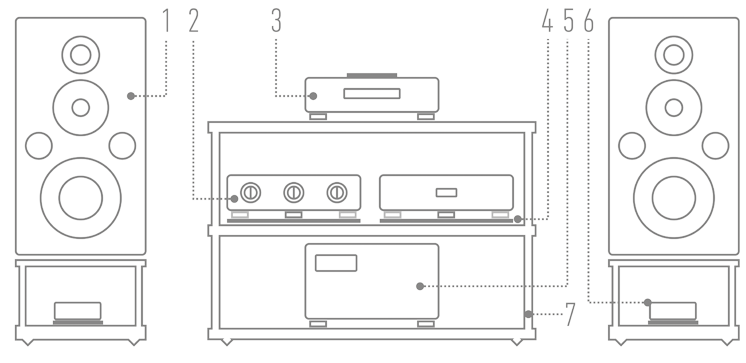 1) Loudspeakers: HARBETH M40.1 |REVIEW| 2) Line preamplifier: AYON AUDIO Spheris III Linestage |REVIEW| 3) Super Audio CD Player: AYON AUDIO CD-35 HF Edition No. 01/50 |REVIEW| 4) Stands (loudspeakers): ACOUSTIC REVIVE (custom) |ABOUT| 5) Power amplifier: SOULUTION 710 6) Loudspeaker filter: SPEC REAL-SOUND PROCESSOR RSP-AZ9EX (prototype) |REVIEW| 7) Hi-Fi rack: Hi-Fi rack: finite elemente MASTER REFERENCE PAGODE EDITION Mk II, more → HERE |
|

|
Cables Analog interconnect SACD Player - Line preamplifier: SILTECH Triple Crown (1 m) |ABOUT|» ANALOG INTERCONNECT Line preamplifier → Power amplifier: Siltech ROYAL SINLGE CROWN RCA; review → HERE Speaker cable: SILTECH Triple Crown (2.5 m) |ABOUT| |

|
AC Power Power cable | Mains Power Distribution Block - SACD Player: SILTECH Triple CrownPower (2 m) |ARTICLE| » POWER CABLE Mains Power Distribution Block → Line preamplifier: Acoustic Revive ABSOLUTE-POWER CORD, review → HERE » POWER CABLE Mains Power Distribution Block → Power amplifier: Acoustic Revive ABSOLUTE-POWER CORD, review → HERE Power cable | Power Receptacle - Mains Power Distribution Block: ACROLINK Mexcel 7N-PC9500 (2 m) |ARTICLE| Power Receptacle: Acoustic Revive RTP-4eu ULTIMATE |REVIEW| » ANTI-VIBRATION PLATFORM under Acoustic Revive RTP-4eu ULTIMATE: Graphite Audio CLASSIC 100 ULTRA, review → HERE Power Supply Conditioner: Acoustic Revive RPC-1 |REVIEW| Power Supply Conditioner: Acoustic Revive RAS-14 Triple-C |REVIEW| Passive filter EMI/RFI: VERICTUM Block |REVIEW| |

|
Anti-vibration Speaker stands: ACOUSTIC REVIVE (custom)Hi-Fi rack: finite elemente MASTER REFERENCE PAGODE EDITION Mk II, more → HERE Anti-vibration platforms: ACOUSTIC REVIVE RAF-48H |ARTICLE| » ANTI-VIBRATIONAL FEET: |

|
Analogue Phono preamplifier: Phono cartridges:
Clamp: PATHE WINGS Titanium PW-Ti 770 | Limited Edition Record mats:
|

|
Headphones » HEADPHONE AMPLIFIER: Leben CS-600X, review → HEREHeadphones: Headphone Cables: Forza AudioWorks NOIR HYBRID HPC |