

|
POWER AMPLIFIER • stereo SOULUTION
Manufacturer: C/O SPEMOT AG |

 |
 |
 |
|
Review
text by WOJCIECH PACUŁA |

|
No 263 April 1, 2026 |
THE 717 is a stereo power amplifier and belongs to a select group of products referred to as “ultra high-end.” It was designed alongside the 727 preamplifier by FABIAN MORANT. 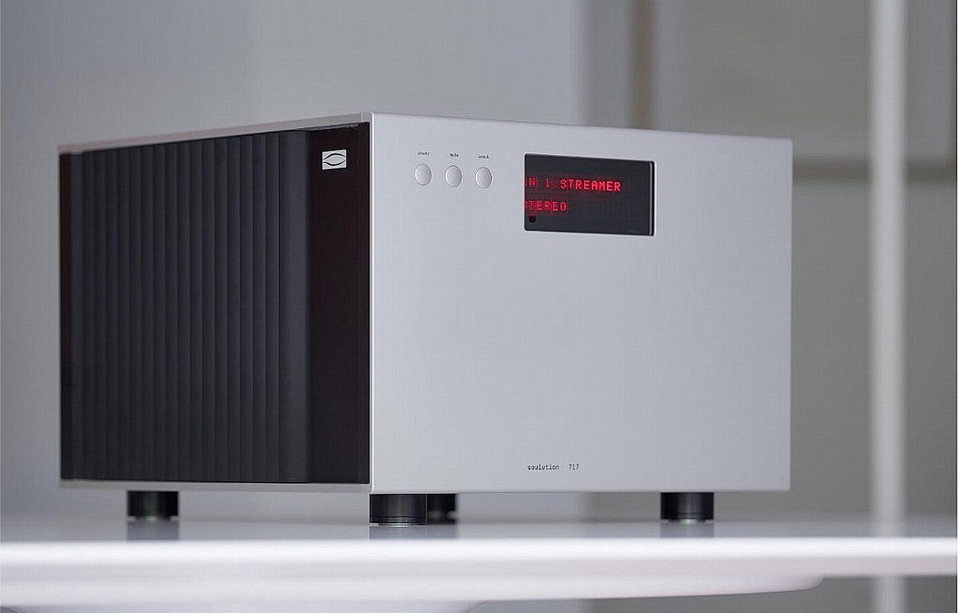
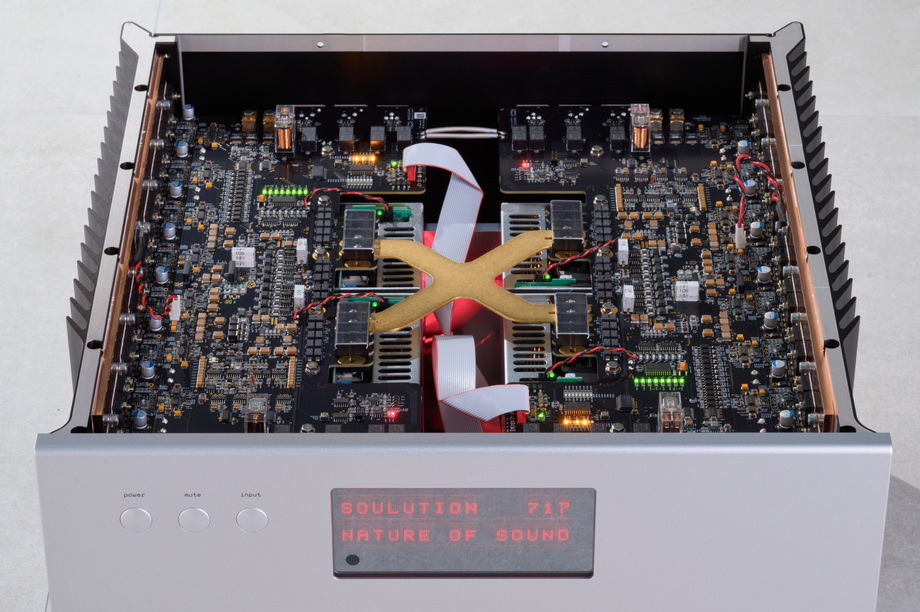
It is a huge device. It measures 480 x 530 x 350 mm and weighs 50 kg. It delivers 2 x 150 W at 8 Ω and 2 x 600 W at 2 Ω, and when bridged, 600 W and 2400 W, respectively. Its frequency response ranges from DC to 2 MHz; the output damping factor is >10,000, and the input impedance is 4 MΩ. I have never seen specifications like these in a single device's description. However, we will pay for this, and we will pay a lot – the 717 amplifier costs 420,000 PLN. However, it comes with a price, a steep price – the 717 amplifier costs 420,000 PLN. ▓ Background The SOULUTION brand is the brainchild of Cyrill Hammer Jr. and Roland Manz, the owners of Spemot. In addition to their work at the parent company, they also distributed audio products in Switzerland, including those from the German brand Audiolabor. After some time, they bought the company and hired Christoph Schürmann, its former owner, as chief engineer. He designed two iconic amplifiers that propelled the company into the exclusive world of high-end audio: the 710 stereo power amplifier and the 700 monoblocks. As we have written before, Soulution is an “engineer-driven” company, and an innovative one at that. Its owners were therefore focused on designing devices with the best possible measurable parameters and then confronting the measurements with the results of listening sessions. This is how amplifiers with exceptionally refined performance were developed – a frequency response from DC to 800 kHz, a damping factor >10,000, negligible distortion, and extremely high dynamics. A Class AB push-pull amplifier is particularly susceptible to several specific types of distortion, the most troublesome of which are those related to the zero-crossing, thermal “drift” of the amplifier circuits, and power supply efficiency. The latter problem is the easiest to solve, though it is also the most expensive. In a Class AB amplifier, the current draw by the gain circuit is dynamic and depends on the input signal. Therefore, it is assumed that the circuit will very rarely require maximum power, and cost-saving measures are taken in the power supply by reducing the size of transformers, capacitor capacity, etc. Soulution uses power supplies that exceed the maximum power draw by several times. To minimize residual distortion, a technique widely criticized in the audio world was employed: negative feedback. This solution involves feeding a small portion of the output signal back to the input, minimizing noise and distortion while broadening the frequency response. However, if used improperly, it causes Transient Intermodulation Distortion (TIM), which is particularly unpleasant for listeners. But if done correctly, then… As Jonathan Valin wrote, when the editor of the German magazine “Stereo” measured the “710,” he was so impressed that he framed the results and hung them above the measurement system as a reference (The Absolute Sound’s Illustrated History of High-End Audio. Volume Two: Electronics, p. 298). At Soulution, it was assumed that the problem was not the feedback itself, but its inertia (too slow a response time). Consequently, circuits were designed with exceptionally fast rise times – measuring just a few centimeters from input to output – optimized for an ultra-wide frequency response (and here even the shape of the traces, their bends, etc., become significant) with such a fast response time that – as the manufacturer assured – the listener is unable to detect the delay resulting from feeding the output signal back to the input. When we look at Soulution amplifiers, we usually react in one of two ways. For most people, mainly those who are not familiar with audio or whose education in this field ended in the Technics era, it is a cross between an oven and a refrigerator. Flat fronts with rectangular, dark displays, black side panels – all of this adds up to a simple, even ascetic design. And this design doesn’t immediately reveal what we’re dealing with. Some see added value in this form, contrasting it with “baroque-style” designs (MBL), postmodern whims (Wadax), and above all, the aesthetic canons that have prevailed since the 1970s, according to which audio products are a kind of equipment representing science – and thus the laboratory. This trend was most evident in amplifiers from McIntosh (MC2205) and Audio Research Corporation (D150), but it has been widely used. As you can see, Soulution positioned itself as an ultra-modern manufacturer of devices where sound is the only thing that matters, and their design – inspired by Scandinavian style – was meant to “take a back seat” rather than impose itself. Yeah, right… Except that… 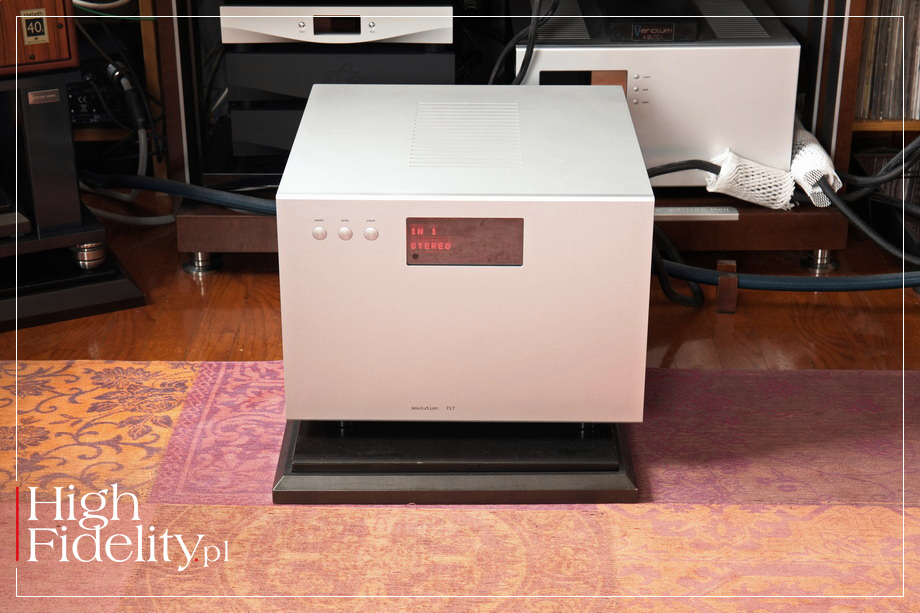
Minimalism isn’t really a style. As the authors of an article published in “The Guardian” titled To be minimalist ... or maximalist?, we should “move away from viewing minimalism as a style and instead understand it as a way of thinking about space: its proportions, surfaces, and the way light falls” (more → HERE ). Minimalism, in the case of this manufacturer, would therefore be a deliberate choice. Moreover, it is a well-thought-out choice that requires a great deal of effort and taste behind it. In the case of amplifiers from companies such as Vitus Audio, Perraux, or Soulution, the seemingly simple exterior conceals complex systems resulting from many years of work and money invested in their refinement. Such is also the case with the Swiss company’s latest amplifier, the 717 stereo power amplifier. ▲ Timeline 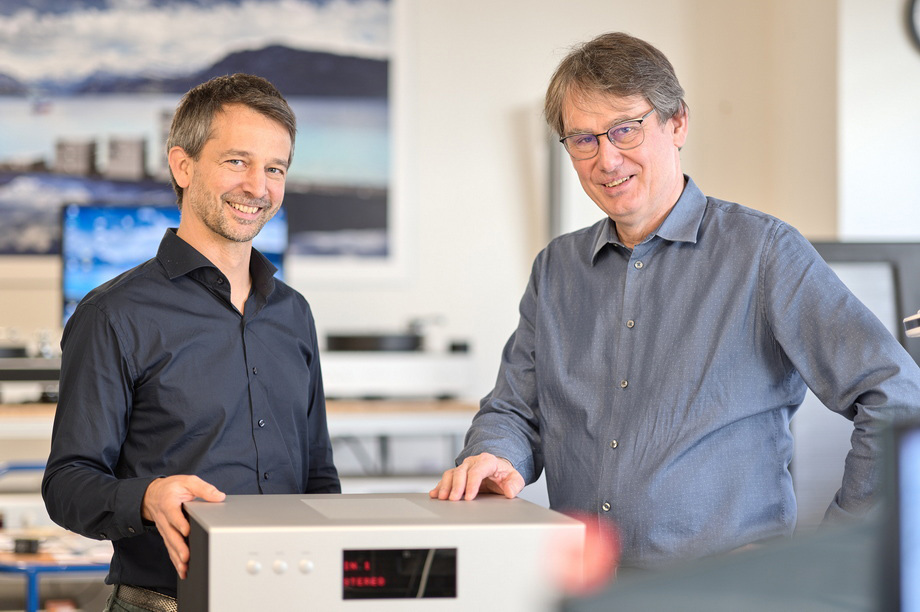
‖ Fabian Morant, designer of the 717 (on the left) and Soulution CEO, Cyril Hammer • photo courtesy of Soulution → 2006: 710 Wide frequency response (1 MHz), ultra-low noise and distortion, stable up to <1 Ω. → 2013: 711 Performance is similar to that of the 710, but with a new switching power supply; the amplifier section remains unchanged. The result is more defined bass and better resolution in the midrange, with a more “musical” sound. → 2024: 711+ Similar to the 711, but featuring a new voltage gain module characterized by a more linear negative feedback and improved transistor temperature management. This results in a more linear phase response, which delivers better bass resolution and a wider soundstage. → 2024: 717 A completely new design – no two components are the same as compared to previous models. ‖ CH 
‖ Fabian Morant, designer of the 717 with his amplifier • photo courtesy of Soulution ▓ 717 THE MODEL 717 IS THE THIRD (and a half) device of its kind at the top of Soulution’s lineup. The first was the 710 power amplifier from 2005, which has served as the foundation of the HIGH FIDELITY reference system since 2011. In 2015, the 711 was introduced, developed by a different team of designers, and was equipped with a switching power supply instead of a linear power supply – an area in which Spemot, the parent company, is exceptionally well-versed. In 2014, the 711+ model was unveiled, featuring an improved power supply, and last year, during the Munich High End Show 2025, a completely new design was presented: the 717, serving as a sort of “anniversary” product. DESIGN • We were talking about the visual design, right? Well, for Soulution, it’s just as important today as it was twenty years ago. Throughout all this time, the overall concept behind the company’s design hasn’t changed. But anyone who has been familiar with the company for a long time knows that while successive generations of its products are similar, they differ in the details. And, just as with watches, fashion, or cars, it is precisely these details that matter most to enthusiasts. Of course, the change in dimensions catches the eye first. The “717” is significantly taller than the 710 and 711 models, so it makes a much bigger impression, measuring (W x H x D): 480 x 350 x 505 (“717”) vs. 480 x 275 x 540 mm (“710”). Instead of flat side panels, they now feature something resembling a heat sink’s “ribs”; the display now occupies the entire ‘window’, and the buttons are larger and arranged horizontally, as are the three previously vertical LEDs. These are small details, but – as I said – significant ones. As Rem Koohaus, the Dutch architect and designer of the Guggenheim Museum in Las Vegas, once said, “minimalism is the ultimate form of ornament,” and Grzegorz Piątek adds in “The Temple and the Dumpster” that modernism in its most luxurious form transforms precisely into minimalism – “simplicity so refined that it becomes expensive.” The design of the 717 amplifier is also no accident. It was created by GBDesign, a Swiss design firm based in Zurich, which describes itself as:
Our project portfolio represents our experience in a wide variety of fields and topics, from tableware and high-end audio to office furniture systems. Every project has its own unique requirements. Creativity begins with allowing questions to be asked. The design process is chaotic and often serendipitous. Our thoughts jump from the small to the large and sometimes get lost. We find what is essential, what is enduring, and what is relevant.
⸜ Studio, → GBDESIGN.ch, accessed: 27.01.2026. The company was tasked with designing a set consisting of the 727 preamplifier, which debuted in May 2024 in Munich and was named “Product of the Year” by "The Absolute Sound” magazine and received the 2024 German Design Award, and a year later, the 717 power amplifier. We read:
The precise design formally and aesthetically communicates the quality, value, and performance of the Soulution devices. The practical and technical functions primarily involve cooling and protecting the high-end electronics. The extruded and milled aluminum parts of the outer shell are joined to form a form-fitting cooling element.
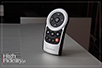
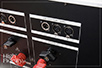
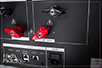
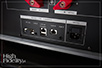
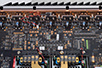
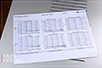
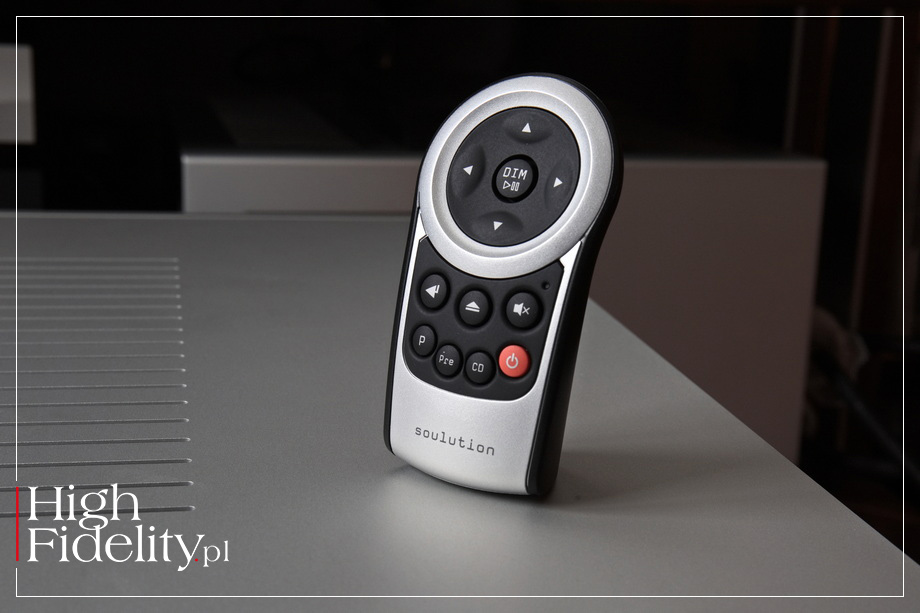
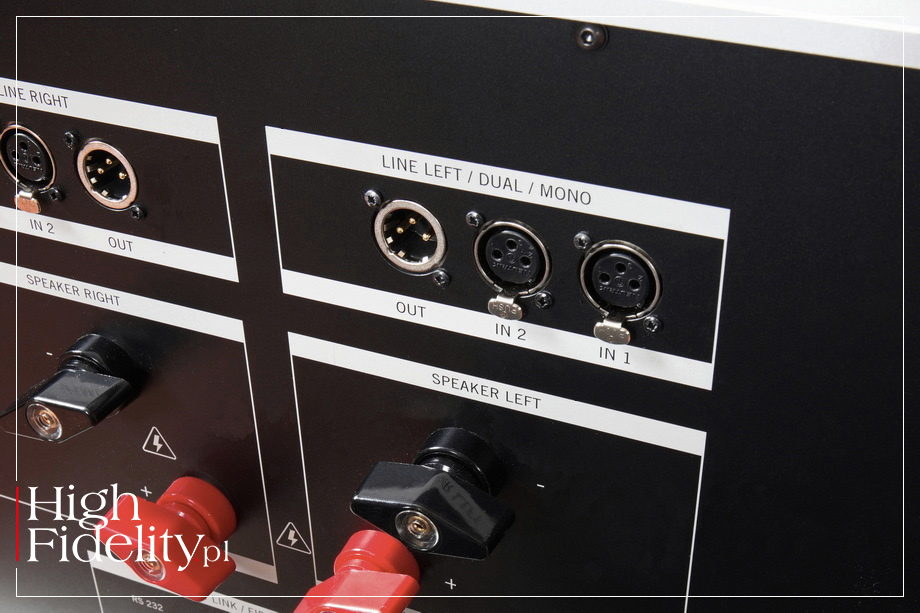
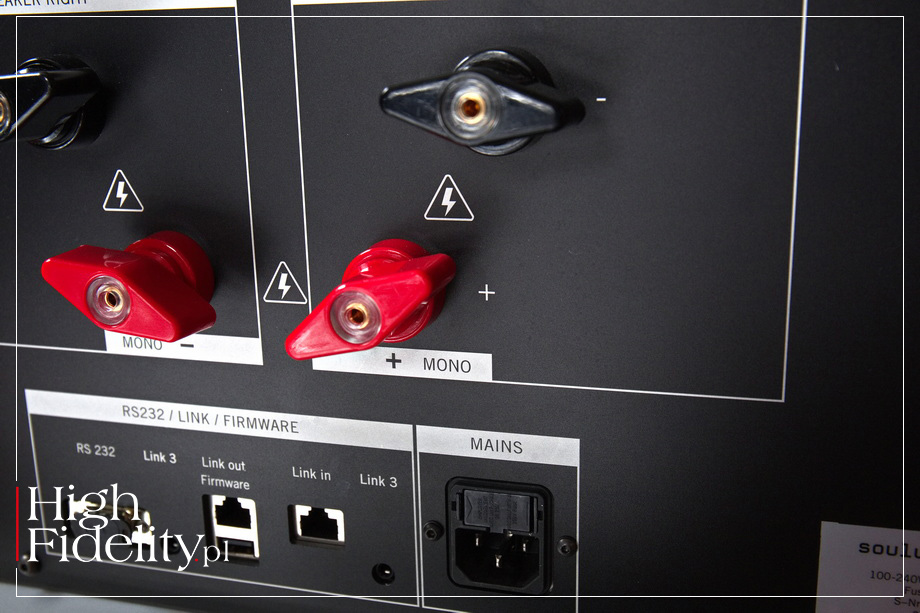
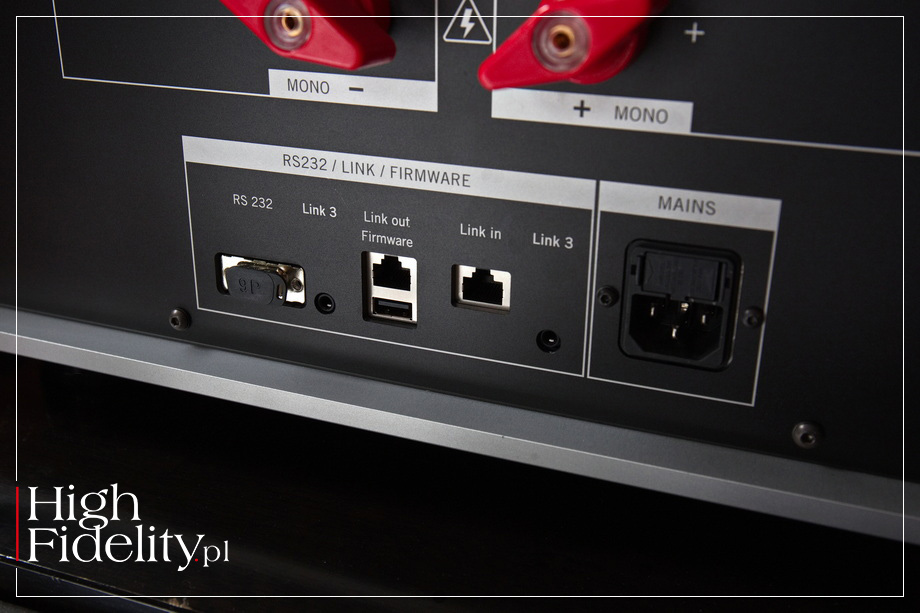
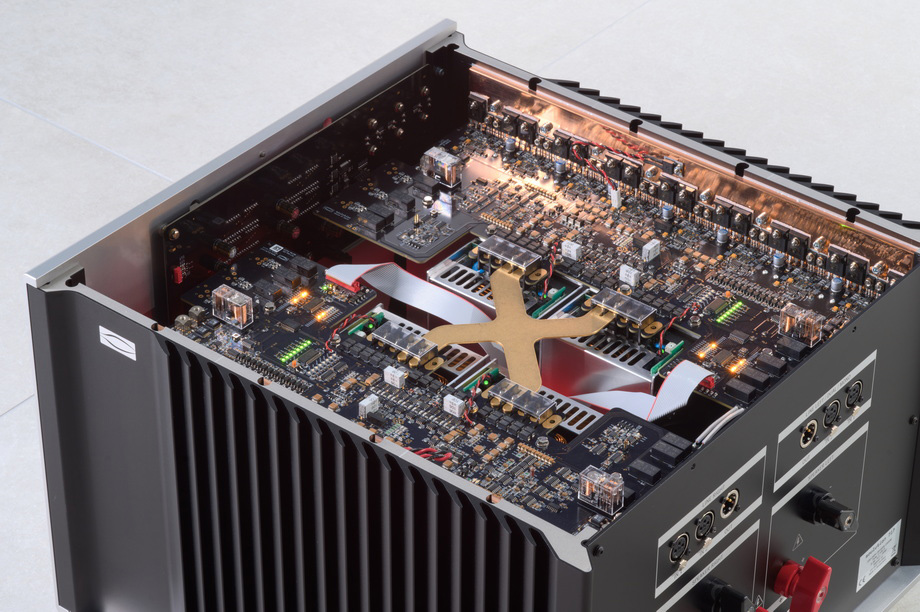
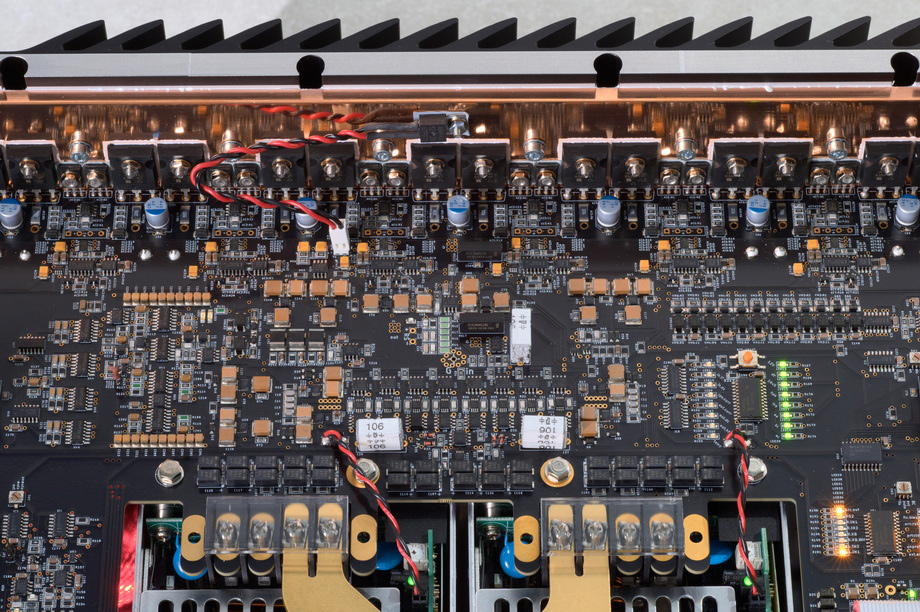
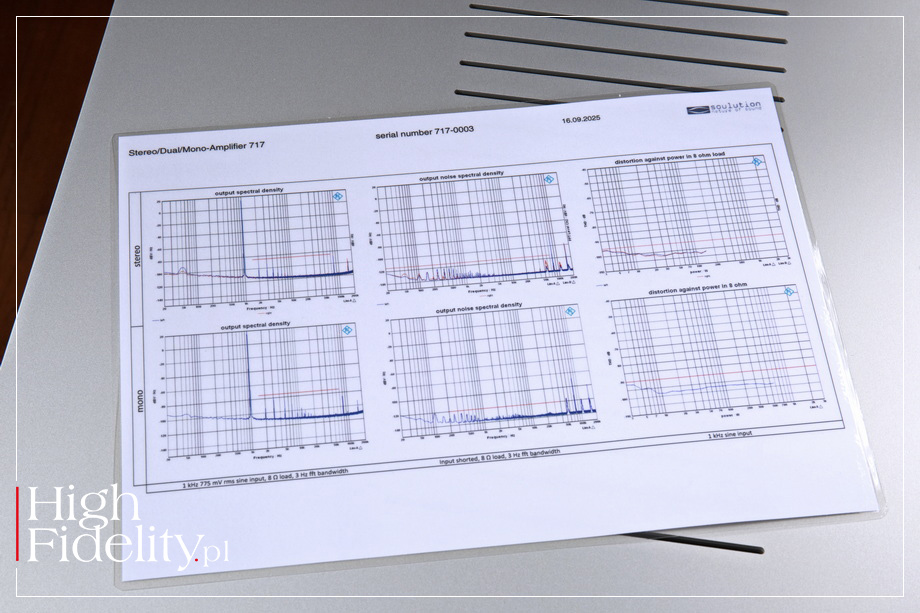
⸜ Soulution, ultra-high-end audio, accessed: 27.01.2026. FEATURES • This is a very good design. It’s clean, yet not “empty,” and represents quite an achievement, since a power amplifier is, almost by definition, just a “box” with a line input and a speaker output. Even in the first generation of its devices, Soulution enhanced the front panel with a ‘window’ behind which sat a small display, accompanied by three LEDs; the entire unit was red. The display showed the selected input – RCA or XLR – whether the unit was on or off, as well as messages regarding the activation of one of the many safety features; I don’t recall ever seeing any of these messages appear on my unit. The window in question was much larger than the messages themselves and served more as a design element, only partially linked to technology and functionality. In the “717,” it is similar in size, yet a dot-matrix display, also in red, occupies its entire surface. After turning on the device and hearing the contactors click rather loudly, a welcome message appears: “Soulution 717 – Nature of Sound,” which is the company’s official slogan. After activating the inputs and outputs – which takes a moment while the device determines and analyzes all voltages – the input number or its name will appear, along with the operating mode (stereo or mono) below it. Regarding the name, the user can, if they wish, assign a separate name to each of the two inputs, for example, DAC or Phono. These two inputs function differently from those in the “710.” There, it was simply a choice between an unbalanced and a balanced input. In theory, you could connect two different devices with volume control to them, but that wasn’t really the point. And, getting back to the display, you can dim it in three steps or turn it off. If I’m reading this correctly, after many years of experience with real-world systems, the company decided to give us a mini-input selector with two positions so that we could connect to the “717,” for example, a DAC and a phono preamp with volume control, or a source with an external preamp and a source with an adjustable output. This creates a system where you can do without an external preamp in both or in one of the cases. The switching can be controlled using the button on the front panel, next to the “Mute” button and the power button, or via the remote control. Yes, the power amplifier we are testing comes with a small remote control, which is also useful for controlling other components from this manufacturer. We can use it to switch between inputs, turn the device on or off, and activate “mute” mode. But we can also use it to change the input name. As we mentioned, there are two inputs, both XLR. And this is, at least for me, a significant change (and a problem). It means that the “717” is designed to work in systems with a balanced signal path. While you can use an RCA-to-XLR adapter, doing so will degrade the sound quality. I should add that there is also an XLR output next to it, which we can use to send the input signal to another power amplifier standing nearby. This way, we can create a bi- or tri-amping system. If these are amplifiers operating in monoblock mode, that means a cost of 1,680,000 PLN for four and – respectively – 2,520,000 PLN for six amplifiers :) That’s a lot of money. Even the manufacturer’s first amplifier had an extensive connectivity system with other system components. That’s the case here as well. On the back, we have connectors for the company’s communication system, Link and Link 3 (for the “3” series), an RS232 port allowing the amplifier to be integrated into a home automation system, as well as a USB port through which we can upload new software to control the device. The amplifier features a single pair of speaker outputs, very robust, with gold-plated copper terminals. You can choose between two different types of terminals – spade terminals or classic acrylic ones. They were supplied by Mundorf. TECHNOLOGY • As we mentioned, the “717” is a stereo power amplifier capable of bridging and mono operation. It is a Class AB device operating in push-pull mode with minimal local negative feedback. Its power output, compared to the “710,” has increased slightly – by 30, 60, and 120 W (8/4/2 Ω) – while its measurable parameters have improved significantly. As the designer, Fabian Morante, explains, the transistors are “heavily” biased toward Class A operation, so the amplifier runs quite hot. What stands out most in the tested unit is the extremely wide frequency response, reaching 2 MHz, as well as noise levels lower than most available measurement systems can measure: <-165 dBV (noise density relative to the input). Each unit is measured individually, and the results are provided on a laminated sheet. Perhaps so you can hang it above the fireplace. The 717 amplifier was designed as a full dual-mono layout, including the power supplies. The left and right channels utilize their own circuit boards, making them completely separate from one another. As stated in the company’s materials, “this ensures significantly better channel separation (> 120 dB) than in previous models.” This is largely attributed to the input stage, built with FET transistors, which the company describes as “innovative.” We read further:
This is achieved with parallelized instrumentation amplifiers designed for wide bandwidth (20MHz), lowest noise, and optimal common mode rejection (CMMR >105dB). This ensures that even the faintest musical signals can be properly received by the 717 power amplifier.
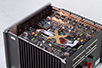
⸜ 717 power amplifier, → SOULUTION-AUDIO.com, accessed: 28.01.2026. According to the company, in the design of amplifiers with negative feedback, higher loop gain is preferable to lower loop gain, provided that the design remains stable. The 717 is designed to meet these standards (in terms of phase coherence and distortion) thanks to a bandwidth exceeding 2 MHz, a loop gain above 120 dB (DC), and “ultra-linear feedback network” The output amplifier stage consists of sixteen MOSFETs per channel (from Vishay), operating in Class AB. A smart bias current control circuit measures the instantaneous current of each individual transistor and controls its idle current, ensuring optimal and identical operating conditions. Short current pulses of 400A and more are readily attainable. For safety reasons, the continuous current output is limited to 32Arms per channel. 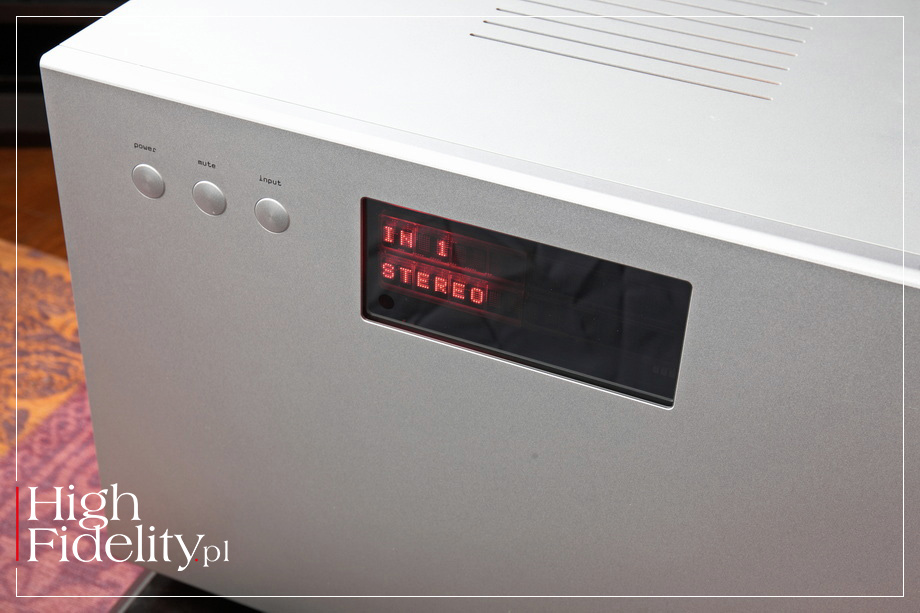
The 710’s power supply utilized a linear one with massive power transformers. With the “711,” switch-mode power supplies were introduced to the company’s product line. As Cyril told me at the time, the goal was to reduce noise and improve dynamics, which they had been unable to achieve with a conventional power supply. So it’s no surprise that the 717 model also features a switching power supply. It consists of four power modules with a peak power of 2100 W (for 5 seconds, two channels, each with a positive and negative rail). The manufacturer writes:
The output impedance of the regulated supply remains ultra-low over the relevant frequency range, which renders large storage capacitors redundant. Distributed local power supplies, with highly efficient DC-DC converters and extremely low-noise, fast linear regulators right next to the sink, power the small signal section of the 717. This ensures the lowest noise and shortest signal paths for the small signal section.
⸜ Ibidem. |
The device features a rigid aluminum chassis and anti-vibration feet consisting of two elements mechanically connected by a pin. It is a rigid structure, reinforced internally with additional components. Only the rear panel seems to me to be insufficiently damped, as it continues to resonate for a moment after being tapped. The circuit is cooled by a fan, just like all other amplifiers in the “7” series – the one here is quieter than in the 710 model and has no vent on the rear panel. As a result, it is much more intuitive and easier to use than the 710. The amplifier is available only in silver, with black sides and back. ▓ SOUND HOW WE LISTENED • The Soulution 717 power amplifier was tested in the “High Fidelity” reference system. It was compared to the reference amplifier, the Soulution 710 transistor power amplifier – in both cases, the signal was transmitted to the speakers via a Siltech Triple Crown speaker cable. 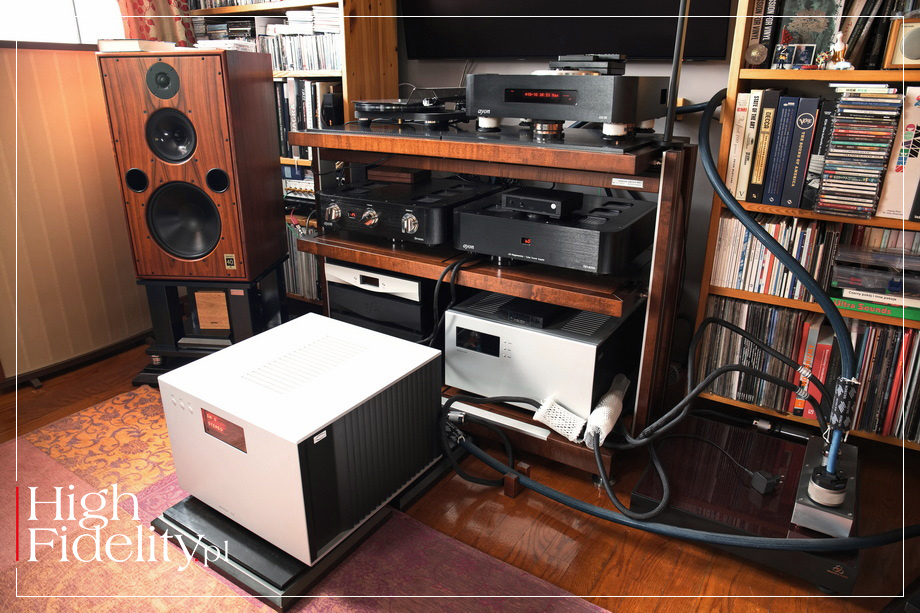
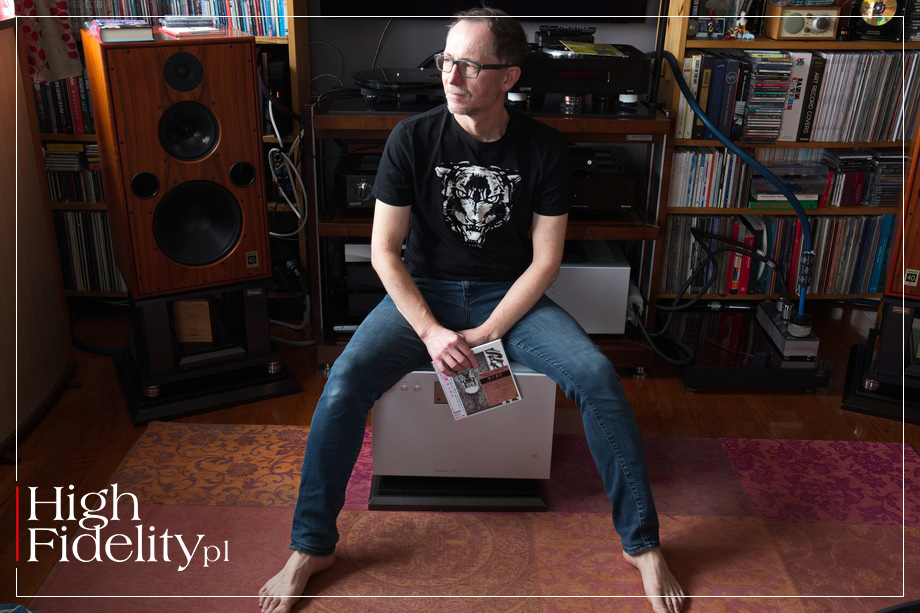
During the test, I used the Ayon Audio CD-35 HF Edition SACD player as the source, connected to the preamplifier via Siltech Triple Crown RCA cables. The preamplifier was an Ayon Audio Spheris Evo, and the signal was sent to the power amplifiers via Siltech Single Crown balanced cables. The amplifier drove Harbeth M40.1 speakers. During the test, the unit stood on Acoustic Revive RST-38H platforms, which were placed on the floor in front of the system. The “717” was powered by an Acoustic Revive Absolute Power cable. 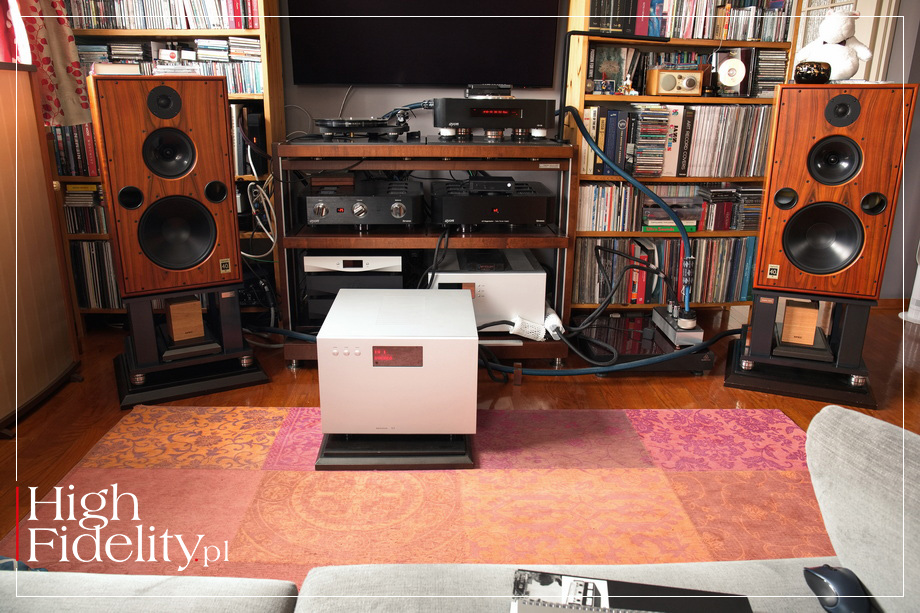
» RECORDINGS USED FOR THE TEST ⸜ a selection
⸜ WES MONTGOMERY & WYNTON KELLY TRIO, Smokin' At The Half Note, Verve/Analogue Productions CVRJ 8633 SA, SACD/CD ⸜ 1965/2013. SO I SIT DOWN IN FRONT OF this massive component, and even though I’m aware of the price tag next to its model number in the catalog, I’m not particularly worried about it. After all, this isn’t the first expensive amplifier in my system, and my “710” isn’t exactly a bargain either. Well, I’m sitting a meter, maybe a meter and a half away from the “717,” and after just a few beats of the drums and tambourine from ˻ 4 ˺ The Gift, a track from Mark Hollis’s album, I know – I know exactly what kind of device this is and how it sounds. 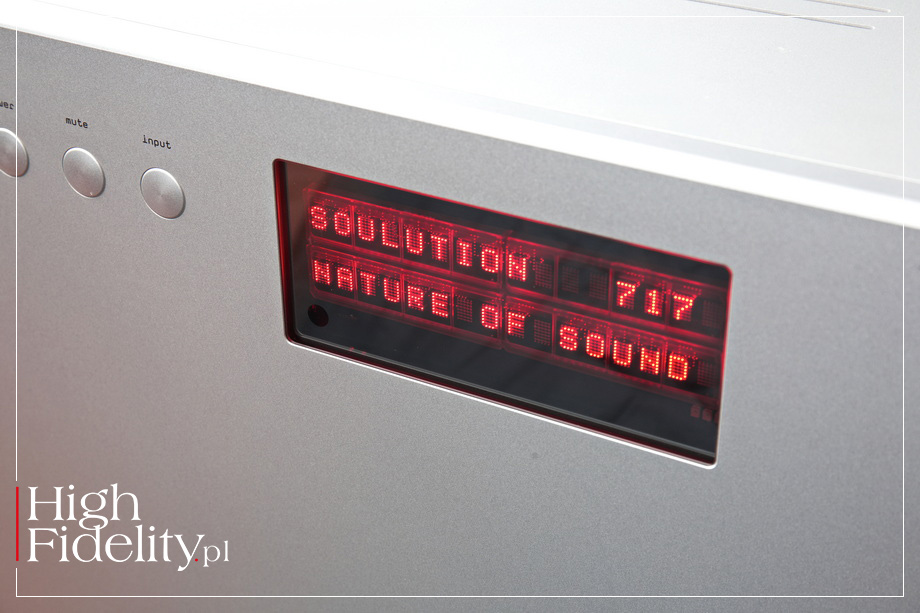
But then I reach for another album, and another, and yet another, and I know less and less. I hear exactly the same thing as when the vocals kick in, when the harmonica comes in on the track mentioned above, and yet I have to reevaluate what I had already organized so neatly in my head. Because testing audio components involves sorting through what you hear, so that in the end you can try to give it some context – that is, interpret and evaluate it. I have no trouble with the evaluation; it’s a blast, the stratosphere, a dream come true. Interpretation is a different story. So, as I said, I sit in front of the Soulution, seemingly unfazed by its size and performance, let alone its price, and yet every now and then I have to glance at it whenever something I didn’t expect flows from the speakers or something I need to think about more deeply. I thought it was because of the display, so similar to the one on the 710 yet different – and thus unsettling – but I did the same thing even after I turned it off. My encounter with this Swiss amplifier turns out to be an opportunity to re-understand the sound of my system and, more generally, ultra-high-end systems, as well as a chance to learn something new. As is usually the case with the most interesting audio products (and “interesting” has nothing to do with price), I learn a lot in the process – both about the equipment and about myself. For example, I actually prefer when the sound has more weight, even at the expense of clarity. But that this can also be balanced by the richness and depth of the sound. These qualities are, in fact, extraordinary in the amplifier under review. The music reaches us as if it were being performed on real instruments rather than generated by speakers. It’s not a cloud of sounds, nor is it a soup, but something in between – jelly, perhaps? I mean something that possesses both vagueness and solidity. The solidity comes from the filled spaces and surfaces, while the vagueness stems from their speed and the multidimensional space in which we perceive them. The instruments have weight, a “foundation” upon which they are built, but also delicate details that contribute to richness – not “detail-orientedness,” as this isn’t that kind of amplifier, but rather “multiplicity.” This is all the more powerful because the speakers literally disappear from the room. Even such large speakers as the Harbeth M40.1. Soulution presents sound in such a way that it blends the acoustics of the recording with what is actually in our room – and that is what makes it unique. My experience so far has been that either our room’s acoustics are replaced by the recording’s space – as if the latter were pushing the air out of our room and offering the recording’s atmosphere in return – or the instruments are placed within our room, with its own acoustics. Both are appealing, and both have their pros and cons. 717 combines these perspectives. The amplifier positioned WES MONTGOMERY’s guitar from ˻ 1 ˺ No Blues, the opening track of the Smokin' At The Half Note, recorded with the Wynton Kelly Trio, positioned at the far left, where it should be, but even closer to the left side of the speaker than usual. Seemingly impossible, since the drivers are on the speaker’s axis, but still. It was as if phase shifts, even the most minimal ones, were recognized by this amplifier and reproduced with ultra-precision. Just like with 300B tube amplifiers. The 710 reveals a bigger instrument’s body, but also connects it more firmly to the speaker. This amplifier sounds much like the way it renders space. That is, it sounds in an effortless yet transparent and open way, and at the same time, it offers excellent differentiation. Much like the best 300B tube amplifiers I’ve heard. Of course, there is no “standard” for this triode; it is used in various ways. But there is a sort of “shared philosophy” that unites the various designs. The first is excellent differentiation, and consequently, insane resolution. The second is effortlessness. And this is how that powerful device, standing – I know I’m repeating myself – right in front of me, sounds. It amplifies the sound as if it were on vacation, if you know what I mean. A great vacation in a place where you want to be, without worrying about money. Meaning without stress, with a smile on your face. Montgomery’s album was partially recorded in a club, and this atmosphere of stress on one hand – the artists, even when they look relaxed, are brimming with emotion – and freedom on the other – they are, after all, top-tier jazz musicians – is perfectly audible. The performance by ARNE DOMNÉRUS and his band from Jazz At The Pawnshop sounded similar. Both of these albums were united by the ease and perfect precision they were played and presented with by 717. But this isn’t surgical precision – a term we usually reserve for devices whose sound has a distinct attack, is selective, and is fast. Neither the best 300B tube amplifiers nor the 717 model sound like that. The reviewed amplifier sounds more rounded, with less aggression in its attack and more silkiness and fluidity. Which, paradoxically, makes it more precise. Because, along with the attack, we also get body and decay – all in one package. 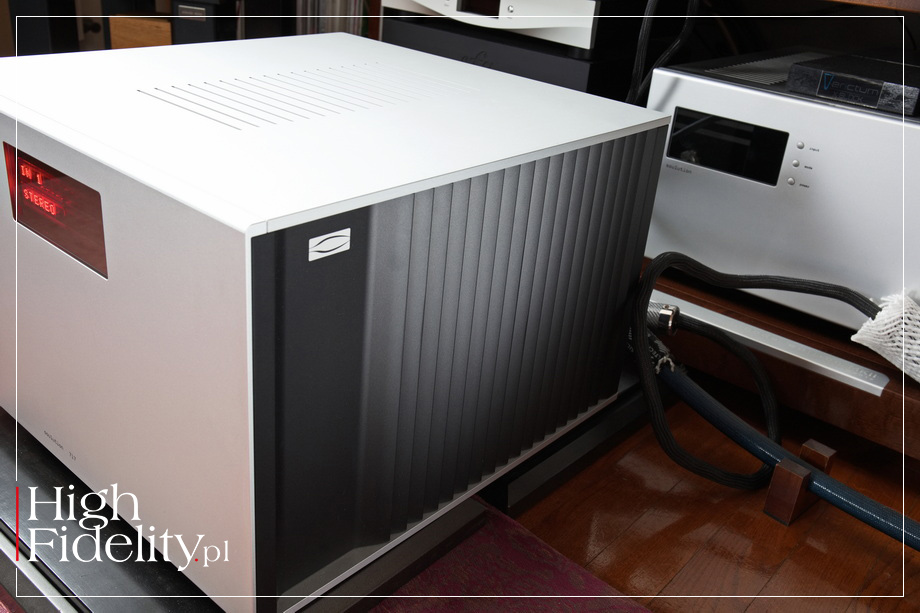
This is, as I see it, in a way, a “tube-like” sound. More in the style of → KONDO ONGAKU than → ANCIENT AUDIO SILVER GRAND MONO II, more like Dan D’Agostino’s components than Naim’s, EL34 tubes rather than KT120s. I know, I know – you don’t hear it that way at shows; systems with Soulution tend to sound rather clear, sometimes bright. But this is similar to the top-of-the-line Harbeths – they also sound light at shows. And yet anyone who has heard them at my place knows that they deliver powerful bass and a strong lower midrange. I perceive the amplifier we’re discussing similarly. This “tube character” would manifest itself in the silkiness and saturation of the midrange. When I listen to FRANK SINATRA on Sinatra Sings Gershwin, especially on ˻ 2 ˺ I’ve Got a Crush on You or ˻ 4 ˺ Someone To Watch Over Me, I can clearly hear the vibrato in his voice; it’s impossible not to notice the Blue-Eyed One’s perfectionism in his phrasing and diction. The Soulution 717 conveys this in a soft, friendly, yet ultra-precise manner. This is because it is – ultimately – a device with negligible distortion. So whether it was the hiss accompanying older recordings or the tape hiss from the aforementioned Hollis album, it was always clear; it wasn’t smoothed over or suppressed. Not through brightening – this is absolutely not a bright amplifier; it’s even the opposite of bright – but through the precise rendering of individual layers. And noise is one of them. In this respect, the device resembles a tool. And yet it’s still musical, incredibly musical. So here I am, sitting in front of this machine, trying this time to grasp the power of its sound. Did I say it was something like a „300B plus” amplifier? – I said it, and it’s true. But what I started with is also true, namely that the amplifier plays with a freedom that most devices I know lack. And not just at the top end of the frequency range, but at the bottom end as well. This is an amplifier that doesn’t pump up the bass and doesn’t saturate it to the point where we feel its pressure on our eardrums, like – for example – my 710, which we’ll come back to later. So when VANGELIS unfolds a cosmos of sounds before me in ˻ 1 ˺ Main Titles, the opening track of his soundtrack for the Blade Runner, and after a moment transitions into the intimacy of ˻ 2 ˺ Blush Response, but an intimacy laced with uncertainty and melancholy, it does it in such a way that I sink into it completely. All the more so because it is pure and unhurried. This is an amplifier capable of delivering a powerful sound. The Harbeth M40.1 speakers make this possible, like few others, aside from the very largest models. The 717 creates a three-dimensional soundstage that extends far back and spreads wide, but also high. This isn’t horizontal sound; it’s a three-dimensional sound. The lowest frequencies are perfectly controlled, yet remain soft rather than hardened, as is often the case. The upper end of the frequency range sounds similarly – smooth and silky, yet open. We get this regardless of what kind of music we’re dealing with or how it was released. It’s not quite the same level of internal “harmony” I get with the 710, but it’s pretty close. This means that when switching from a Crystal Disc featuring a Domnérus concert to MICHAEL JACKSON’s Thriller, when that rocking bass hits in ˻ 6 ˺ Billie Jean, I don’t feel a sense of loss or deficiency, and I’m not stressed out. Most amplifiers, however, emphasize these differences. Soulution showcases them perfectly, and we know this is a multi-track production, with numerous overdubs, copies, and so on. And yet its perfection is what matters most – it’s what drives the music, what draws us into this world. That’s exactly what this amplifier does so well: it creates worlds. Actually, it re-creates them, but it does so well that it can be allowed to name them and present them in its own unique way. Just like a 300B amplifier, with its beautiful midrange, but with a wide frequency range and incredible sound volume. 710 vs 717 • Like any product, the 717 has its own sound signature. In other words, it has characteristics that can be described and compared to other products. This becomes most apparent when we compare it to the 710 model. To an outside observer – someone unfamiliar with systems of this class or with Soulution – the differences between them may seem less important than the sound they produce. And that sound, in my opinion, is top-notch; it represents the pinnacle of what modern audio has to offer. But still, these differences exist and cause us to perceive these devices differently. The older Soulution model produces a more “compressed” sound. That is, it saturates a given section of the soundstage more intensely, though the sounds are less precise and not as well differentiated as with the 717. The bass is more pronounced with the 710, which, combined with a deeper lower midrange, creates a unique sense of energy in the low frequencies – suddenly, the entire air seems to act as a membrane. And that’s the kind of sound I love. The 717 is not quite as ‘boosted’ in those two frequency ranges. It, therefore, seems to have a better tonal balance. That slight “thickening,” which gives the 717 its weight and density, has been refined in the latest version. That’s good; it’s a step toward a more accurate sound and – ultimately – a more credible one. Maybe not “prettier,” because that’s something the 710 does perfectly and what I’d miss if I didn’t have it, but certainly more realistic. And we perceive this even when listening to music that doesn’t exactly meet ‘audiophile’ criteria, yet timeless, like that from THE BEATLES’ Yeah! Yeah! Yeah! with the soundtrack to the A Hard Day’s Night movie. The release of its remastered stereo version has just been announced, and I’m listening to it from a 1984 German club CD release. This is also a stereo version and the first album by the Fab Four, recorded on a four-track tape recorder. It sounds great with the new Soulution. Every time I switch the cables between the 717 and the 710, even though it takes me a good while, I have to re-calibrate my ears. And yet, the differences are truly clear and consistent. It only seems like a very similar sound because, in reality, the sound is so different! The new amplifier is incomparably purer in the upper range and mid-bass, while at the same time less saturated in the lower midrange. It brings the foreground closer to me and also pulls the background toward me. And at the same time, it plays more freely. One could even say more gently. JOÃO GILBERTO’s vocals in ˻ 1 ˺ Girl of Ipanema, the opening track of the Getz/Gilberto album, with the 717, were right at my fingertips; they were velvety and soft, yet perfectly defined in space in every direction. My amplifier presents it deeper in the soundstage and with greater tonal depth. But it also does so in a less nuanced way, shifting Astrud Gilberto’s voice more to the right and presenting it in a brighter light, with slightly less integration with the rest of the acoustics. ▒ Summary SO HERE I AM, lost in thought, sitting in front of this stunning piece of equipment, but I’m also sitting in front of my reference system, just as unsure of what to make of it all. I simply have to accept this “new” as a lesson, even though it stings a little and feels uncomfortable. For right before my eyes, progress has been made, and it’s truly significant progress. The 717 is one of the best amplifiers I know – that is to say, one of the best amplifiers on Earth, in my opinion. Its sound is remarkably similar to that of small, 8-watt amplifiers with 300B tubes in terms of resolution, speed, and energy transfer. But it also has the sound of a powerful Kondo Ongaku with its richness and “flamboyance.” And it also builds on the foundation of excellent transistor amplifiers, such as → YPSILON HYPERION. It’s a sort of mix of these qualities plus something extra – namely, absolute freedom in conveying even the grandest concepts and the most complex passages. 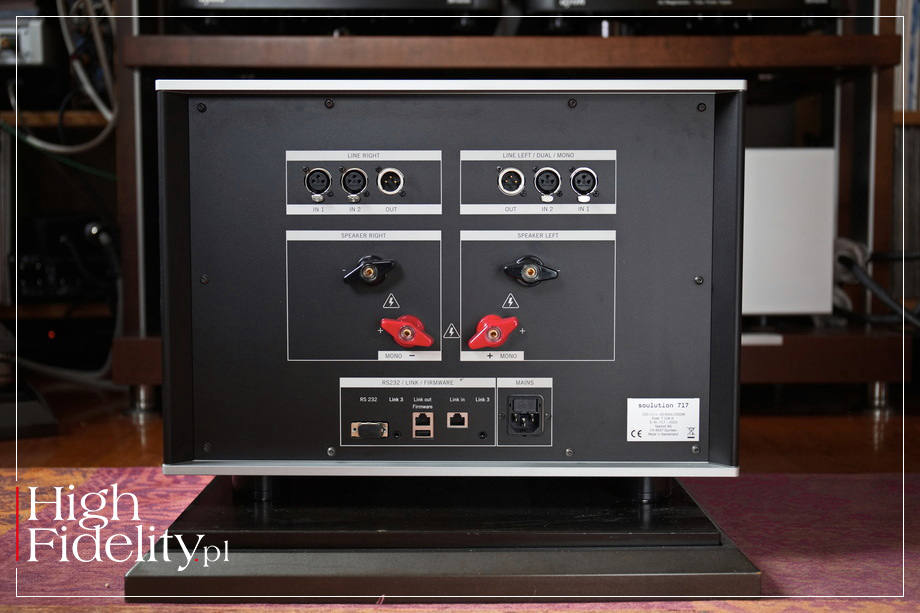
So there is a silky, smooth, golden treble that is, however, perfectly clear and well-defined in terms of tone, dynamics, and spatial depth. There is also a very, very low bass with excellent texture and control, but it is never “boxy” or overly defined (by which I mean an excess of attack and a lack of body). But above all, it is the midrange – it is the most important element here, and it is the most beautiful. It’s hard to cover everything in a short review – especially when it’s not really that short – and it’s even harder to make sense of it all in your head. But that’s just how it is with the best audio products; that’s how it is with the top of our industry. And the Soulution 717 amplifier takes its rightful place at the very top. Perhaps not alone, but among a small, exclusive group of amplifiers that I mentioned in this review, to which I would also add → NAIM STATEMENT and → AAVIK I-880 From us, a well-deserved ˻ GOLD FINGERPRINT ˺, although I am not sure, whether is significantly highlights what the designers have achieved with this power amplifier. ‖ WP ▒ Technical specifications (according to the manufacturer)
Type: solid-state, AB Class, push-pull 
THIS TEST HAS BEEN DESIGNED ACCORDING TO THE GUIDELINES adopted by the Association of International Audiophile Publications, an international audio press association concerned with ethical and professional standards in our industry, of which HIGH FIDELITY is a founding member. More about the association and its constituent titles → HERE. |
 |


|
Reference system 2026 |
|
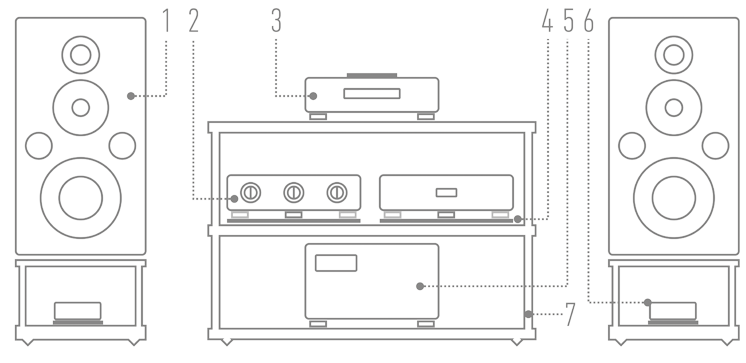 1) Loudspeakers: HARBETH M40.1 |REVIEW| 2) Line preamplifier: AYON AUDIO Spheris III Linestage |REVIEW| 3) Super Audio CD Player: AYON AUDIO CD-35 HF Edition No. 01/50 |REVIEW| 4) Stands (loudspeakers): ACOUSTIC REVIVE (custom) |ABOUT| 5) Power amplifier: SOULUTION 710 6) Loudspeaker filter: SPEC REAL-SOUND PROCESSOR RSP-AZ9EX (prototype) |REVIEW| 7) Hi-Fi rack: Hi-Fi rack: finite elemente MASTER REFERENCE PAGODE EDITION Mk II, more → HERE |
|

|
Cables Analog interconnect SACD Player - Line preamplifier: SILTECH Triple Crown (1 m) |ABOUT|» ANALOG INTERCONNECT Line preamplifier → Power amplifier: Siltech ROYAL SINLGE CROWN RCA; review → HERE Speaker cable: SILTECH Triple Crown (2.5 m) |ABOUT| |

|
AC Power Power cable | Mains Power Distribution Block - SACD Player: SILTECH Triple CrownPower (2 m) |ARTICLE| » POWER CABLE Mains Power Distribution Block → Line preamplifier: Acoustic Revive ABSOLUTE-POWER CORD, review → HERE » POWER CABLE Mains Power Distribution Block → Power amplifier: Acoustic Revive ABSOLUTE-POWER CORD, review → HERE Power cable | Power Receptacle - Mains Power Distribution Block: ACROLINK Mexcel 7N-PC9500 (2 m) |ARTICLE| Power Receptacle: Acoustic Revive RTP-4eu ULTIMATE |REVIEW| » ANTI-VIBRATION PLATFORM under Acoustic Revive RTP-4eu ULTIMATE: Graphite Audio CLASSIC 100 ULTRA, review → HERE Power Supply Conditioner: Acoustic Revive RPC-1 |REVIEW| Power Supply Conditioner: Acoustic Revive RAS-14 Triple-C |REVIEW| Passive filter EMI/RFI: VERICTUM Block |REVIEW| |

|
Anti-vibration Speaker stands: ACOUSTIC REVIVE (custom)Hi-Fi rack: finite elemente MASTER REFERENCE PAGODE EDITION Mk II, more → HERE Anti-vibration platforms: ACOUSTIC REVIVE RAF-48H |ARTICLE| » ANTI-VIBRATIONAL FEET: |

|
Analogue Phono preamplifier: Phono cartridges:
Clamp: PATHE WINGS Titanium PW-Ti 770 | Limited Edition Record mats:
|

|
Headphones » HEADPHONE AMPLIFIER: Leben CS-600X, review → HEREHeadphones: Headphone Cables: Forza AudioWorks NOIR HYBRID HPC |