


|
PHONO PREAMPLIFIER MM/MC/optical KECES
Manufacturer: HUIKANG ELECTRONIC CO., Ltd. |

 |
 |
 |
|
Review
text by WOJCIECH PACUŁA |

|
No 262 March 1, 2026 |
WE HAVE GOTTEN USED TO THE FACT that audiophile ‘toys’ come at a price. And even if we say that we haven't gotten used to it, we are at least aware that it is an expensive hobby. Like any other hobby of this type. Perfectionist pursuits are, by definition, based on work, technology and experience that we do not get in mass-produced or even ‘premium’ products. That is why we know that, in the context of audio products, 'inexpensive' does not mean ‘cheap’ at all. 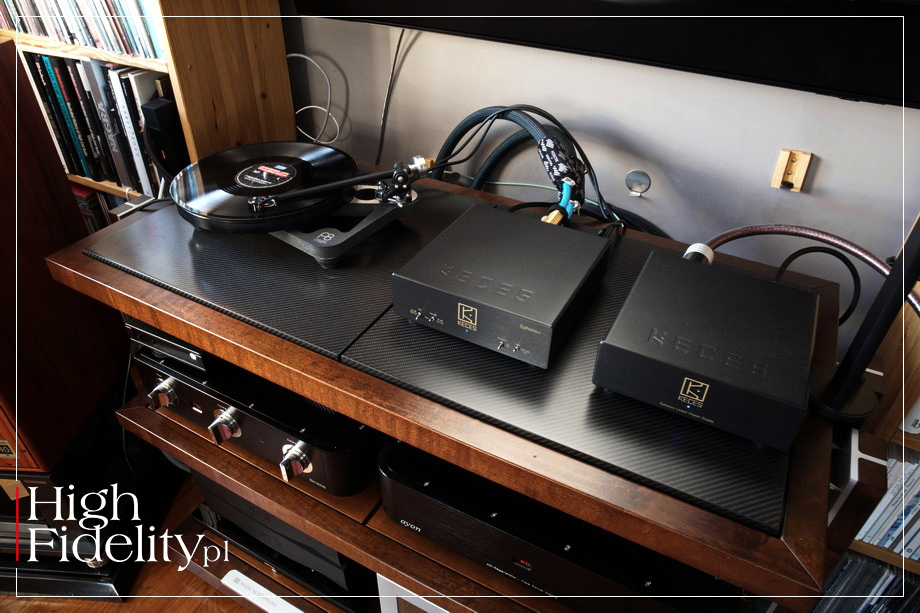
An outside observer, i.e. anyone who is not into listening to music on a good audio system, will say ‘expensive’ when they see the price of the new Keces phono preamplifier. On the other hand, those who have been with us longer than the lifespan of a mayfly will not say ‘cheap’, but they will not be surprised by the price of the Ephono+, either. If you are acquainted with this company and its devices, and know how much importance it attaches to power supply, you'll nod your head in understanding when you see the two enclosures. ▓ Ephono+ The EPHONO+ IS A NEW, MORE ADVANCED version of the Ephono preamplifier, which was introduced in 2018. That was eight years ago, which is quite a long time. Several changes have taken place in the audio industry since then, but one of the most interesting ones is the creation of a market for optical cartridges by DS Audio. These are cartridges in which the movements of the stylus are processed not by a mechanical-electrical system (magnets/coils), as in a classic cartridge, but by an optoelectrical system; more in the DS W2 cartridge review → HERE. And I think that one of the reasons behind the decision to design the Ephono+ was the need to integrate preamplifiers for MM and MC cartridges (a classic feature) and optical cartridges (still a novelty) into a single device. But that's not the only or primary reason. With this addition, we get redesigned circuits and, above all, a better power supply, now called the Ephono+ Power. And it is, after all, power supplies that Keces is known for. 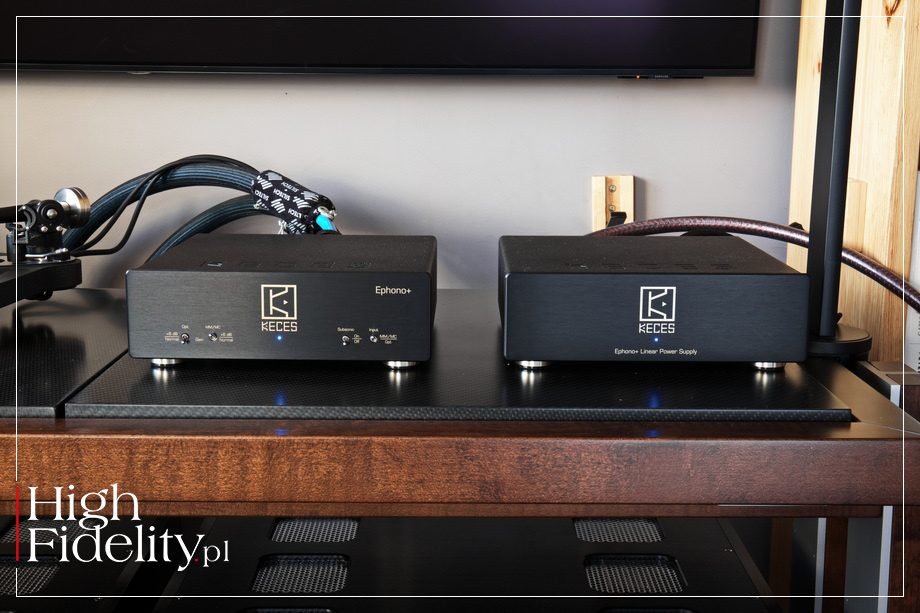
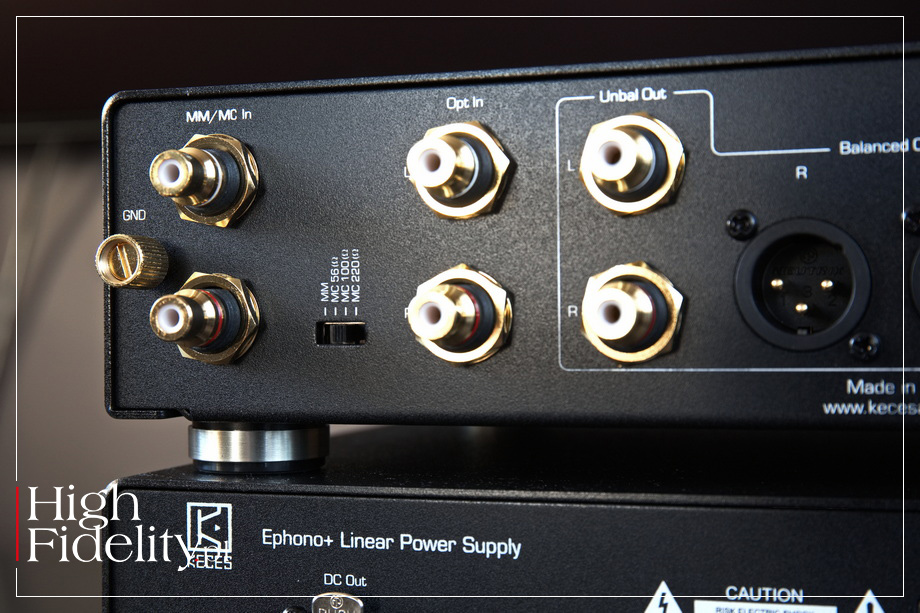
FUNCTIONALITY • The Ephono+ is part of the Essential series, a basic one for this manufacturer. The Taiwanese company aims for the low and medium price range, focusing on refining inexpensive, well-made devices providing good sound – I speak from experience. The same applies to the preamplifier we are testing. It is a two-part phono preamplifier with a separate power supply, designed for three types of cartridges: moving magnet (MM), moving coil (MC) and optical. In the case of the latter, at this point, it is only cartridges from one company, DS Audio, as I am not familiar with any other contemporary manufacturers. It offers one correction curve – RIAA. I am mentioning this because the more expensive model from this manufacturer, Sphono, allowed you to choose between RIAA and IEC. The device offers three separate RCA inputs, so in theory it can work with up to three cartridges simultaneously, suspended on three arms. That's the theory – at this price point, such turntables are rather rare. The inputs are unbalanced, but the output signal is available in both balanced (XLR sockets) and unbalanced (RCA) form. Both types of sockets look solid and have gold-plated contacts. Moving coil cartridges can be connected to the MM input. The load is fixed at 47 Ω and 100 pF. However, we can change the load for MC cartridges in three steps: 56, 100 and 220 Ω (100 pF). You can also change the gain: 46 dB or 52 dB for MM, 66 dB or 72 dB for MC and 24 dB or 30 dB for OPT (optical). The older Ephono model offered three gain levels. The impedance switch is located at the rear, while the gain is adjusted using two attractive toggle switches on the front panel. There are four such switches – in addition to these two, there is also a subsonic filter and an input selector. The former is used to filter out interference from turntables. The manufacturer states that the ‘Subsonic’ filter:
Effectively removes ultra-low frequency noise caused by turntable vibrations or warped records, preventing unwanted energy from affecting amplifiers and speakers, and improving overall soundstage clarity.
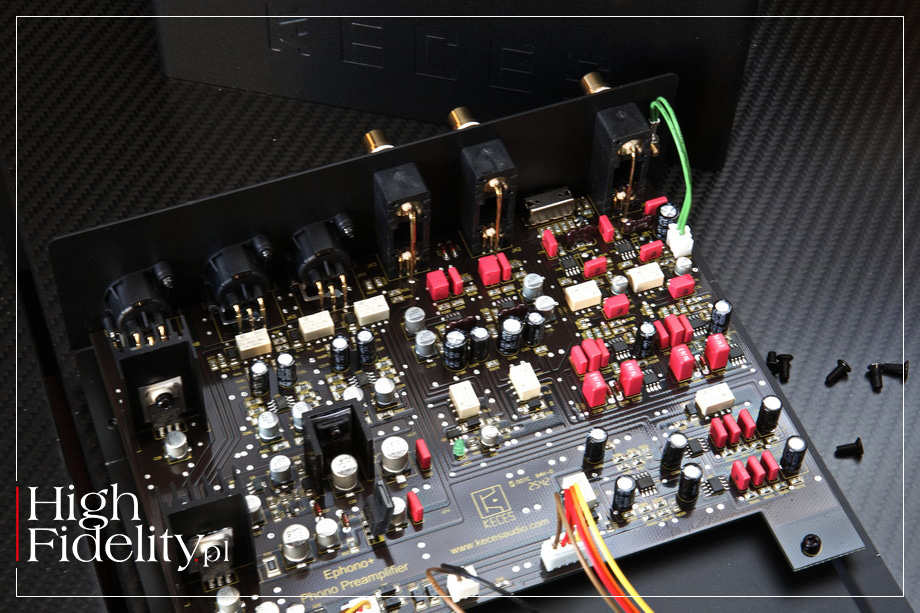
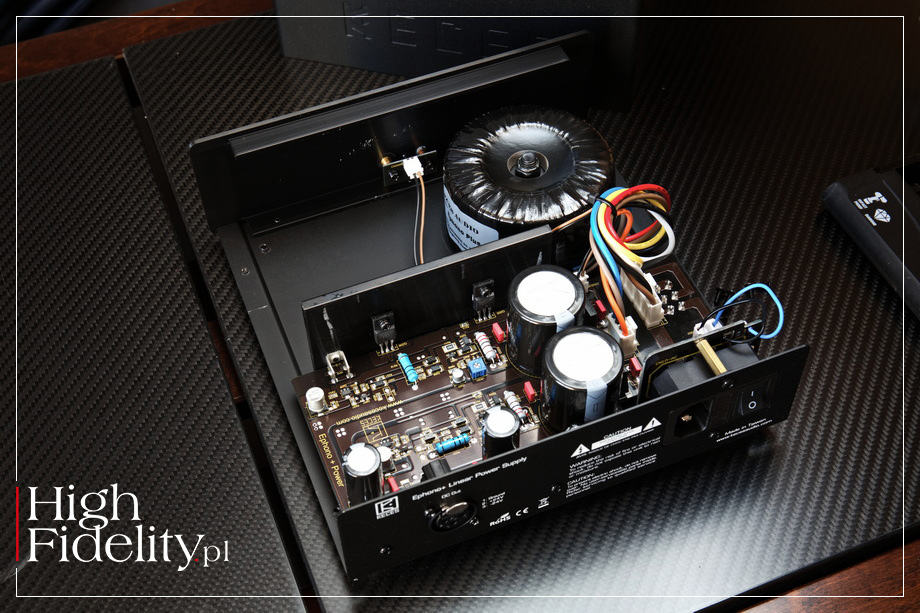
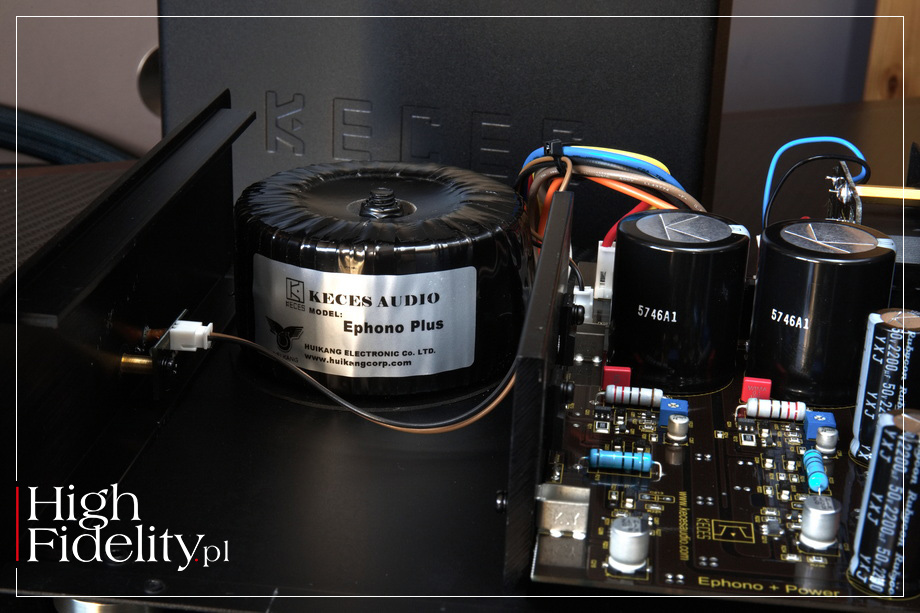
⸜ Ephono+ Preamplifier, → www.KECESAUDIO.com, accessed: 19.01.2026. Unfortunately, the manufacturer does not specify at what frequency the filter starts to work and with what attenuation. In general, Keces gives s rather little information on its products, as Dirk Sommer wrote in his review of this device in → HIFISTATEMENT.net. Let us remind you that, in 2024, our magazines awarded the company's K4 linear preamplifier the Statement in High Fidelity | German Edition 2024 award; more → HERE. TECHNOLOGY • The Ephono+ is a device with a separate power supply. This means that we have two separate ‘boxes’ – in this case, both with the same small dimensions of 220 x 220 x 66 mm (W x D x H). Removing the power supply from the enclosure containing the electronics usually reduces the likelihood of signal interference. This is not necessary, as many high-end products have an integrated power supply, but in their case this requires the use of a larger enclosure. The enclosure in the Keces Ephono+ Power has the same dimensions as the amplifier circuit. The devices are connected with a short cable with XLR plugs on both sides. The power supply is linear and is based on a toroidal transformer with the brand name H-Sonic and a patented design – remember that the parent company Keces is a transformer manufacturer. The manufacturer says that it provides ‘ultra-low noise and stable power’, but does not provide any information on what this innovation consists of. When we look inside the power supply unit, apart from a large transformer filled with resin, we can see a complex multiple stabilised power supply unit. Interestingly, separate rectifiers, and thus separate power supplies, were built for the positive and negative halves of the 24 V DC voltage. The voltage stabilising elements are circuits screwed to a large aluminum plate separating the electronics from the transformer. The power supply is equipped with over temperature protection (OTP). The amplifier circuit was assembled mainly on the surface, except for some electrolytic capacitors and all Wima capacitors in the correction and amplification circuits. Analog Devices ADA4898 integrated circuits were used as amplifying elements. The manufacturer refers to ‘ultra-low noise and distortion’, ‘stable amplification’ and ‘voltage feedback’. Interestingly, they can be found in both the MMMC and optical sections. The output features classic NE5532 circuits manufactured by JRC. 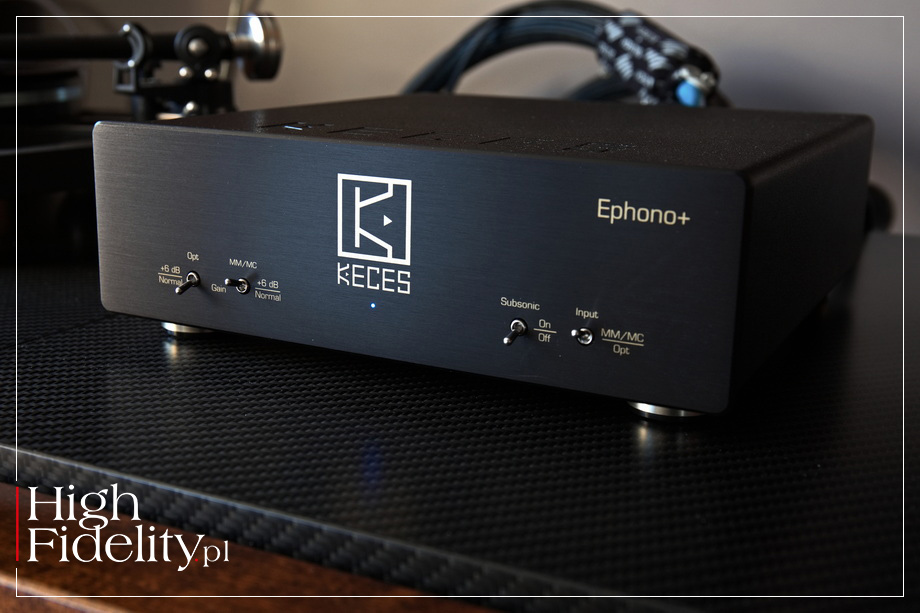
Both elements stand on simple plastic feet resembling those used by Japanese companies in the 1980s, which Chinese companies began mass-producing in the 1990s. The feet are screwed on, so they can be easily replaced with better ones. ▓ SOUND THE WAY WE LISTENED • The Keces Ephono+ phono preamplifier (the company uses the name Ephono Plus interchangeably, for example on nameplates) was tested in the HIGH FIELITY reference system and compared to the RCM Audio Sensor Prelude IC preamplifier. The source was a Rega 6 turntable with the MC Denon DL-103R cartridge. It was powered by an Acrolink Mexcel 7N-PC9500 cable. 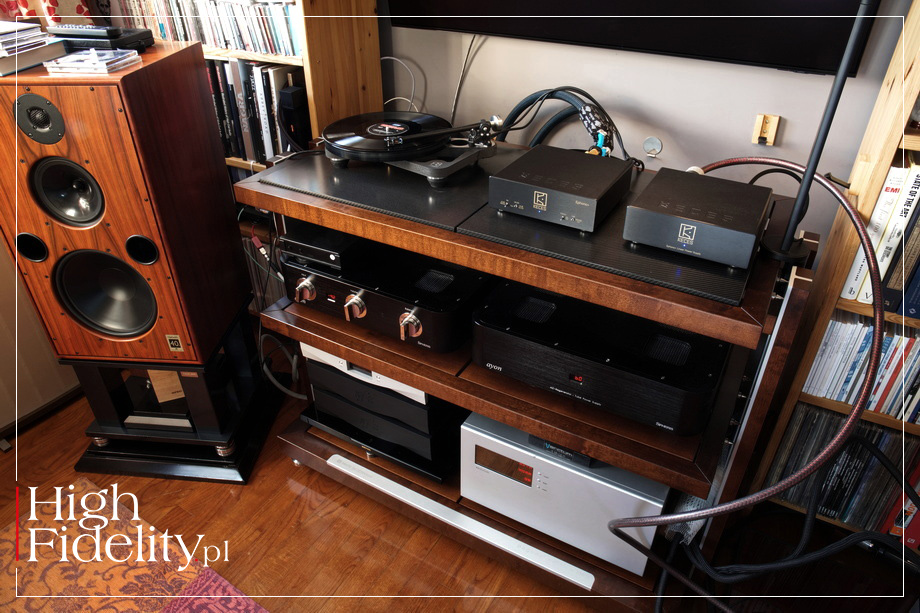
Signal from the tested preamplifier was sent to the Ayon Audio Spheris Evo line preamplifier and then to the Soulution 710 power amplifier. We used Harbeth M40.1 speakers and Siltech Triple Crown and Acoustic Revive Absolute Power Cable cabling. Before being played, the records were cleaned in an ultrasonic Audiodesksysteme Gläss Vinyl-Cleaner. » ALBUMS USED IN THE TEST ⸜ a selection
⸜ JEAN-MICHEL JARRE & TANGERNE DREAM, Zero Gravity, The Vinyl Factory VF184, 45 RPM 180 g LP. IT IS VERY COOL AND REALLY EASY to test devices with music played on acoustic instruments. We know what they sound like. In the sense that, for better or worse, we know them. When listened to repeatedly through an audio system, they are ‘compatible’ with our life experience, i.e., with what we hear around us. That is why I usually start my tests with them. They allow me to make a diagnosis in a short time. |
This time, for some reason, I chose something completely different, as if, looking at these devices, I didn't have to rely on what was organically familiar to me, but could choose something that I like in a non-committal way. I reached for JEAN-MICHEL JARRE's maxi single recorded with the band TANGERINE DREAM, entitled Zero Gravity. It accompanied the release of the album Electronica and was pressed by the British label The Vinyl Factory – perfectly. 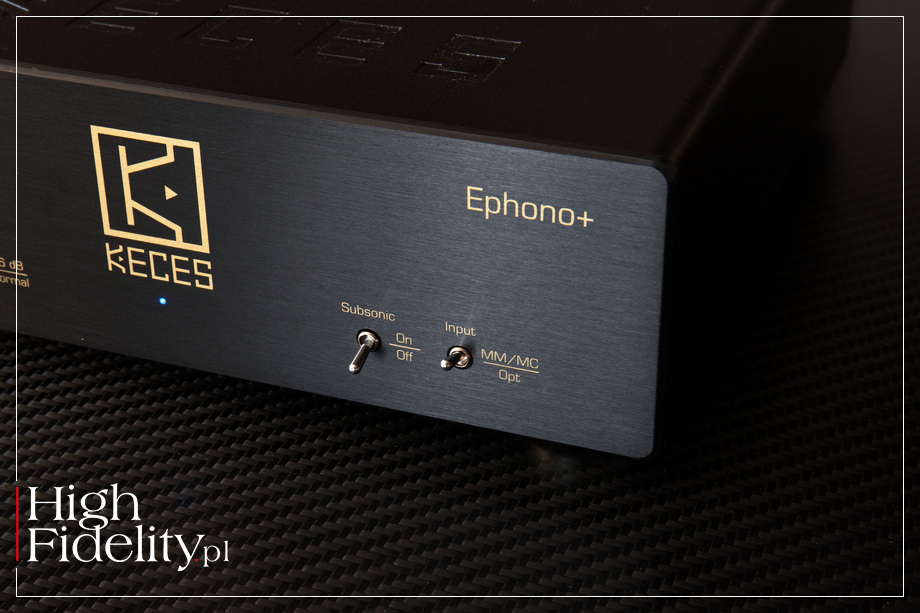
It played with the preamplifier from Taiwan softly, deeply and warmly. But also quite accurately, without blurring the details. The most important thing for me was that the device maintained signal integrity. It did not scatter the sounds into a nebula, but kept them in order, as if on a gravitational leash. It was low and powerful sound with a deep stage and soft, pulsating waves. But when I turned the record over and played the Above & Beyond remix on side B, with its powerful percussion and bass, the preamplifier brought it all together into a powerful whole, hitting me with the sounds and really conveying the energy of the track. It was still a rather warm sound, with a boosted low midrange and a slight hesitation before the attack. This is part of the Rega P6 sound with the Denon DL-103R cartridge. But the preamplifier did not overdo it. It added a deep soundstage. Even with very strong bass in the second part of the track, the reverb accompanying the same sound, repeated over and over again, developed far into the depths, fading away after a long moment. Reverb is one of the most important tools of a sound engineer and can transform a boring track into an energetic set. And when it is missing, everything fades away. The Ephono+ does not fade reverberations, it does not shorten them. All in all, it is a device that is very balanced in terms of colour. Inexpensive, maybe that's why it caught my attention, but simply – balanced. Not boring and balanced, but energetic, engaging and balanced. Even in such an expensive system as the one it was playing in, it showed no weaknesses. It wasn't as resolving and dynamic as the reference preamplifier, let's say. But it wasn't bad either, because it's just representative of different aesthetics. And when we play something as sophisticated in sound as ˻ A-1 ˺ You Go To My Head, and then ˻ A-2 ˺ Blues In The Closet from the album Blues For K. by TSUYOSHI YAMAMOTO TRIO, we hear a powerful piano, positioned further back on stage, clear percussion and a low double bass. The preamplifier played it softly, I repeat, but did not soften the attack. The bass on this album is rather low and not very contoured, with more resonance and ‘wood’ than contour. And yet it was clear, and the drum brushes sounded nicely in the space. This is a recording in which the piano is not as percussive as in Yamamoto's 1970s recordings produced by Three Blind Mice. He is an elderly gentleman – he will celebrate his 78th birthday on 23 March this year – and although it is not immediately apparent, the attack and dynamics when he is playing are clearly subdued. They have a creamier tone. The Ephono+ showed this nicely, but without emphasising – it tried to convey the magic that accompanies this pianist's encounters with music. This is also a device that conveys the atmosphere of recordings, their ‘spirit’, in a good and proper way – perhaps without sophistication when it comes to differentiating small details, we don't get that with the Ephono+. However, I would not expect that for less than twenty thousand PLN. Here, this aspect, i.e., the ability to create a pleasant, credible event with high volume, is above average. It is as if this preamplifier had reserves that it releases like a professional, calmly and deliberately. It is like this in the opening track of the Jazz at the Panwshop album – in ˻ A-1 ˺ Intro we hear sounds from the stage and from the club. Or when the whole band starts playing. It's a tiny stage, and during the concert the musicians stood shoulder to shoulder on it. You can hear something like that with this preamplifier. And although it is a calm musical message, in the sense that there is no excessive attack, Keces is not boring, and even less so with its lengthy pieces. Let’s listen to something equally energetically explosive, e.g., ˻ A-1 ˺ Old Fashioned Love from BENNY CARTER’S album Jazz Giant, and that will become clear. The trombone in the left channel will cut in, and the drums in the right channel will sound open and powerful. When the guitar comes in at the same point, Roy DuNann, who was producing the album (live), will immediately mute it and ‘release’ the guitarist. And when, a moment later, Webster's tenor saxophone sounds again in the left channel, it will almost ‘jump’ out of the speaker. 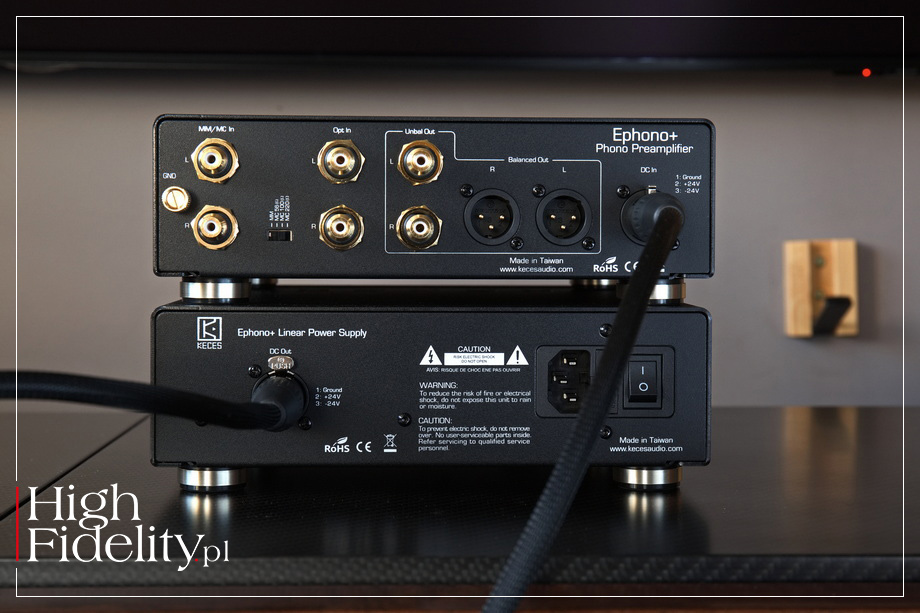
Everything leads to the following conclusion: the Keces Ephono+ handles both powerful and melancholic music very well. It neither dulls the former nor overdoes the latter. But, it must also be said, it is warm sound that focuses on the midrange. That’s why FRANK SINATRA’S vocal from the album The Voice, in ˻ A-1 ˺ I Don't Know Why (I Just Do), recorded as early as in 1946, sounded so romantic. However, it would be wrong to say that Keces is only suitable for such recordings. Because when we hear ˻ A-2 ˺ Try a Little Tenderness right afterwards, it immediately becomes clear to us that the master recordings for this album come from different sessions. This one is incredible in its ‘presence’ and I am sure that it is a 16-inch transcription disc, the kind Columbia used to record Sinatra at the time, already with the Long Play format in mind. The preamplifier under review is not a master of selectivity. Every time I thought something like that, I had to remind myself that it is a really well-priced, inexpensive device – in the context of audio. But in this respect, we get what we pay for. The Mobile Fidelity version of DIRE STRAITS' Brothers in Arms had powerful bass and a dense texture – that's the version – but the treble was not muffled and was also clear. Nevertheless, I felt a slight distance towards the recordings. This is a very elegant preamplifier in terms of constructing the musical message, with good but not excessive selectivity – somewhat mild. It is good at differentiating colours and, without exaggeration, but still – resolving, with a perspective slightly closer to the line connecting the speakers. While the reference preamplifier places Sinatra's voice almost in front of me, and spreads some of the sounds from Jarre's album around me, including from above, the Keces shows it all together, on stage. It is not the case that some companies hide their ‘treasures’ from us by selling them for little money, while everyone else preys on us and makes us pay many times more for almost the same thing. At least when we talk about reliable companies that we want to present to you. If we were to believe the many reviews in which we find exclamations suggesting that a given product should cost two or three times more, it would mean that the entire market is undervalued. And that is not the case. Keces shows that a well-designed, reliably manufactured and priced product costs what it should, but also that some features can be refined in such a way that they are hard to find at this price point. But this does not mean that more expensive devices should be cheaper. There are things that you have to pay more for because the technology and design that make them possible are costly. And the sound of the Ephono+ allows us to prove it. ▒ Conclusions WHEN WE SET the sound of the preamplifier from Taiwan in our minds in this way, we will understand that it is extremely cool and that it plays music very well. But it is not a high-end device either. And that's it. Once we get rid of this mental ‘baggage’, we can focus on the fact that it is a truly successful, great product from people who love music, created for people like them. 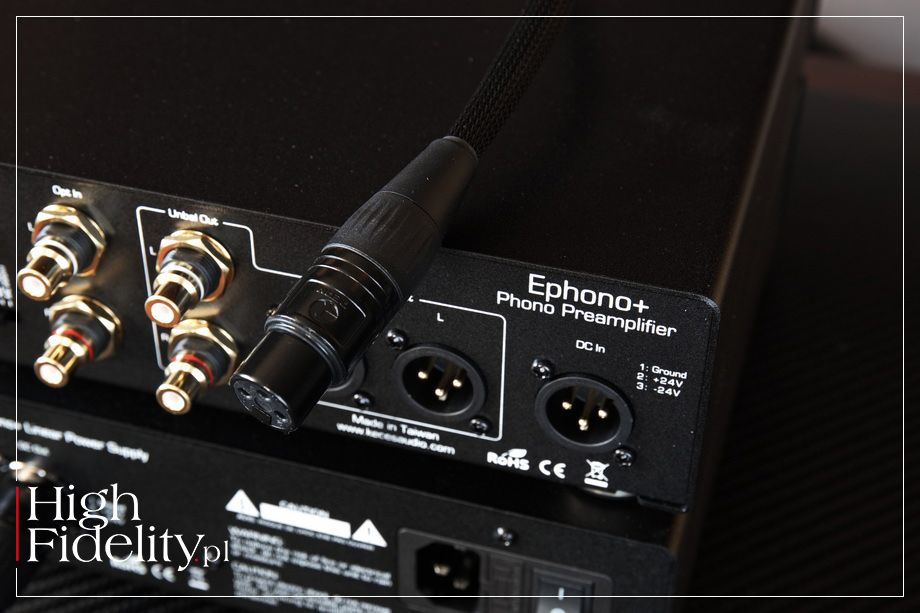
It plays warmly, softens the sound attack and is quite ‘round’ in building the bass. But both the attack and the sound are presented in a clear and energetic way. The sound sources are equally clear and pleasant, but they are not strongly defined either. It is more about playing with larger planes, colour and saturation, saturation here is above average. It is colourful sound, and it is colourful not in its monotony, but in its subtleties. Simply cool. ‖ WP ▓ Technical specifications (acc. to the manufacturer)
‖ EPHONO+ 
THIS TEST HAS BEEN DESIGNED ACCORDING TO THE GUIDELINES adopted by the Association of International Audiophile Publications, an international audio press association concerned with ethical and professional standards in our industry, of which HIGH FIDELITY is a founding member. More about the association and its constituent titles → HERE. |
 |

|
Reference system 2026 |
|
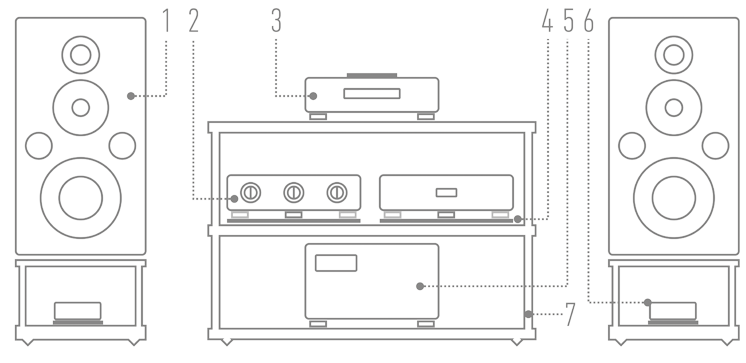 1) Loudspeakers: HARBETH M40.1 |REVIEW| 2) Line preamplifier: AYON AUDIO Spheris III Linestage |REVIEW| 3) Super Audio CD Player: AYON AUDIO CD-35 HF Edition No. 01/50 |REVIEW| 4) Stands (loudspeakers): ACOUSTIC REVIVE (custom) |ABOUT| 5) Power amplifier: SOULUTION 710 6) Loudspeaker filter: SPEC REAL-SOUND PROCESSOR RSP-AZ9EX (prototype) |REVIEW| 7) Hi-Fi rack: Hi-Fi rack: finite elemente MASTER REFERENCE PAGODE EDITION Mk II, more → HERE |
|

|
Cables Analog interconnect SACD Player - Line preamplifier: SILTECH Triple Crown (1 m) |ABOUT|» ANALOG INTERCONNECT Line preamplifier → Power amplifier: Siltech ROYAL SINLGE CROWN RCA; review → HERE Speaker cable: SILTECH Triple Crown (2.5 m) |ABOUT| |

|
AC Power Power cable | Mains Power Distribution Block - SACD Player: SILTECH Triple CrownPower (2 m) |ARTICLE| » POWER CABLE Mains Power Distribution Block → Line preamplifier: Acoustic Revive ABSOLUTE-POWER CORD, review → HERE » POWER CABLE Mains Power Distribution Block → Power amplifier: Acoustic Revive ABSOLUTE-POWER CORD, review → HERE Power cable | Power Receptacle - Mains Power Distribution Block: ACROLINK Mexcel 7N-PC9500 (2 m) |ARTICLE| Power Receptacle: Acoustic Revive RTP-4eu ULTIMATE |REVIEW| » ANTI-VIBRATION PLATFORM under Acoustic Revive RTP-4eu ULTIMATE: Graphite Audio CLASSIC 100 ULTRA, review → HERE Power Supply Conditioner: Acoustic Revive RPC-1 |REVIEW| Power Supply Conditioner: Acoustic Revive RAS-14 Triple-C |REVIEW| Passive filter EMI/RFI: VERICTUM Block |REVIEW| |

|
Anti-vibration Speaker stands: ACOUSTIC REVIVE (custom)Hi-Fi rack: finite elemente MASTER REFERENCE PAGODE EDITION Mk II, more → HERE Anti-vibration platforms: ACOUSTIC REVIVE RAF-48H |ARTICLE| » ANTI-VIBRATIONAL FEET: |

|
Analogue Phono preamplifier: Phono cartridges:
Clamp: PATHE WINGS Titanium PW-Ti 770 | Limited Edition Record mats:
|

|
Headphones » HEADPHONE AMPLIFIER: Leben CS-600X, review → HEREHeadphones: Headphone Cables: Forza AudioWorks NOIR HYBRID HPC |