


|
DIGITAL-TO-ANALOG CONVERTER/PREAMPLIFIER EVERSOLO
Manufacturer: EVERSOLO AUDIO TECHNOLOGY |

 |
 |
 |
|
Review
tekst WOJCIECH PACUŁA |

|
No 260 January 1, 2026 |
|
˻ PREMIERE REVIEW ˼ ⌈ EVERSOLO is one of the youngest brands on the audio market, established in 2023. It belongs to EVERSOLO AUDIO TECHNOLOGY Co. Ltd., which in turn is owned by Zidoo Technology Co, Ltd. Zidoo itself was founded in 2014. Despite its short history, EverSolo is already well known in audio circles. We are testing its new D/A converter – this is its FIRST press test in the world. ⌋ THE FOCUS OF THE Eversolo engineers is on digital circuits. The first product that the company pre-sented to the world in 2023 was the DMP-A6, a file player. The second was the DMP-A8, unveiled at the end of the same year, which was developed as an improved version of the DMP-A6, with more advanced features and a different design, with which the manufacturer aimed at a higher price range. In 2025, they were joined by the flagship DMP-A10 model. 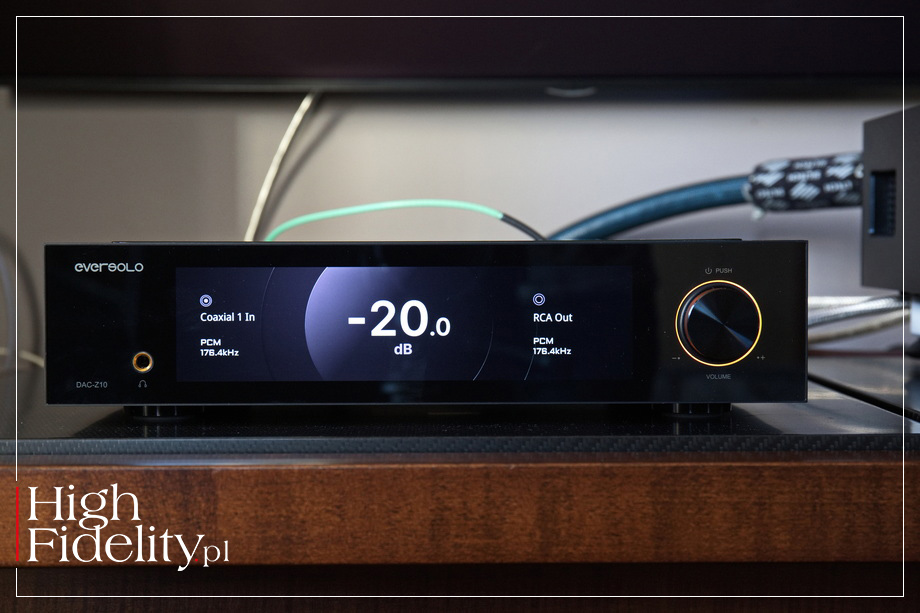
Among the first devices produced by this company were also digital-to-analog converters, DAC-Z6 and DAC-8Z, based on players with similar symbols, created back in 2023. These two lines, i.e., devices used to play files and D/A converters, are complementary. No wonder that after the DMP-A10 player, it was time for the DAC-Z10 converter based on it. ▌ DAC-Z10 THE DEVICE IN QUESTION is a digital-to-analog converter with an integrated preamplifier. It was designed as the center piece of the audio system, a kind of “hub” to which you can connect both digital and analog signal sources on one side and a power amplifier on the other, preferably – according to the company – their AMP-F10 model, which we tested for you in June this year; more → HERE. It is an exceptionally versatile device. What is more, it is built just as you would dream it to be, includ-ing almost any solution that we would like to see in it. Although I would like to see products of this kind, at this price, also manufactured by companies outside China, I know that this is not possible at the moment, because the state subsidizes the export of its products in one way or another. And it is very difficult to compete with that. Be that as it may, the DAC-Z10 looks, is built, and has the specifications of a top-of-the-line product. Its “heart”, the digital-to-analog converter, is based on top-of-the-line chips from the Japanese company AKM, the AK4191 delta-sigma modulator and the AK4499EX converter itself. This solution was first presented at the Munich 2022 High End Show. At the time, we wrote:
The DAC, via USB input, supports PCM formats up to 32 bits and 768 kHz, as well as native DSD512. I accidentally discovered that it also decodes MQA files, both from files and MQA-CDs. Although no icon appears on the display, the sampling frequency is shown. The device also allows you to change the digital filter and even activate a circuit that reconstructs clock – it is “corrected” in the FGPA circuit. 
The converter offers a whole range of inputs and outputs. It accepts digital signal via six inputs. These are: USB-B Audio, two HDMI I²S with eight configuration modes (changeable in the menu, up to DSD512 and PCM 768 kHz, 32 bits), AES/EBU, two optical Toslink and two coaxial RCA; all accept PCM signals up to 192 kHz and 24 bits, as well as DSD64 DoP. The latter feature allows you to connect the Onyx Zenith XST20 SACD transport to the Eversolo; more → HERE. There is also an analog input, XLR and RCA, from which the signal is routed through the analog path. We output either balanced (via XLR) or an unbalanced (via RCA) signal from the device – the entire signal path is balanced. However, before we do that, the signal is attenuated so that the device can function as a complete preamplifier. Press materials may mention that the D/A section in the tested device is based on an R2R resistor ladder, but this is incorrect. There is a ladder, but it is an analog attenuator, not a DAC. The volume is controlled by a knob, which can also be adjusted using a nice, handy remote control. There is also a headphone amplifier with adjustable gain. Low setting is intended for headphones with an impedance in the range of 16-32 Ω, and high for 32-300 Ω. The gain is set automatically by the DAC when headphones are plugged in (!). In addition to classic wired connections, the DAC-Z10 also supports Bluetooth 5.0, decoded in the Qualcomm QCC5125 module, which supports high-quality audio codecs. Add to this two inputs for an external reference clock, adapted to frequencies of 10 and 25 MHz, as well as impedance of 50 and 70 Ω, a ground terminal, and we understand that everything we need is here. In fact, an external clock is not really necessary, because the manufacturers have used a precise, thermally compensated OCXO clock in the tested DAC. ▌ OCXO 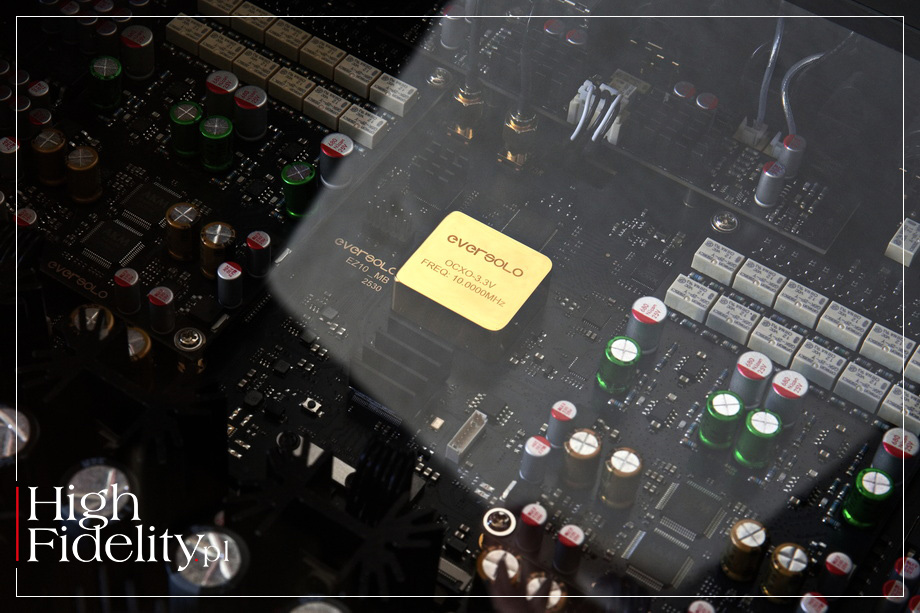
OCXO stands for Oven Controlled Crystal Oscillator. It is a precision circuit that generates a reference fre-quency for digital circuits, using an internal ‘oven’ to maintain the quartz crystal at a constant, optimal temperature. This process ensures exceptional frequency stability and accuracy, making OCXO ideal for appli-cations that require exceptional timing precision and low phase noise levels, such as telecommunications and test equipment. And, of course, audio. ALTHOUGH IT WAS TEMPTING, I was very tempted to start with this, I will leave the description of the dis-play until the end. Although we encounter this type of large, colorful, touchscreen, attractive displays in other products from Asia, for example in Korean devices from Aurender or HiFi Rose, it is still an exception. Here, it has been used in a truly creative way. 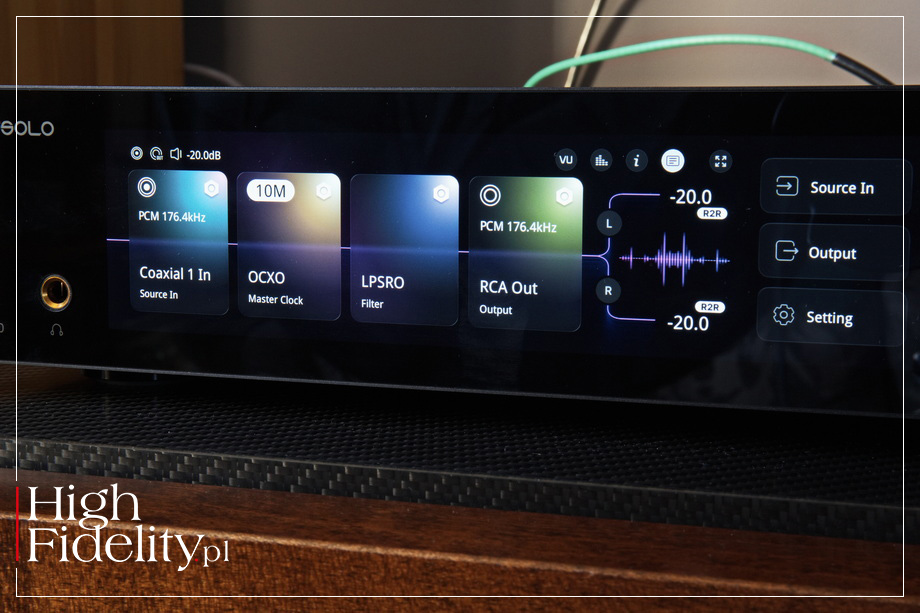
It can display VU meters in many different colors and variants, greatly aids in menu navigation, and can also serve as a display on which you can read all the necessary information about the status of the device, even from a greater distance. There is also a section with a graphical frequency indicator, something like a spectrum analyzer. Each section has several visual versions, so there is plenty to choose from. And there is also a good, ergonomic, and attractive remote control. The only information I missed was information about the word length (in bits). And I'm waiting for a company from China or Korea (I'm not counting on the West) to finally apply an HDCD decoder in its device. ▌ SOUND HOW WE LISTENED • The Eversolo DAC-Z10 digital-to-analog converter was tested in the HIGH FIDELITY reference system and compared to the D/A section of the Ayon Audio CD-35 HF Edition SACD player, which also functioned as a transport. At the same time, I listened to the Sforzato DSP-05EX file player with the PMC-05EX clock working as a file transport. The DAC-Z10 was tested using RCA (unbalanced) outputs because I use RCA cables in my system. 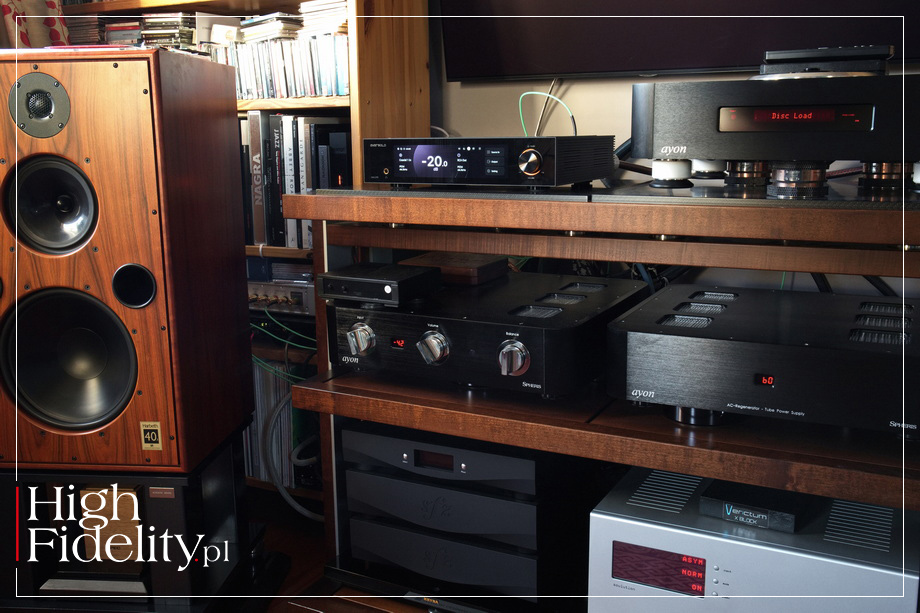
The Ayon digital output with the converter input was connected using an Acrolink Mexcel 7N-DA6100 II RCA→RCA cable, and with the Sforzato with an Acoustic Revive USB-1.0 PL Triple-C USB cable. The test was performed both with and without the Ayon Audio Spheris Evo preamplifier. The DAC was powered by an Acrolink Mexcel 7N-P9100 cable and placed on the top shelf of the Finite Elemente Master Reference Pagode Edition Mk II table. It was tested with the clock regeneration circuit enabled. The settings were as follows: • output → RCA, 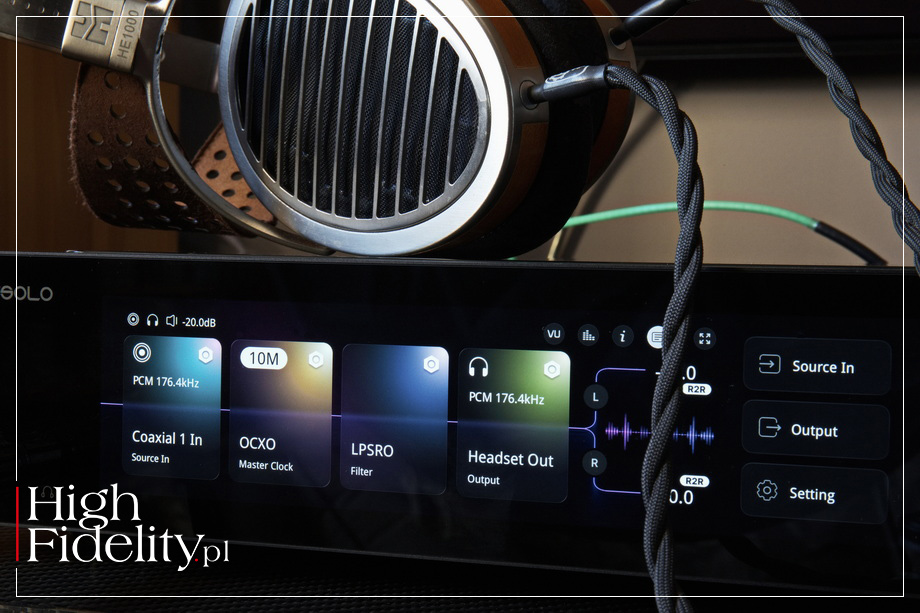
I used three pairs of headphones to listen to the headphone output: HiFiMAN HE1000 v2, Sennheiser HD 800, and Lime Ears Pneuma. » RECORDINGS USED FOR THE TEST ⸜ a selection
⸜ ARNE DOMNÉRUS, Jazz in the Panwshop 1+2, AudioNautes Recordings, Master CD-R & MQA ⸜ 2025. IT IS NOT EASY TO CAPTURE the “sound signature” of this device. It rarely happens, but when it does, it sug-gests high-quality sound. This is the case with the Eversolo DAC-Z10. The sound of the tested converter is open and very energetic. The characteristic, powerful and even slightly distorted tambourine that can be heard in the second minute of ˻ 4 ˺ Jeep’s Blues, a track from ARNE DOMNÉRUS's album Jazz at the Pawnshop, was incredibly natural. This was due to the slight overdrive of the tape, the dynamics, but most of all the outstanding energy. Similarly, the drums in this track, which you listen to from a some distance, yet to-gether with the acoustics of the room create the effect of being “there”. As I said, it's an open and powerful sound. There is no attempt to warm up or tame the sound. Rather, there's a push to convey as much information as possible in the shortest possible time – what we call resolution. Yes, it really is a very high-resolution DAC, exceptional at this price point. At the same time, the openness of the treble, clear and unambiguous, does not brighten the sound. I've been hearing this for some time now and I can only applaud it – manufacturers have cured themselves of the “disco” treatment of high frequencies, i.e., “at full blast and over the top”. Eversolo plays in a modern way. Not vintage in the sense of the 1950s and 1960s, not romantic, but al-so not overly flashy, which almost killed music in the 2000s. The maximum compression used by labels, which was part of the so-called “loudness war”, made a large group of albums from that period, whether new or remas-tered, unlistenable. Unless you have speakers with a burnt-out tweeter. 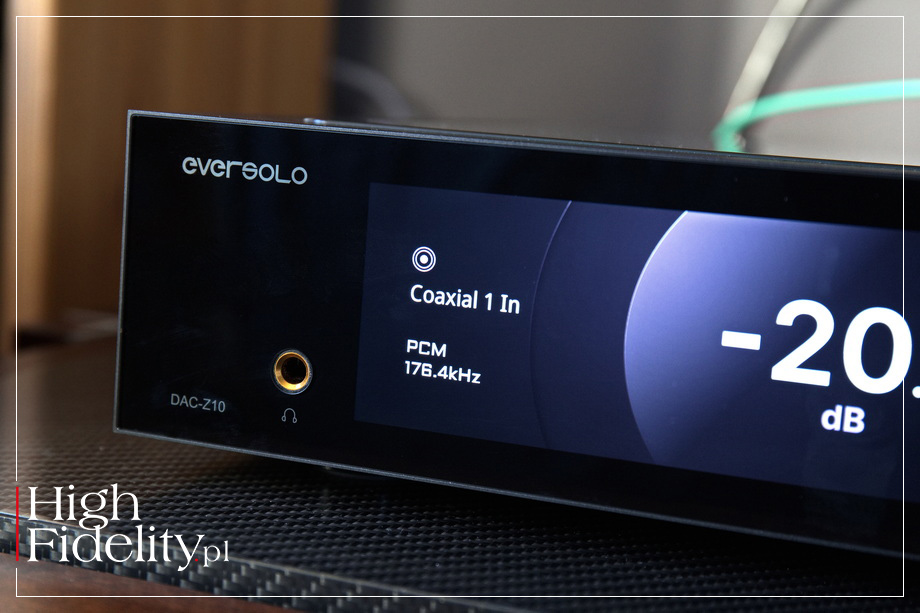
The DAC-Z10 keeps it under control. The vocals of Ella Fitzgerald from the album Ella and Louis, recorded with Louis Armstrong and released in 2011 by First Impression Music on the Lasting Impression Music sub-label, were clear and powerful, and also slightly forward. There was no hint of nervousness or exaggeration, because the brightened “hoarseness” often heard in her voice was not separated from the main vocals here. |
The trumpet in track ˻ 2 ˺ Moonlight in Vermont, which comes in at 1:47, also had power, dynamics, and fire in it. And yet it retained its natural “bite”, the slight insistence that characterizes this instrument, especially when played by Armstrong. I believe that the tested DAC owes this to its very good instrument differentiation. It is so good that when, at 2:38 of the aforementioned piece, the trumpeter relaxes his lips with a quiet “prrrrr”, it is naturally blended into the background, yet still clear. However, the tested DAC will not be a super-versatile device. It will not satisfy those who like low rum-blings, puffs. Its tone is open and well saturated, and it is really very good. But the way this device forms sounds directs our attention to the upper end of the spectrum. It is not that it sounds light. In fact, the bass extends sur-prisingly low, and when the bass kicks in on ˻ 2 ˺ Back To Tupelo, a track from MARK KNOPFLER's The Trawlerman's Song EP, it does so powerfully and deeply. But not densely. I had heard this before, on the Ella/Louis album, where the strong “pops” in ˻ 3 ˺ Cheek To Cheek, for example at 0:42, were fantastically clear and well-formed, yet not as saturated as on the reference player. With this limitation in mind (or character, de-pending on what we are looking for), I listened to several albums, including KENICHI TSUNODA BIG BAND Big Band Supreme. It's a powerful sound with boosted bass, especially in the midrange, and at the same time a sound with panache. 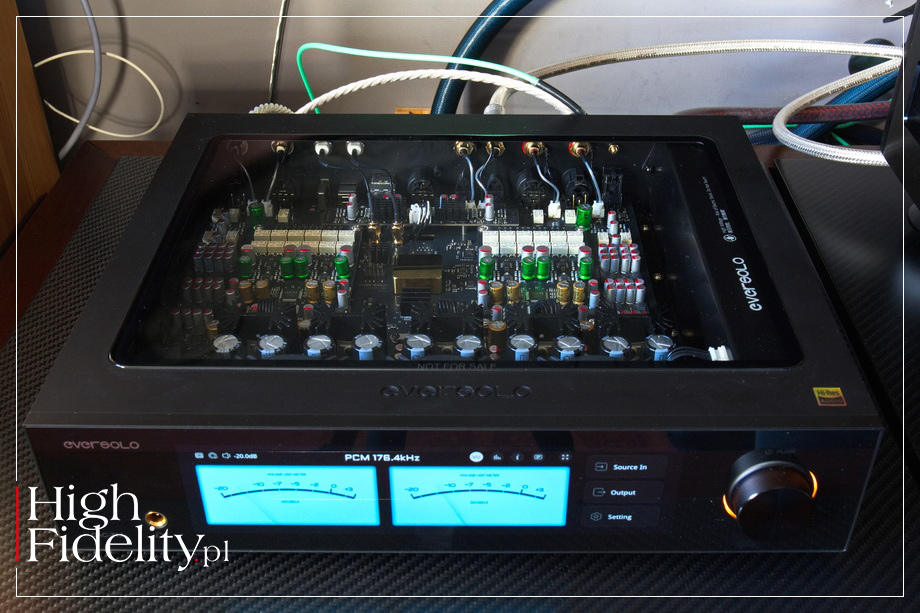
The Chinese converter played it in a nicely differentiated way, at every level. There was room for de-tail, selectivity, and resolution. The layers were brought closer to me and were not pulled as deep into the scene as with the Ayon player. But within these layers, the differentiation of acoustics, and thus of space, was really good. It was with this album that I best heard what the “sound” of this converter was all about. It is about a slight withdrawal of the lower midrange. Minor, but still noticeable. This is achieved by reducing the saturation of vocals in this range and opening up the upper bass. That is why it is so noticeable. The drum solo in the fifth minute ˻ 1 ˺ Sing, Sing, Sing had momen-tum and was outstanding – yes, outstanding – in its transmission of energy. And underneath it all, the electric bass sounded exceptional. It didn't have the mass that I know from my player and other devices of this type, that was clear. However, it was equally clear that this was not a flaw, but a choice. All this resulted in sound with characteristics rarely found in this price range. Such as clarity – unbelievable – openness of sound, energy, dynamics, organization. Yes, it is very organized sound in terms of timing. Nothing is blurred or muddy. But not by emphasizing the attack, which is incredibly tiring, but by maintaining coherence. Everything “plays” together, everything “clicks.” That is why the openness of the signal from Eversolo is not brightness, but naturally presented infor-mation, which with most other converters, including more expensive ones, would be buried in saturation or blurred. Thanks to this feature, the treble with the DAC-Z10 is downright sweet. Although this word is rarely used in the context of open sound, here it is a natural descriptor of what you hear. DAC & PREAMPLIFIER • All of the above comments apply to listening to Eversolo with the volume set to maximum. It turns out that with the DAC-Z10's active volume control it sounds different. Not completely, but in terms of tone and imaging, still different. When connecting the DAC directly to the Soulution 710 power amplifier, bypassing the Ayon Audio Spheris Evo preamplifier, the sound was saturated in the mid-bass. This range also had softer contours and was no longer as selective as before. But it was denser. The double bass in the second track from the album Big Band Supreme, ˻ 2 ˺ It Don’t Mean a Thing (If It Ain’t Got That Swing), the bass and guitar on Knopfler's album, and finally Louis Armstrong's vocals, all these elements were boosted and lowered. And that's OK, it's also a very cool take on music. It won't be as clean and selective as with a high-end external preamplifier, but there's always a trade-off. But there will also be no problem with a lack of “meat”. And that's even with such noisy albums as OASIS (What's the Story) Morning Glory? It's fantastic mu-sic, recently released in Japan with a new remaster to mark the album's 30th anniversary, on two BSCD2 discs. With Eversolo's volume control, it sounded softer than with an external device. The attack was round-ed, and the mid-bass was not lean, which sometimes happens with these recordings. The device immediately showed flattened dynamics, as we said, it is super accurate in this respect, but it did not extinguish it. In the sense that I turned up the volume and everything gained color, air, and drive. But it was still not unpleasant. 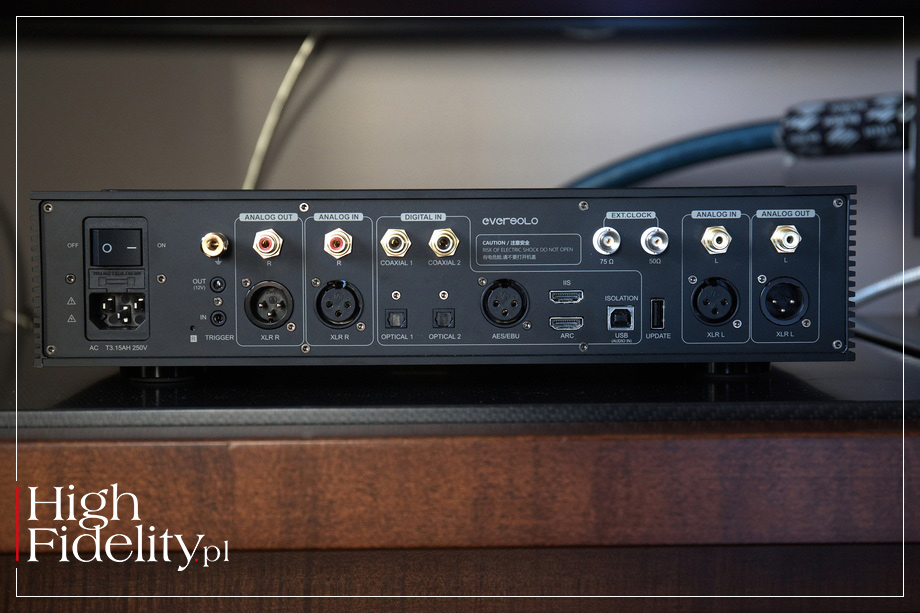
HEADPHONES • Similarly, I perceived the sound of the headphones, which shows that in the tested DAC’s sound, the output section with the attenuator plays a very important role. It is this section that largely shapes the final result. The DAC itself is more resolving and open, but it also does not saturate the lower midrange in the same way as in the full configuration. The headphone output repeats these characteristics. When listening to music from Eversolo through speakers and switching to headphones, we will not notice any significant change, which is really cool. However, I would avoid headphones that sound expressive, such as the HE-1000 v2 from HiFiMAN, etc. With the Polish Pneuma headphones, the device sounded much better, because it was rich, dense, yet selective. It was really, re-ally good sound, which negates the need for an external headphone amplifier. ▌ Summary THE DEVICE FROM CHINA, which I have presented to you, is mentally a product of the 21st centu-ry. This applies to its design, functionality, and sound. It is a modern approach to each of these elements. In the sense that it does not try to replicate the character of devices from the past, but opens up to recordings in its own, very neutral way. It is selective and energetic sound. With sweet high tones, which are abundant and strongly defined. The time domain coherence of the sound is so good that we perceive it as natural, rather than brightened. All the more so because the other end of the spectrum is very similar in terms of clarity, selectivity, and energy. The midrange is very nice, never bright, never exaggerated. Its lower part is slimmed down in the name of transpar-ency when using an external preamplifier. So it is not a meaty sound. With the internal attenuator and direct connection to the power amplifier, the device plays lower, but also in a less clear way. Wait – not less clear, because it will still be much better than most DACs in this price range. So I would say: less energetic. Not by much, but that's how I perceive it – as a slight calming of the attack and its rounding. The bass will be warmer. The important thing is that in this mode, all albums will sound pleas-ant, even the bright ones. And the dense ones will “purr” pleasantly. Still, we're talking about a contemporary sound, without warming, but with low frequencies. It is also an extremely functional device that allows you to tailor its functionality, appearance, and sound to your needs. It is fantastically built and easy to use. And, in this context, inexpensive. Bravo! ▌ DESIGN The DAC-Z10 is a medium-sized device, with dimensions defined in audio terms as “midi”: 265 x 310 x 78 mm. Its casing is made of aircraft-grade aluminum. It is rigid yet lightweight. The manufacturer says that it “combines precision workmanship with a sophisticated texture.” The device stands on four low feet. 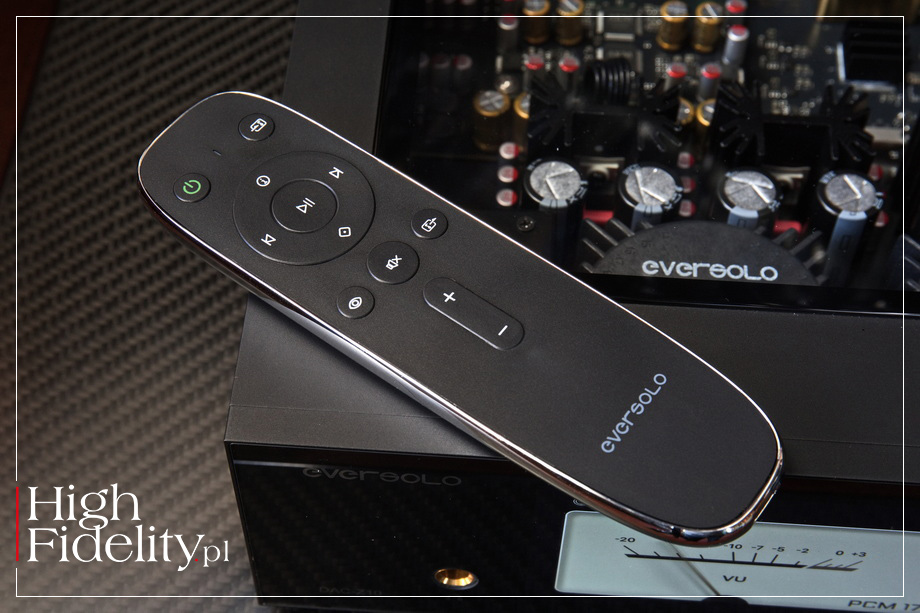
FRONT AND REAR • Almost the entire front is occupied by a large 8.8" IPS touchscreen (In-Plane Switching) with a clear and intuitive interface. It displays all the necessary infor-mation, as well as other data, including the signal path, menu, VU meters, and more. Next to it is a volume knob, which also functions as a standby switch. It is backlit all around, and you can choose the color. On the other side, there is a 6.3 mm TRS headphone jack. The rear panel is really crowded. The digital input sockets are located in the middle, with the analog section – XLR and RCA inputs and outputs – on the sides. All sockets are solid and gold-plated. There are also trigger sockets, a ground terminal, and an IEC power socket. However, there is no screw-in Bluetooth antenna – it is hidden in a small bulge. INSIDE • The unit we received for testing was a demo unit from the Show, one of the first to leave the factory. It therefore has a glass top instead of a metal one. But this allows you to see—and that was the point—how nice the layout is. There is a large PCB covering the entire bottom. It houses the input and output sections. The device features a design called FIA (Fully Isolated Architecture), which is supposed to separate the digital domain from the analog domain, “minimizing interference and maintaining signal purity”. We connect it to an external file transport or computer via a powerful multi-core USB audio processor, which, according to the manufacturer, pro-vides greater processing speed and bandwidth, “ensuring lossless transmission of high-resolution audio data”. 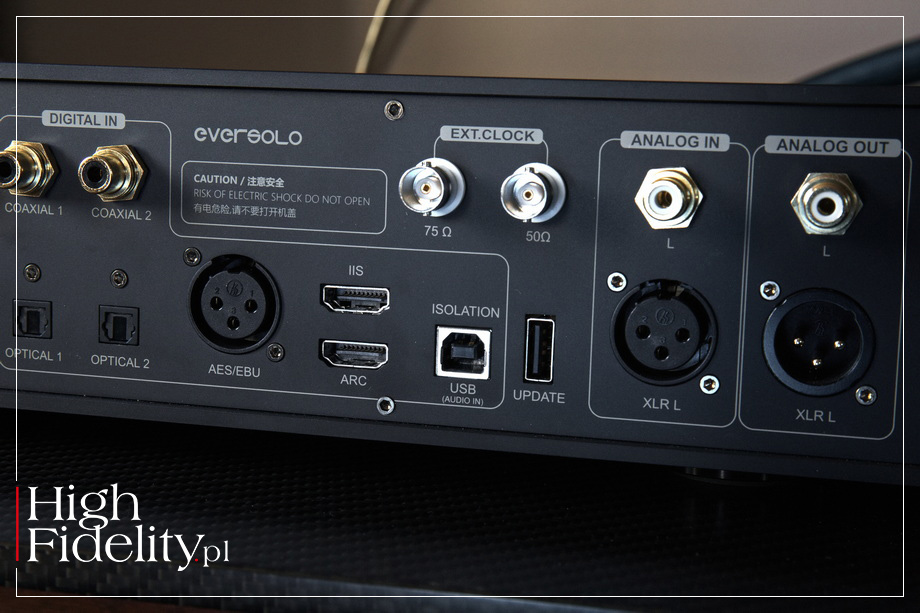
The USB input features an XMOS chip, while the other digital inputs are buffered with matching transformers. The analog inputs are buffered with OPA1612 integrated circuits. The actual converter and volume control cir-cuitry was assembled on separate boards for the left and right channels, and then connected to the main board. The basis here is the two-part AKM Verita AK4191 + AK4499 converter, part of the Velvet Sound series. It is currently the company's top-of-the-line chip. Eversolo decided to use one per channel in mono mode, which further improves its performance. The volume control is also separate for each channel. It is an R-2R type circuit, discrete, made on a resistor ladder switched by Omron relays. It is a surface-mounted circuit, but with high-quality passive components. Between the boards, you can see a large OCXO clock (Oven Controlled Crystal Oscillator) enclosed in a gold-plated screen. It controls the operation of all converter circuits. The circuit is powered by three linear power supplies, one for the left channel, one for the right chan-nel, and a third for the system circuits. According to the manufacturer, this allows “each of them to operate in an ultra-low noise environment”. It features three toroidal transformers preceded by a filter system for AC pow-er supply interference. The filters are hidden behind a screen so that they do not interfere with the signal them-selves. 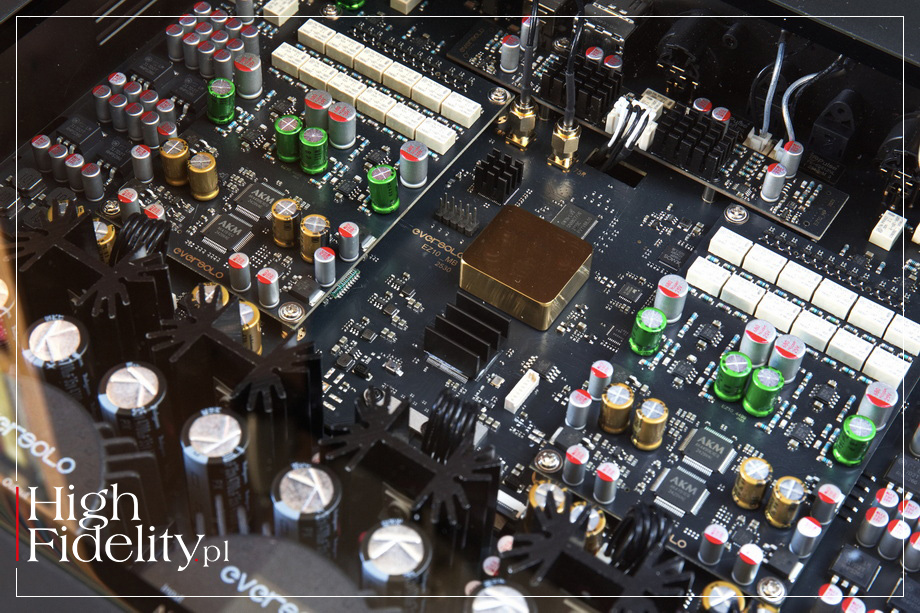
It is a superbly crafted device with high-end components – such as Nichicon capacitors, etc. – and ex-pensive solutions. In addition, it is incredibly functional and very attractive. It seems that at the moment, it is impossible to make something similar for this price outside of China. ● ▌ Technical specifications (according to the manufacturer):
Audio inputs and outputs: 
THIS TEST HAS BEEN DESIGNED ACCORDING TO THE GUIDELINES adopted by the Association of International Audiophile Publications, an international audio press association concerned with ethical and professional standards in our industry, of which HIGH FIDELITY is a founding member. More about the association and its constituent titles → HERE. |

 |
|
Reference system 2025 |
|
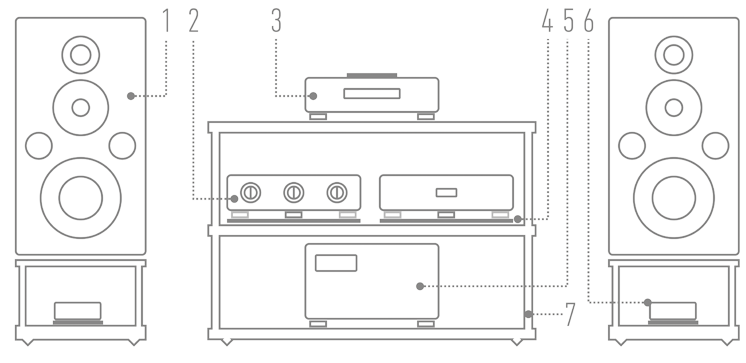 1) Loudspeakers: HARBETH M40.1 |REVIEW| 2) Line preamplifier: AYON AUDIO Spheris III Linestage |REVIEW| 3) Super Audio CD Player: AYON AUDIO CD-35 HF Edition No. 01/50 |REVIEW| 4) Stands (loudspeakers): ACOUSTIC REVIVE (custom) |ABOUT| 5) Power amplifier: SOULUTION 710 6) Loudspeaker filter: SPEC REAL-SOUND PROCESSOR RSP-AZ9EX (prototype) |REVIEW| 7) Hi-Fi rack: Hi-Fi rack: finite elemente MASTER REFERENCE PAGODE EDITION Mk II, more → HERE |
|

|
Cables Analog interconnect SACD Player - Line preamplifier: SILTECH Triple Crown (1 m) |ABOUT|» ANALOG INTERCONNECT Line preamplifier → Power amplifier: Siltech ROYAL SINLGE CROWN RCA; review → HERE Speaker cable: SILTECH Triple Crown (2.5 m) |ABOUT| |

|
AC Power Power cable | Mains Power Distribution Block - SACD Player: SILTECH Triple CrownPower (2 m) |ARTICLE| » POWER CABLE Mains Power Distribution Block → Line preamplifier: Acoustic Revive ABSOLUTE-POWER CORD, review → HERE » POWER CABLE Mains Power Distribution Block → Power amplifier: Acoustic Revive ABSOLUTE-POWER CORD, review → HERE Power cable | Power Receptacle - Mains Power Distribution Block: ACROLINK Mexcel 7N-PC9500 (2 m) |ARTICLE| Power Receptacle: Acoustic Revive RTP-4eu ULTIMATE |REVIEW| » ANTI-VIBRATION PLATFORM under Acoustic Revive RTP-4eu ULTIMATE: Graphite Audio CLASSIC 100 ULTRA, review → HERE Power Supply Conditioner: Acoustic Revive RPC-1 |REVIEW| Power Supply Conditioner: Acoustic Revive RAS-14 Triple-C |REVIEW| Passive filter EMI/RFI: VERICTUM Block |REVIEW| |

|
Anti-vibration Speaker stands: ACOUSTIC REVIVE (custom)Hi-Fi rack: finite elemente MASTER REFERENCE PAGODE EDITION Mk II, more → HERE Anti-vibration platforms: ACOUSTIC REVIVE RAF-48H |ARTICLE| » ANTI-VIBRATIONAL FEET: |

|
Analogue Phono preamplifier: Phono cartridges:
Clamp: PATHE WINGS Titanium PW-Ti 770 | Limited Edition Record mats:
|

|
Headphones » HEADPHONE AMPLIFIER: Leben CS-600X, review → HEREHeadphones: Headphone Cables: Forza AudioWorks NOIR HYBRID HPC |