

|
INTEGRATED AMPLIFIER DARTZEEL AUDIO
Manufacturer: CAPE124 |

 |
 |
 |
|
Review
text by WOJCIECH PACUŁA |

|
No 270 November 1, 2026 |
THERE ARE SOME BRANDS that you have to wait many years for, but you keep waiting. That was the case for me with the Dartzeel brand (the name is stylized by the manufacturer as darTZeel). As it happens, I met its founder, designer, and chief manager, Mr. Hervé Delétraz, during the first year of “High Fidelity’s” operation, back in 2004. A coincidence, but a significant one. 
It happened at the first edition of the Munich High End Show, where I had previously arranged to meet another luminary of the audio world - already a legend at the time - Mr. Bé Yamamura. Yamamura-san was a Japanese audio equipment designer and musician living in Paris, known for building extremely luxurious, custom-made horn-loaded speaker systems - such as the powerful Requiem and Dionisio sets - as well as tube-based electronics sold under the Yamamura Churchill brand. He also wrote for French audio magazines. I arranged the meeting with him so that I could get to know cables from Oyaide and Acrolink, which he was helping introduce to the European market at the time. Somewhat eccentric but full of passion, he asked me after our meeting if I’d like to meet someone special - someone whose amplifiers he holds in extremely high regard. Although, as he added, they weren’t tube amplifiers. Well, of course I wanted to. That’s how I met Mr. Delétraz. In 2004, the Dartzeel brand was already well known in the audiophile industry. It had won awards such as the Positive Feedback Brutus Award and received honors from „Stereophile” for its amplifiers, which featured an innovative design without global feedback. Furthermore, in early 2004, the company unveiled its ambitious prototype of the NHB-18NS reference preamplifier at T.H.E. Show in Las Vegas. In a word - “the star was born”… Twenty-two years later, its amplifier found its way into my listening system. ▲ A few simple words HERVÉ DELÉTRAZ MY NAME IS HERVÉ DELÉTRAZ. I am an electronics engineer, but I have a good excuse for that. From a very young age, I have always loved understanding how things work. I clearly remember taking my grandmother’s gramophones apart and telling her that I knew how to put them back together. She did not believe me for a second, but she knew I was far too curious for her to say no. I ruined two of them. I was 6 or 7 years old at the time, and I remember it as if it were yesterday. Today, I think I would be able to put them back together. 

Equally passionate about mechanics and electronics, it was the latter that I eventually chose to pursue more specifically. I started assembling circuits when I was 9, thanks to my mother, who had given me a Philips electronics construction kit. It was the very beginning of the 1970s. All the components in the kit were discrete, and their operation was explained in detail in the manual. It was fascinating! That is how I built my first superheterodyne AM radio. It worked brilliantly! At the same time, I was also becoming passionate about music reproduced through stereo systems. Back then, we talked about hi-fi systems; the term high-end did not yet exist. In the early 1980s, I entered the engineering school in Geneva, where I studied electrical engineering. I graduated in 1984, and my diploma project was an audio amplifier … in Class D! Built entirely with discrete components … That was when I began to understand what the absence of feedback could bring, and what its massive use could alter. Which led to a question that I was far from alone in asking: Why can two amplifiers whose measurements both appear excellent nevertheless sound so different? That very simple question, whose answer is so complex, has remained at the heart of virtually everything I have done ever since. In the mid-1980s, I was fortunate enough to correspond with Matti Otala, one of the first people to highlight the drawbacks of extensive use of global feedback (more → HERE – ed. ˻PL˺). He strongly encouraged me to pursue the work I had begun, which allowed me to go even further in that field. You know, we never really start from nothing. We search, we observe, we experiment, we imagine. What truly helped me was having acquired a sufficiently deep understanding of the analog world through my studies, while at the same time having a profound love of music. This duality allowed me to listen with my emotions while imagining circuits that might bring something more, go one step further. It was actually quite exciting: I could almost imagine the circuits while listening to my favorite albums. There was something almost magical about it, and I am fortunate to have retained that ability to this day. It is actually quite a difficult feeling to explain. In 1999, the the darTZeel NHB-108 zero model was born. The circuit was innovative enough to be patentable. Which, incidentally, my mother strongly advised me to do. So I listened to her. In 2002, I presented the darTZeel NHB-108 model one at T.H.E. in New York, and the commercial adventure began. The NHB-18NS preamplifier followed in 2005. 
When the model zero first came to life in 1999, after more than 15 years of research, my close friends - along with my mother, always her, thank you Mom - encouraged me to produce my amplifier in small series. darTZeel Audio was officially founded in Geneva in 2004. After 20 years of success, we took a new direction to develop the darTZeel brand even further through Cape124 Ltd, a company created specifically for this purpose. Those who know me know how much I love playing with words, letters, numbers, and the relationships between them. The name darTZeel is an anagram of my surname, Delétraz. NHB stands for Never Heard Before. It was deliberately a little provocative, but it perfectly expressed my ambition at the time. I did not simply want to build “just another amplifier.” I wanted to offer the result of years of personal research and an architecture unlike anything that already existed. 108 meant “100 watts into 8 ohms.” Later came CTH for Close to Heaven, and LHC for Little Heaven Corner. And so on. Everything, absolutely everything, in the darTZeel universe has a meaning or a hidden significance. It is part of who I am, that slightly mischievous side combined with the desire to produce the very best I can. Even Cape124 Ltd follows the same rule today. It was created in 2025, at a very special turning point. That year, I was 62 years old. And I was born in 1962. 62 + 62 = 124. The perfect number for setting a new course, don’t you think? Now you know almost everything. I have never wanted to renew our range of instruments every two or three years simply to have something new to present. On the contrary, darTZeel’s philosophy is based on the long - even very long - term, so that every owner of one of our instruments can enjoy it for many years. And rather than replacing one model with another, our instruments evolve over time, as technology and inspiration allow. 
It is only when a given instrument can no longer evolve, when its original design can no longer be taken any further, that we begin to consider its successor. And you know what? So far, that has never happened! The people who say it best are our customers, who write to us after 5, 10, or 15 years to tell us that they are still just as delighted to listen to music through their darTZeel system. The CTH-8550, followed by the LHC-208, two integrated amplifiers both acclaimed by critics, and by our happy customers, made it possible to bring much of this philosophy into compact, versatile instruments capable of appealing to a wider audience. At the other extreme are the NHB-468, our reference monophonic power amplifiers. They represent the most advanced expression to date of my research into analog power amplification. Thanks to Cape124 Ltd, the darTZeel brand continues its adventure with renewed energy, bringing music lovers the emotion that has driven us from the very beginning. Today, we are launching a series of revolutionary loudspeakers - in the literal sense of the word - designed to complement our electronics as magnificently as possible. These loudspeakers give us the same thrill we felt when the NHB-108 model one was born. We are immensely proud of them. As the founder of the darTZeel brand in 1999, darTZeel Audio in 2004, and Cape124 Ltd in 2025, I am extremely happy today to be able to fulfill the expectations of all those who seek to come even closer to the truth. ‖ HD ▓ CTH-8550 Mk II A STORY OF COMPANY SPECIALIZING in amplifiers usually begins with integrated amplifiers, though for some, the story is different, and their product lineup begins with a power amplifier. This was the case, for example with Krell, which first introduced a series of power amplifiers, starting in 1981 with the KSA-100 model; Pass Labs could be used as another example, as their first product was the Aleph 0 monoblocks in 1992. The same was true for Dartzeel; the integrated amplifier didn’t hit the market until after the preamplifier. The CTH-8550 integrated amplifier was unveiled in 2008 and was intended to be a device that, as we read in press materials, would rival separate pre / amp combos, despite a compact, sleek chassis. A distinctive feature of this model was that it did away with traditional global negative feedback in the output stages and used light-dependent resistors (LDRs) in the input for source selection. The amplifier stood out also for another reason: the color of its chassis. The front panel was gold, a feature we were already familiar with thanks to Accuphase devices, but the chassis - that is, the rest of the enclosure - caught the eye with an unusual red color. The second generation (Mk II), unveiled in 2020, introduced a number of design improvements, including an aluminum chassis that better suppressed radio frequency interference (RFI) and a redesigned power supply and phono preamp section; however, the appearance remained unchanged. When the CTH-8550 was introduced in 2008, it was one of the best integrated amplifiers on the market, according to many, the very best. So when, twelve years later, its designer concluded that there was room for improvement in its design, the changes were minor: an aluminum chassis replaced the steel one; the phono preamp circuit was given 6 dB more gain to better fit MC cartridges with an output voltage below 0.3 mV; and the power supply was equipped with two rectifier bridge circuits, independent for each channel. FEATURES • CTH-8550 Mk II is an integrated amplifier, with an output of 2x 200 watts (230 watts peak) at 8-ohm load, 330 (360) into a 4-ohm load, and as much as 400 (500) into a 2-ohm load (software-limited). The manufacturer describes as follows:
The CTH-8550 embodies everything an integrated amplifier should be:
Compactness, practicality, versatility, musicality, elegance, and power. ⸜ CTH-8550, → www.DARTZEEL.com, accessed: 19.08.2026. On the rear panel, you’ll find nine line inputs, including both RCA and XLR connectors, as well as Zeel BNC jacks with a 50 Ω impedance. Two of the RCA pairs are phono inputs, separate ones for MM and MC cartridges. You can start by buying a basic version of this device featuring no active phono inputs, and later purchase and unlock this feature at any time using a file uploaded via the amplifier’s USB port. The RIAA preamp is built into every unit sold. The front panel is a classic in a way, yet also very typical of this manufacturer. It’s nice feature that you can control the volume using a classic knob. It has a somewhat unusual shape and label - instead of “Volume Control,” it reads: “Pleasure Control.” It turns with a slight resistance, and it’s a pleasure to operate. Below it there are small function buttons, such as “mono” and “balance.” Accessing the menu offers more options - there, for example, you can change the device’s name. The selected volume level, source, and other parameters are displayed on an amber “plasma” display, as the manufacturer describes it. It offers good contrast and doesn’t noticeably change brightness even when viewed from an angle. Below it there are more buttons - these are used to switch inputs. The buttons, it should be noted, have a round front and are pleasant to use. The same buttons can also be found on the remote control. The golden remote is made of aluminum. An interesting feature is the inclusion of a dedicated pendrive. It contains the owner’s first and last name, the device’s serial number, the installed firmware version, and the voltage settings. This data can then be used to change any firmware or software settings. That is why, when powered on, the amplifier “greets” its owner by their name. TECHNOLOGY • The CTH-8550 Mk II amplifier operates in Class AB, although Mr. Hervé Delétraz believes it could just as easily be Class A or even Class D device… It does not use global negative feedback, and local negative feedback is kept to a minimum. The transistor-based output stages are bolted directly to heat sinks on both sides. The separation of the power supplies allows the manufacturer to refer to it as a dual-mono topology. The chassis is very rigid and functions as one large heat sink. 
The design of the unit centers around a large toroidal transformer sourced from Noratel. It occupies most of the interior and supplies voltage separately to the left and right channels of the output stage. A smaller toroidal transformer is bolted onto it. It is intended for both the preamplifier and the logic circuits - just as in the power amplifier, each channel of the preamplifier has a separate secondary winding here as well. Its windings are electrostatically shielded, which prevents mutual capacitive coupling. In the tested amplifier, the inputs are switched using Analog Devices chips, and the volume control circuit is based on an integrated circuit (resistor ladder) by Burr Brown, the PGA23201, combined with an optical encoder from Elma, which uses magnets to provide that already-mentioned pleasant sensation when turning the volume knob. As the designer says, this is “an extremely advanced and expensive solution that no other manufacturer has used to date.” An email from Mr. Delétraz, reads:
For the CTH-8550 model, we wanted to find a volume control circuit that would be as close as possible to the sound characteristics of the NHB-18NS. We tested many different solutions, and in terms of sound quality, we liked this circuit from Texas Instruments the best.
One of the add-ons we can purchase at a later date is a phono preamp. In reality, we don’t actually buy it physically; we simply unlock it - the circuit is an integral part of the amplifier. We can choose between MM and MC inputs. The former offers an impedance of 47 kΩ, while the latter has a high impedance of 1 kΩ. This is because it is a current-based phono preamp. Its advantages include sound quality, as well as the fact that it does not require load adjustment. Both of darTZeel’s phono sections use the so-called Neumann correction with a fourth correction point. ▓ Neumann pole text by Hervé Delétraz IN REALITY, Neumann's fourth pole is not really a pole as such. It is more accurately a high-frequency attenuation correction that ultimately reaches a plateau, just as naturally happens at the low-frequency end of the RIAA correction. At low frequencies, the signal is recorded 20 dB lower before its amplitude is gradually increased. 
During playback, the gain in the low frequencies increases as the frequency decreases, with a plateau at 20 Hz, below which the signal is no longer amplified further, thus first avoiding unwanted hum, and second, to avoid amplifying the resonances of the tonearm/cartridge system. Incidentally, although this is not the primary reason, it would in any case be impossible to continue increasing the gain with the same slope as frequency decreases, because mathematically this would lead to infinite amplification at zero hertz, which is physically impossible. |
At high frequencies, exactly the opposite happens. During recording, the amplitude of the signal is progressively increased as frequency rises, and during playback the reverse is applied. The standard RIAA curve indeed provides attenuation with a slope corresponding to roughly -20 dB relative to the 1000 Hz region of the midband curve, to simplify matters, but this attenuation continues to act at higher frequencies with the same slope. Mathematically, this would imply that during recording, the treble is boosted more and more as frequency rises, and here too there is a physical limitation, because the cutting head cannot increase its power indefinitely without burning its coils. Recording systems are therefore limited by an additional filter acting at around 50 kHz, above which the signal is no longer boosted further. 
All of this is very well, and everyone will tell you that above 20 kHz the human ear can no longer hear, so why go to all this trouble for nothing? When the signal is no longer boosted during recording, but continues to be attenuated during playback, even though this cannot be heard as a frequency response effect because it occurs above the human hearing limit, this asymmetry creates a phase rotation that results in a reduction of the spatial dimension accuracy of the stereo image. In a system capable of reproducing the finest nuances, one can perceive a certain lack of "air" in the presentation, as if the music had less "height". By applying what is known as the fourth-pole correction, we stop attenuating frequencies above 50 kHz. This cancels the previously induced phase rotation and restores the natural sense of air originally present in the recording. This is a long explanation for a small thing, but every small thing matters when one wishes to get closer to the truth - if such a thing is even possible. ‖ HD It should be noted that the phono preamp circuit in the CTH-8550 model is not fully discrete, as is the case with the NHB-18NS model, for the same reasons related to technical sophistication and production costs. Mr. Hervé says that “after numerous comparative tests”, he decided to use “the highest-quality professional integrated circuits” found in microphone preamplifiers, in which he implemented a fully discrete and fully passive RIAA equalization curve. He continues:
The result, while not quite on the same level as our reference preamplifier, the NHB-18NS, is quite similar in terms of sound character and clarity. It’s similar enough that we decided to incorporate it into the CTH-8550. Many standalone phono preamps cannot match us in this regard, which is something we’re quite proud of.
I would like to add that the build quality of the amplifier under review is excellent, and the components used in it are truly top-notch. The power supply features Leclanché capacitors, the entire unit uses Wima capacitors, and (in the output section) precision through-hole resistors. Also noteworthy are the high-quality connections between the preamp and the output section, which maintain an impedance of 50 Ω and are terminated with appropriate connectors. The devices also features sturdy, gold-plated RCA and speaker terminals. ▓ SOUND HOW WE LISTENED • The Dartzeel CTH-8500 Mk II integrated amplifier was tested in the HIGH FIDELITY reference system. It was compared to a two-piece reference amplifier system consisting of the Ayon Audio Spheris Evo preamplifier and the Soulution 710 transistor power amplifier. During the test, the unit stood on its own feet on the top carbon fiber shelf of the Finite Elemente Pagode Edition Mk II rack. 
I used the Ayon Audio CD-35 HF Edition SACD player as the source for the integrated amplifier. The signal between the player and the amplifier was transmitted via a Crystal Cable Absolute Dream RCA interconnect, and the signal to the speakers was delivered via a Crystal Cable Da Vinci speaker cable. The amplifier drove Harbeth M40.1 speakers and was powered by an Acrolink Mexcel 7N-PC9500 power cable. » RECORDINGS USED FOR THE TEST ⸜ a selection
• FRANK SINATRA, Sinatra Sings Gershwin, Columbia/Legacy/Sony Music Entertainment 507878 2, CD ⸜ 2003. I’LL ADMIT THAT my heart was beating faster than usual - and my resting heart rate is actually quite low -when I sat down for the first time in front of a system that included the Dartzeel CTH-8550 Mk II amplifier. My expectations were extremely high. I’m familiar with this brand from countless listening sessions at the Munich High End Shows, but I’d never heard it in my own room. From the very first seconds of the ˻ 2 ˺ I’ve Got a Crush on You, a track recorded by FRANK SINATRA in 1948 on a 16” Transcription Disc, I knew that it was worth the wait. I’ve been listening to this track ever since it was released by Legacy, a sub-label of Sony Music, in 2003, and I have never got tired of it. It’s extraordinary in the “presence” of the vocals and in the way the layers behind them are built - whether it’s the orchestra, the trumpets, or the drums. From the very first bars, I knew that the Swiss amplifier played the music in such a natural, effortless way, that for a moment you could even think the was no dynamics, no detail, and no space in it. It would be a brief moment of disorientation after switching from almost any other device - a moment that would reveal just how different the world sounds through this amplifier. Because there was incredible dynamics, an exceptional amount of detail, and an outstanding - simply outstanding - spatial arrangement of the instruments on the soundstage. As I said, this device presents music to us in a way that’s unique to it. It’s a sound that’s almost warm, silky, brilliantly rich, and imbued with an inner calm. That’s why, at first, we feel like we’re missing elements that other amplifiers usually emphasize in an effort to impress us. Here, it’s the whole package that’s striking. The amount of detail, the sheer volume of information, is incredible. From this warm, dense sound, details emerge that are usually highlighted by studio monitors - which are very precise, and therefore unbearable for everyday listening. Take, for example, the fact, that at 0.13 into the ˻ 3 ˺ Embraceable You track from the same album, and then, after the end of the second minute, we can hear an edit. How is this possible? – It’s a transfer from a 78 rpm shellac record; tape recording wasn’t even a thing yet… The thing is, splicing already existed back then; they would simply play a fragment of one take from one acetate, and then, at a chosen moment, play the next fragment from a second acetate, recording it all onto a third acetate (that’s why many older recordings sound so bad - they come from several generations of acetates). These editing points are audible; any amplifier will reveal them. But Mr. Delétraz’s device did something that even powerful studio monitors cannot do: it revealed the producers’ intent, not just the technical aspect of these maneuvers. The track simply made musical sense and sounded good as a whole. Sinatra’s vocals on I’ve Got… were outstanding in terms of “presence” - the very aspect that keeps me listening to him over and over again and using him for testing. It had great volume, but it wasn’t exaggerated. Moderation, alongside naturalness, is in fact the second characteristic that defines the amplifier under review. The CTH-8550 Mk II neither pumps up the sound nor inflates it. Yet it saturates everything and builds a tangible musical image. One might therefore think that the sound would be slightly “bulged out” in that direction. But it wasn’t. 
The moderation I’m referring to is in fact part of the resolution that the Dartzeel amplifier brings to the table. I’d heard this before with some integrated amplifiers, for example with the → YPSILON PHAETON NEO or the → ACCUPHASE E-800S. Even greater resolution than these two models was offered by the → AAVIK I-880. And yet… Listening to the electric guitar on the “JOJO” TAKAYANAGI SECOND CONCEPT’S Cool Jojo - a 1963 Gibson ES-175, a hollow-body guitar - I couldn’t get enough of it. I’d been writing about this music ever since the remaster of this album was released, because it’s a 14-bit recording made using an experimental Diatone (Mitsubishi) processor on U-matic tape. It shouldn’t sound this good, but it does. The tested amplifier reproduced both the guitar’s body and the amp to which it was connected. It did so in a “laid-back” manner, yet with full control over the entire frequency range. “Soft,” “warm”, “silky”, these are terms often used in the context of tube amplifiers. And these amplifiers almost always lose control of the lower end, especially when driven hard and played through large speakers. This doesn’t interfere with listening to music; the tubes saturate sound nicely, so the distortion isn’t unpleasant. However, a side effect is a loss of focus. With the Dartzeel, that’s not the case. All three characteristics of its sound were present throughout the entire listening session, and yet they weren’t an “add-on” to something else - they existed “on their own,” so to speak. That is to say, they didn’t describe anything beyond themselves, didn’t suggest any pomposity, and didn’t mask a lack of sound definition. The latter is excellent, though it’s implemented differently than in most cases - in a way that I’ve achieved in my own system. That doesn’t mean it can’t be done differently. All three devices mentioned earlier are excellent, and the Aavik goes the farthest in terms of selectivity and precision. However, if we want something different, something more “bohemian” in style, then the CTH-8500 Mk II is simply perfect for this purpose. So we already know that it delivers a soft, warm, and tangible sound. It is a sound that is perfectly controlled and defined. The control here lies in filling out the sound and bringing it to a close without prolonging the tails. At the same time, this is done without shortening them, as amplifiers with a drier sound tend to do. Here, there is fullness and a sense of mastery over the material. Even in a challenging release like KENICHI TSUNODA BIG BAND’s Big Band Supreme. The SACD version of the recording has a slightly bass-heavy sound, but that’s precisely what allows me to assess how well the equipment handles it. The Swiss amplifier played it with a beautifully rich and deep sound. Throughout the entire track it remained composed and even with very low-frequency beats from the drum or bass, it didn’t cause the soundstage to blur, as if those brief, very high current spikes had no effect on it. Amplifiers without global feedback usually “let this part of the spectrum loose”, focusing on the midrange. The Dartzeel keeps an eye on everything, the entire frequency range, yet it remains warm and rich. It was interesting that the device didn’t impose its own interpretation on the albums, but merely guided them in that direction, ultimately allowing them to “speak” in their own “voice.” When I switched from the Big Band Supreme to a collection of ABBA singles on 7-inch release, almost everything changed. The sound was focused in the midrange with boosted treble around 5–8 kHz. This is because that’s how these recordings sound. They aren’t particularly bass-heavy; they tend to emphasize the upper bass range, and they are they especially selective. And yet, you get goosebumps when you hear the beginning of the ˻ 5 ˺ Waterloo or ˻ 14 ˺ Money, Money, Money. The CTH-8550 Mk II will keep those chills going, and even amplify them. RIAA • The phono input of the Swiss amplifier turned out to be very interesting. First of all: it doesn’t sound at all like a circuit integrated into a line preamp, but rather like a high-quality, standalone device. It dawned on me pretty quickly that it’s better than my own little RCM Audio, which I’ve always cherished so much. And that happens so rarely, even though I also test very expensive equipment. Secondly, even a setup as simple as a Rega P8 with a Denon DL-103R cartridge, when paired with the MC input of this amplifier produced an incredibly colorful sound, yet one that was also precise. Interestingly, whether listening to WES MONTGOMERY playing with the WYNTON KELLY TRIO, or Clifford Brown with Max Roach, and later also with Jean-Michel Jarre, I actually had the impression every time that this input leaned more toward definition than what I achieved with my SACD player. Even though that SACD player certainly doesn’t lack definition. The sound this phono preamp offers can be described as rich, colorful, incredibly dynamic, and serving music up close. Yes, this is the kind of preamplifier that brings the music to life in a tangible way - not “somewhere out there,” but “right here, right now.” Personally, I really like this kind of presentation; it makes me feel as if I were sitting right in front of the musicians, rather than in a stadium. I know, however, that not everyone listens to music this way - so those people need to listen to this phono preamp for themselves before deciding to buy it. However, if you’re drawn to music and the emotions it evokes - emotions that are just being discovered for you, right before your eyes - the phono stage in the CTH-8550 Mk II might seem absolutely sufficient. That is, unless you decide to buy an expensive external device such as the Phono Entzerrer Mk III from Thöress, for example. In any other case, it will be, in my opinion, an unnecessary expense and an unnecessary complication of the system. The phono preamp in the amplifier under review is so dynamic and so well-balanced that most other devices will simply seem boring to you. That said, I don’t hear any “artificial enhancement” in this sound - it just sounds like this. It’s tonally rich, dynamic, and natural. And on top of that - it’s superbly defined. It’s also worth noting that the device doesn’t emphasize pops&cracks - that is, it doesn’t react nervously to impulses with steep rise times - yet it’s perfectly transparent, fast, and excellent at defining details. ▒ Summary THE SOUND OF THE DARTZEEL integrated amplifier is quite easy to describe: it’s warm, rich, full-bodied, natural, and smooth. I could add a few more adjectives that would also be accurate. When we listen to music with it, we don’t really hear those qualities; they don’t even come to mind. And that’s because they create something much greater than themselves, something that transcends those limitations. Because the softness and warmth here mean a natural entry into the sound - silky, soft, yet well-controlled and detailed. So this won’t be an amplifier for everyone; there’s no such thing as „swiss knife” in audio. However, if you’re looking for the inner truth of music, you have to give it a listen. It can successfully replace many - even very good - sets with separate preamplifier and amplifier. This is a device that transports us to a better world. And it delivers, no matter what kind of music we listen to or what format we use. Its incredibly colorful and dynamic sound worked well for me with Sepultura, Clifford Brown, sophisticated recordings from the Crystal Disc series, and even a standard Polish pressing from Takt. There’s something about this device that drives the music from within, bringing that better world we’ve been talking about within reach. 
The amplifier receives the Statement in High Fidelity award in the 2026 Polish edition, jointly presented by hifistatement.net and “High Fidelity” magazines. The award ceremony will take place during the Audio Video Show 2026 in Warsaw. ‖ WP ▒ Technical specifications (according to the manufacturer)
Nominal output: |
 |



|
Reference system 2026 |
|
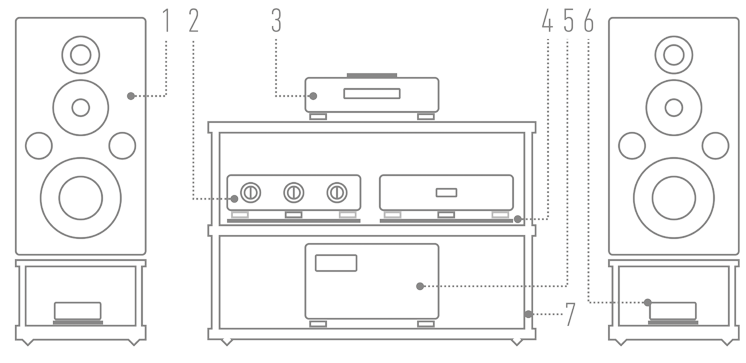 1) Loudspeakers: HARBETH M40.1 |REVIEW| 2) Line preamplifier: AYON AUDIO Spheris III Linestage |REVIEW| 3) Super Audio CD Player: AYON AUDIO CD-35 HF Edition No. 01/50 |REVIEW| 4) Stands (loudspeakers): ACOUSTIC REVIVE (custom) |ABOUT| 5) Power amplifier: SOULUTION 710 6) Loudspeaker filter: SPEC REAL-SOUND PROCESSOR RSP-AZ9EX (prototype) |REVIEW| 7) Hi-Fi rack: Hi-Fi rack: finite elemente MASTER REFERENCE PAGODE EDITION Mk II, more → HERE |
|

|
Cables Analog interconnect SACD Player - Line preamplifier: SILTECH Triple Crown (1 m) |ABOUT|» ANALOG INTERCONNECT Line preamplifier → Power amplifier: Siltech ROYAL SINLGE CROWN RCA; review → HERE Speaker cable: SILTECH Triple Crown (2.5 m) |ABOUT| |

|
AC Power Power cable | Mains Power Distribution Block - SACD Player: SILTECH Triple CrownPower (2 m) |ARTICLE| » POWER CABLE Mains Power Distribution Block → Line preamplifier: Acoustic Revive ABSOLUTE-POWER CORD, review → HERE » POWER CABLE Mains Power Distribution Block → Power amplifier: Acoustic Revive ABSOLUTE-POWER CORD, review → HERE Power cable | Power Receptacle - Mains Power Distribution Block: ACROLINK Mexcel 7N-PC9500 (2 m) |ARTICLE| Power Receptacle: Acoustic Revive RTP-4eu ULTIMATE |REVIEW| » ANTI-VIBRATION PLATFORM under Acoustic Revive RTP-4eu ULTIMATE: Graphite Audio CLASSIC 100 ULTRA, review → HERE Power Supply Conditioner: Acoustic Revive RPC-1 |REVIEW| Power Supply Conditioner: Acoustic Revive RAS-14 Triple-C |REVIEW| Passive filter EMI/RFI: VERICTUM Block |REVIEW| |

|
Anti-vibration Speaker stands: ACOUSTIC REVIVE (custom)Hi-Fi rack: finite elemente MASTER REFERENCE PAGODE EDITION Mk II, more → HERE Anti-vibration platforms: ACOUSTIC REVIVE RAF-48H |ARTICLE| » ANTI-VIBRATIONAL FEET: |

|
Analogue Phono preamplifier: Phono cartridges:
Clamp: PATHE WINGS Titanium PW-Ti 770 | Limited Edition Record mats:
|

|
Headphones » HEADPHONE AMPLIFIER: Leben CS-600X, review → HEREHeadphones: Headphone Cables: Forza AudioWorks NOIR HYBRID HPC |