


|
INTEGRATED AMPLIFIER MORE AUDIO
Manufacturer: MORE AUDIO |

 |
 |
 |
|
Review
text by WOJCIECH PACUŁA |

|
No 269 October 1, 2026 |
|
˻ THE FIRST REVIEW ˼
TWO YEARS OF WORK, and an amplifier arrives for testing exactly the same as the previous one. Maybe not quite “exactly the same” or “to the letter,” since they are, after all, different amplifiers, but to an outsider they would appear identical. The CS200, the new amplifier, shares the same chassis, the same power amplifier stage, and the same power supply with its predecessor, the CS100; read the review of the CS100 → HERE ˻PL˺. I’ll go one step further - the first finished unit sent for testing still came with a remote labeled “CS100.” 
The official launch of the device is scheduled for October; you’ll be able to see and hear it at the Audio Video Show 2026, which is why not everything is quite polished yet - to use a cliché - but formally and technically, the unit I received, brought to me by Tomasz Dębski, its designer, and Jan Siwy, who manages the company, is a finished, completely new amplifier from More Audio. As the listening test shows, truly different. ▲ A few simple words TOMASZ DĘBSKI WE OFTEN SAY that there is no such thing as a perfect amplifier. If someone were to build one, we wouldn't have anything left to do. 
‖ Messrs. TOMASZ DĘBSKI, founder and designer, and JAN SIWY, More Audio’s manager In the CS100, we presented the topology we developed and saw for ourselves its enormous potential. For the first time, it embodied in a coherent form what we consider to be the foundation of the More Audio sound: a combination of control and discipline with organic naturalness, subtle warmth, and freedom. That is what the CS100 is, and we treat it as a benchmark. However, it is not a perfect amplifier. Like any design, it has its limitations - partly due to the target price point and partly due to decisions we deemed appropriate at that stage of development. Nevertheless, the experience we gained with the CS100 showed us the direction in which we should move forward. 
‖ Block diagram of the amplifier • photo courtesy of More Audio The primary goal when designing the CS200 was to achieve an even more precise and clear stereo image. One in which the instruments are better positioned, and the recording’s acoustics become a more distinct part of the musical experience. Another important area where we wanted to make improvements was micro-dynamics—that is, the ability to convey the subtlest changes in volume, accents, and decay. We wanted to better capture the variety of textures, the interplay of sounds, and the inner life of the music. The path we chose to achieve these goals was simplifying the signal path. A larger budget for the CS200 allowed us to completely redesign the preamplifier and this time it is a passive stage. In doing so, we removed stages that were no longer necessary in the new architecture. Each stage removed means fewer active components between the source and the speaker, and thus less interference with the signal. However, a passive circuit places greater demands on the entire design. 
‖ The amplifier is delivered in a nice case This is precisely what constitutes the challenge of conscious minimalism. The trick isn’t simply to remove part of the mix. The trick is to simplify the circuit in such a way that nothing is lost, preserving even the finest details of the recording as faithfully as possible. The line between a deliberately simple design and one that is overly simplified is very fine. That is why it took us two years of intensive work to develop the CS200. Today, it is finally ready. In our opinion, not only have we achieved our goals, but in some respects we have exceeded our own expectations. The final judgment, however, rests with you, and it will come once the CS200 finds its place in various systems. We are convinced that it will bring its listeners great joy in experiencing music. ‖ TD ▒ CS200 CS200 IS AN INTEGRATED AMPLIFIER from the Polish company More Audio. It offers an output power of 100 W at an 8 Ω load and 200 W at 4 Ω, while maintaining a wide frequency response from 5 Hz to 120 kHz (-1 dB). It should be noted that this amplifier features a transformer-coupled input and a passive attenuator. Its enclosure is nearly identical to that of the CS100. In fact, it is identical, because the manufacturer wants to distinguish them from each other by the color of the front panel. In the older amplifier, the aluminum part of the front panel is supposed to be silver, while in the new one it’s black. As far as I’m concerned, this is completely unclear, and I think the model designations should be placed on the cover plate concealing the LEDs. FEATURES • From a functional standpoint, we are dealing with an integrated amplifier, i.e., a device that combines a preamplifier and a power amplifier in a single chassis (hence “integrated”). It offers four line inputs: two unbalanced (RCA) and two balanced (XLR). The signal path is unbalanced, so the balanced inputs are primarily for convenience and for audiophiles who prefer this type of connection. 
This is a classic example of the design philosophy behind products in this class. The CS200 therefore does not include a DAC, a Bluetooth receiver, or a media player. Nor does it feature a phono preamp, a headphone amplifier, or preamp or recording outputs. This is, let me emphasize it once more, a “pure” amplifier. Its enclosure is made of aluminum components and large heat sinks that form the side panels. On the front, behind a glass panel featuring UV-printed elements, there are red LEDs grouped into three sections: a power indicator, a selected-input indicator, and two sections of the volume level indicator. This meter takes the form of a “ruler”; it is very precise and has been divided into several sections. The inputs are mounted in the classic rear-panel layout and consist of widely spaced, gold-plated Neutrik jacks. The individual speaker terminals - a product of the American company CMC (Charming Music Conductor) - are also gold-plated. The CS200 is controlled either via the remote control or the buttons on the top panel. These include buttons for switching inputs, adjusting volume, muting, and waking the unit from standby; the mechanical power switch is located on the back, next to the IEC power inlet. The remote control is made of aluminum and is reasonably comfortable to use. The final version is intended to be black, just like the amplifier’s front panel. TECHNOLOGY • From a technical standpoint, the preamplifier has been changed, and in the power amplifier, the input capacitor has been replaced with another, very nice component from the Polish company Miflex - the KPCU-02. It is a hermetically sealed capacitor with paper and polypropylene layers and a pure copper foil. The entire unit is oil-impregnated. This is the only capacitor in the signal path. It is also worth mentioning that both the power supply and the power amplifier will be built on a gold-plated printed circuit board with a thicker layer of copper. The amplifier’s other circuit boards feature a similar aesthetic. In the unit provided for this test, the power amplifiers still had red finishes, while the rest of the unit was already black and gold. The manufacturer also states that the power amplifiers used in the CS200 will undergo more precise measurements than those in the CS100 and will be matched in pairs based on these results. The power amplifier is exactly the same design (apart from the aforementioned capacitor and the new circuit boards) as the one used in the CS100. And it is a very cool solution. Let me remind you that it features two stages with local negative feedback. The first stage is a voltage amplifier in single-ended (SE) topology operating in Class A. The second and final stage is a current buffer in dynamic single-ended (SE) topology operating in Class AB. It is subject to both negative and positive local feedback. This design ensures that the amplifier features active damping at the speaker output. The manufacturer explains in an email to us:
To clarify: the damping factor listed in amplifier specifications, unlike our solution, refers to passive damping. That is why we often refer to this power amplifier as having an infinite DF (which is a bit of a simplification) or negative output impedance.
So this is a trans-impedance amplifier. In other words, one whose output stage operates in current mode and has a gain of 1. The actual amplifier is therefore the preceding stage, which is also single-ended. Presumably to emphasize taking a step back - but with a new twist - the manufacturer uses the slogan: “Transistor Single-Ended ReEvolution.” As we wrote about the CS100, several audio manufacturers in the high-end segment offer solutions of this type. The Canadian company → TENOR AUDIO, where the input stage uses tubes and the output stage uses transistors, as well as the Italian manufacturer → AUDIA FLIGHT, with fully transistor-based amplifiers. In both cases, however, the output stage is a classic push-pull configuration. Each channel features five output transistors driven by two additional transistors, all connected in parallel. Alongside them are precision Dale resistors, Wima polypropylene capacitors, and Elna Silmic II electrolytic capacitors - that is, those with silk-screened markings. The entire unit is powered by a sizable toroidal transformer from Toroidy.pl. It is enclosed in a shield along with a smaller transformer for the standby circuit. Both channels have separate power supplies with dual secondary windings. Mains ripple suppression is handled by four very large Epcos capacitors, which occupy most of the interior. They are mounted not directly to the bottom of the chassis, but to an additional plate. The CS200 features an expanded power supply protection circuit, making it even more resistant to interference. 
This is a very simple circuit in terms of its amplification path. Along the signal path from the source to the speaker, it features only two stages, which are composed of a total of four active branches. There is also no global negative feedback, and it features an unusual topology for the output stage. The most interesting feature, however, is the purist, fully passive preamplifier circuit. In the CS100, the preamplifier was active, with buffers and an attenuator built using a resistor ladder switched by solid-state switches. It took the company two years to redesign it to make it more functional and sound better. To achieve this, the active stages were eliminated, and the precision resistors are now switched via relays. Studio-grade Lundahl transformers are used at the input. They galvanically isolate the amplifier from the signal sources. |
The operation itself has also been improved. To avoid artifacts that might have occurred previously, the attenuator has been duplicated with a high-end integrated circuit, also featuring a resistor ladder. It is active only when the volume is adjusted and assists the main circuit in such a way that the volume change is absolutely silent. Two seconds after the adjustment is complete, the circuit turns off, leaving only two resistors in the signal path. It’s simple, but twice as expensive as the classic volume control found in any other device of this type. ▲ What if… THE SHAPE OF CS200 AMPLIFIER is quite unusual - it’s tall and quite narrow. I find this shape particularly appealing. There’s something confident and soothing about it. I really liked it two years ago when I tested the CS100 model, and I still like it today. The same goes for the design of the glass panel on the front of the unit. When I saw it again, I thought that if it were the body of a CD (or SACD) player, it would look awesome, too. Following that line of thought, I pictured such a device in my mind - and, I’ll add right away - I really liked that image. I know that More Audio is also planning a digital-to-analog converter in the future, so half the device would already be there. Without pausing for a moment, I thought: “What if…” For example, if two companies were involved in building such a player. The transport section could be developed by Ancient Audio, which specializes in CD players, while the DAC and chassis would be handled by More Audio. And since there would be two companies, why not three? After all, it would be wonderful if Divine Acoustics took care of vibration damping and dissipation - both in terms of the feet, the decoupling of the circuit boards inside, and the transport mechanism itself. And if that were the case, I continued to daydream, the perfect finishing touch would be the noise-elimination techniques developed by Thunder Melody. Interesting idea, isn’t it? Nice and absolutely unrealistic, both because of the final cost of such a crazy device and the hard-to-imagine collaboration between as many as four entities - individualists convinced they’re right. Polish entities. But who’s going to stop us from dreaming… ▓ SOUND HOW WE LISTENED • More Audio CS200 integrated amplifier was tested in the HIGH FIDELITY reference system. It was compared to a two-box reference system consisting of the Ayon Audio Spheris Evo preamplifier and the Soulution 710 transistor power amplifier. Separately, I compared it to the Vinnierossi Brama Integrated Amplifier and the Audio Resurgence AR6A Kraken Evolution. During the test, the unit stood on its own feet on the top carbon fiber shelf of the Finite Elemente Pagode Edition Mk II rack. 
I used Ayon Audio CD-35 HF Edition SACD player as my source. In this test, the signal between the player and the amplifier was transmitted via a Crystal Cable Absolute Dream RCA interconnect, and the signal to the speakers was delivered via a Crystal Cable Da Vinci speaker cable. The amplifier drove Harbeth M40.1 speakers and was powered by an Acrolink Mexcel 7N-PC9500 power cable. » RECORDINGS USED FOR THE TEST ⸜ a selection
• ART BLAKEY & THE JAZZ MESSENGERS, Just Coolin’, Blue Note/Universal Music Llc (Japan) UCGQ-9027, SHM-SACD ⸜ 2020 ‖ reviewed → HERE ˻PL˺. I FOUND THIS NEW More Audio amplifier interesting, really interesting. It seems similar to the CS100, with a similar sound signature, yet it’s so completely different from it. Those first moments of listening to music through it won’t tell us much about it. It’s more about the experience of the music itself. It’s a truism - every company strives for this - but the CS200 actually achieves it - in its own way, but it does achieve it. 
That expression: “in its own way” might be a bit off, because it suggests putting itself in front of the music rather than behind it, which in turn would suggest imposing the amplifier’s own personality, interpreting the music the way the amplifier “sees” it. That’s always the case; there are no perfectly “transparent” devices, and there never will be. I’m not even talking about information theory, according to which every copy contains errors, but simply about everyday experience and the fact that audio equipment is a physical product and will remain so. The “in its own way” I’m referring to here involves a slight departure from imposing anything more on us than is necessary. The CS200 plays in a very clear manner. This is the true clarity and “transparency” we write about from time to time. That is, the kind where we blend into the recording and gain confidence in the events unfolding on the soundstage before us. A confidence that, over time, allows us to let go of any doubts regarding the mechanical nature of this presentation. More Audio is a product that strives to take a back seat to the music, to the albums we play. It’s impossible to do this 100% - as I’ve already said - but it can be approached exactly the way I hear it here. That is, to have something to say, but only at the end, not right off the bat. The CS200’s clarity is evident from the very first moment. The sound is tangible, expansive, and free-flowing. At the same time - and this is the “unique character” I’m referring to - it has a certain “quality” to it; it’s neither empty nor indifferent. The unit under review plays with panache, with a very wide frequency range, and yet neither the high-frequency drum sounds of the leader in ˻ 2 ˺ Close Your Eyes on Art Blakey’s album Just Coolin’, nor was Jimi Merritt’s double bass particularly powerful. They weren’t powerful, yet they were perfectly clear, and when needed, they struck low (the kick drum and double bass) or built a cloud of sound in the right channel (the cymbals). It just so happens, however, that despite this “width” and dynamics, it’s not the frequency extremes that draw attention, but the midrange. This is because that’s where the most information is, and we’re evolutionarily “tuned” to it - not because the amplifier limits our perception to that specific band. When we turn up the volume slightly, both the high and low ends suddenly come to life. After a while, we get used to it, and once again it seems to us that the midrange is the dominant part. And so on. Still, at no point would we say that this is a “warm” sound, much less a “tube-like” one. It has the naturalness of the former and the softness of the latter, yet it is completely different. It has just occurred to me that the top-of-the-line passive preamps sound similarly. Here, too, there is a passive preamp, but that’s not the only thing the CS200 is about - at least that’s how I see it. Where “passives” - even the very best ones - fall short, mainly in the energy of the lower midrange and the fullness of the frequency response, the amplifier under review simply performs very well. Take, for example, ˻ 11 ˺ Leave Me Alone from Michael Jackson’s album Bad. I reached for it because, first, Mobile Fidelity is about to release a new remaster on 1-step LPs and SACDs, and second, Janusz Sikora (J. Sikora), whom I’d interviewed a few days earlier, recalled that his older son - still in a stroller at the time - would start moving his hands to beat whenever he heard this track (which was playing on MTV back then); today, he’s a musician… Let me remind you that this was a bonus track, available only on the CD. Those were the days when a new format was being promoted, and this was a way to encourage people to buy the digital version of the album. 
I’m listening to this album using the tested CS200 - the first U.S. pressing from 1987 - and it sounds wonderful. The recording has a certain patina to it; there’s not much detail in the textures, but it has a certain ease - and even authenticity - to it. And plenty of bass. The Polish amplifier brought out that bass powerfully, deeply, and densely. The entire recording’s tonal balance is set fairly low; it doesn’t reveal its digital nature - the album was recorded on Mitsubishi X-800 digital tape recorders and mixed on a digital X-82. However, there’s something in it that I recognize from those machines: very good definition without an emphasized attack. The amplifier maintains this definition beautifully without sharpening the edges. This isn’t a bright sound - at any moment, with any recording. Nevertheless, it renders details and nuances superbly. It does this, as I see it, thanks to its beautiful fullness and ease in conveying dynamic shifts, in a way that isn’t sterile, but rather appealing. It strives more to reveal the character of the recording than its own. That’s why playing DAVE GRUSIN’s album Out Of The Shadows right after Jackson completely changed the sound. This recording was digitally mixed to a digital master using JVC equipment with a digital U-matic mastering tape recorder. It’s a much drier mix than Jackson’s album, but just as dynamic. And the high frequencies on it are incredibly precise and selective. Let’s listen to that sound that pops up every now and then in the left channel, or the “cow ball” closer to the center of the soundstage in ˻ 1 ˺ Last Train to Paradiso, and you’ll know what I’m talking about. The dryness is also evident in the subdued reverberations. The CS200 conveyed these sounds and these moods in a pleasant, almost gentle way. Yes - “gentle” would also be a good way to describe this device, were it not for the fact that it is also highly detailed and fantastically dynamic. Yet all of this is imbued with a natural softness, and pleasure derived from listening to music. And it’s a pleasure that grows day by day, album by album. I experienced this even over the short time I spent with More Audio. ▒ Summary LISTENED TO TOWARD THE VERY END of the tests, JEAN-MICHEL JARRE’s track from the Equinoxe, on an early reissue of the original release, sounded simply wonderful. The sound was naturally soft, incredibly open, and full. There was also a very wide soundstage. It isn’t exceptionally deep with CS200, but it’s always very well defined and layered. That is to say, the sounds have their own acoustics and a sense of “here and now.” The sound is also remarkably dynamic. And all of this is delivered effortlessly, very nicely, much like with 300B tube-based amplifiers. CS100 was an amplifier I recommended to anyone who wanted density, depth, and fullness, but without sacrificing resolution. The CS200 is more selective, more detailed, and more dynamic. However, it doesn’t add depth to the sound in the same way as its predecessor, nor does it saturate everything to the point of distortion. It’s much more transparent, and as a result, it imposes its personality less on the entire system and the recordings. In short, it’s better, though also different. 
It’s really hard not to smile with delight when I hear ˻ 3 ˺ Equinoxe. Part 3, where there are those low synthesizer sounds in the right channel, and high-pitched notes sparkle in the upper frequencies. That’s exactly what this amplifier is like: ultra-pleasant and incredibly honest. In a sense - it’s “analog.” What more could you ask for? ‖ WP ▒ Technical specifications (according to the manufacturer)
Maximum output: 100 W RMS / 8 Ω, 200 W RMS / 4 Ω |
 |



|
Reference system 2026 |
|
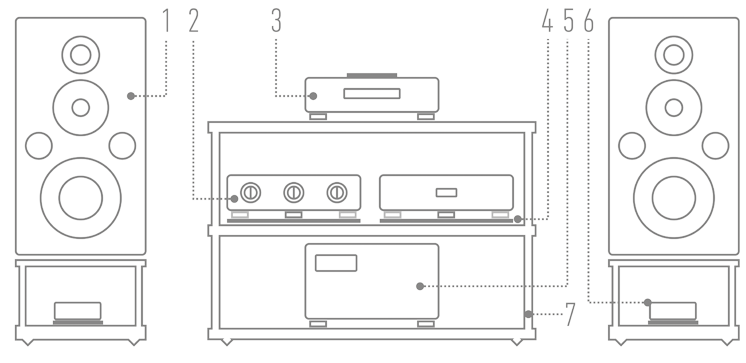 1) Loudspeakers: HARBETH M40.1 |REVIEW| 2) Line preamplifier: AYON AUDIO Spheris III Linestage |REVIEW| 3) Super Audio CD Player: AYON AUDIO CD-35 HF Edition No. 01/50 |REVIEW| 4) Stands (loudspeakers): ACOUSTIC REVIVE (custom) |ABOUT| 5) Power amplifier: SOULUTION 710 6) Loudspeaker filter: SPEC REAL-SOUND PROCESSOR RSP-AZ9EX (prototype) |REVIEW| 7) Hi-Fi rack: Hi-Fi rack: finite elemente MASTER REFERENCE PAGODE EDITION Mk II, more → HERE |
|

|
Cables Analog interconnect SACD Player - Line preamplifier: SILTECH Triple Crown (1 m) |ABOUT|» ANALOG INTERCONNECT Line preamplifier → Power amplifier: Siltech ROYAL SINLGE CROWN RCA; review → HERE Speaker cable: SILTECH Triple Crown (2.5 m) |ABOUT| |

|
AC Power Power cable | Mains Power Distribution Block - SACD Player: SILTECH Triple CrownPower (2 m) |ARTICLE| » POWER CABLE Mains Power Distribution Block → Line preamplifier: Acoustic Revive ABSOLUTE-POWER CORD, review → HERE » POWER CABLE Mains Power Distribution Block → Power amplifier: Acoustic Revive ABSOLUTE-POWER CORD, review → HERE Power cable | Power Receptacle - Mains Power Distribution Block: ACROLINK Mexcel 7N-PC9500 (2 m) |ARTICLE| Power Receptacle: Acoustic Revive RTP-4eu ULTIMATE |REVIEW| » ANTI-VIBRATION PLATFORM under Acoustic Revive RTP-4eu ULTIMATE: Graphite Audio CLASSIC 100 ULTRA, review → HERE Power Supply Conditioner: Acoustic Revive RPC-1 |REVIEW| Power Supply Conditioner: Acoustic Revive RAS-14 Triple-C |REVIEW| Passive filter EMI/RFI: VERICTUM Block |REVIEW| |

|
Anti-vibration Speaker stands: ACOUSTIC REVIVE (custom)Hi-Fi rack: finite elemente MASTER REFERENCE PAGODE EDITION Mk II, more → HERE Anti-vibration platforms: ACOUSTIC REVIVE RAF-48H |ARTICLE| » ANTI-VIBRATIONAL FEET: |

|
Analogue Phono preamplifier: Phono cartridges:
Clamp: PATHE WINGS Titanium PW-Ti 770 | Limited Edition Record mats:
|

|
Headphones » HEADPHONE AMPLIFIER: Leben CS-600X, review → HEREHeadphones: Headphone Cables: Forza AudioWorks NOIR HYBRID HPC |