


|
POWER AMPLIFIER • monaural AUDIO REVEAL
Manufacturer: ALTRONIK |

 |
 |
 |
|
Review
text by WOJCIECH PACUŁA |

|
No 267 August 1, 2026 |
|
˻ PREMIERE TEST ˼
WHEN I WROTE IN THE CONCLUSION OF MY REVIEW of the Classique integrated amplifier that it is “one of the most interesting 300B tube amplifiers currently available on the market” I was not exaggerating in the slightest. The same goes for what I added right after that: “It’s also one of the best Polish amplifiers overall.” What’s more, the way this unit sounds matched my idea of top-tier sound so well that I decided to award it the Gold Fingerprint distinction. 
You’ll agree that for such a young company - it’s celebrating its 10th anniversary this year - this is an exceptional achievement. It achieved this not only thanks to the experience it gained in designing, building, and selling (all of these elements are equally important) single-ended (SE) amplifiers - that is, those with a single amplifying element in the output stage - but also because at some point it turned to the 300B tube; previously, it had used 6550 beam tetrodes in the Junior, KT88s in the First (including the Mk II), KT150s in the Second, and KT170s in the Second Signature. However, the first product bearing the Audio Revive logo to feature this directly heated triode - whose roots date back to 1938 and Western Electric - was not an amplifier, but the Hercules digital-to-analog converter; more → HERE. It was an unexpected and bold move. It wasn’t until a year later that the Classique integrated amplifier - the one I began this review with - was released. Now they are joined by the 300B monoblocks, called the Classique Duo, and by the end of the year, a linear preamplifier - also using the same tubes - is set to be ready, thus completing an audio system whose signal path will consist of almost exclusively 300B triodes, from the output stage of the D/A converter, through the preamplifier, to the power amplifier. ▲ A few simple words… MICHAŁ POSIEWKA AFTER THE CLASSIC AMPLIFIER - based on the iconic 300B tubes - was very well received by customers, I decided to develop a pair of monaural amps based on it, which I named the Classique Duo. 
‖ Capacitors and resistors are measured and matched • photo courtesy of Audio Reveal The new amplifiers are designed as single-ended circuits and operate in Class A. I used 300B output tubes - two per channel - in a parallel configuration, along with 12AU7 and 12BH7 driver tubes. The anode voltage was smoothed and filtered using chokes operating in an LC circuit. The use of two 300B tubes operating in parallel allowed me to achieve 16 W per channel. 
‖ Assembly of auxiliary PCBs • photo courtesy of Audio Reveal By definition, each monoblock operates in a completely separate chassis and uses its own independent power supply, which ensures excellent channel separation. In practice, this translates to a more precise soundstage, better instrument localization, and exceptional spatiality and naturalness of sound. These exceptional sonic qualities are the result of a refined design and the use of carefully selected components. 
‖ The amplifier's main PCB, not yet populated with components • photo courtesy of Audio Reveal The device’s styling builds on Audio Reveal’s signature design. The massive, solidly built chassis, the front panel finished in exotic Merbau wood, and the steel, hand-turned knobs highlight its exclusive character and the attention to detail. ‖ MP ▒ Classque Duo MICHAŁ POSIEWKA’S MONOBLOCKS are priced in the upper echelons of the audio world. They aren’t the most expensive, but they still cost a lot of money. For that price, you get handcrafted amplifiers in the form of two separate units, one for the left channel and one for the right. They deliver 16 watts per channel with 5% total harmonic distortion (THD), which is a typical figure for the 300B tubes used in them. The amplifiers are quite large, especially in terms of their depth. You should therefore need a rack with a larger top than standard. During testing, the amplifiers stood on the floor, on Acoustic Revive RST-38H anti-vibration platforms, and barely fit on them. In fact, with dimensions of 225 x 300 x 500 mm, they need something larger. Each one weighs 25.5 kilograms. ELECTRONICS • The amplification stage in these amplifiers is entirely tube-based. Two dual triodes are used at the input: a 12AU7 in the input buffer and a large, less common 12BH7, which drives the power tubes. And those are fantastic - they’re 300B triodes. The tubes operate in a single-ended configuration, meaning each one amplifies the entire signal, not just half of it. To double the output power, the designer used two tubes per channel, so the 300Bs operate in a parallel single ended mode. The tubes come from several suppliers. The 12AU7, in the 12AU7S version, was purchased from the Chinese manufacturer Psvane, as were the output tubes. The 12BH7, on the other hand, is a product (unfortunately) of the Russian company Electro-Harmonix. However, buyers can request other configurations, especially when it comes to the output tubes - we tested the amplifier with Western Electric tubes; this configuration is more expensive. The amplifier with Psvane tubes costs 109,000 zlotys per pair, while the version with Western Electric tubes costs 122,000 zlotys, also per pair. The amplification stage and power supply feature high-quality passive components. The capacitors include Claritycap polypropylene capacitors (ESA version), WIMA polypropylene capacitors, and - in the power supply - classic Nichicon capacitors, and from the Fine Gold series, plus EPCOS capacitors. The high-power resistors also look great: Vishay, Tyco Electronics, and Royal Ohm. Only the input connectors (single RCA) and output connectors (for 4- and 8-ohm loads) are of standard quality; it would be nice if these were truly top-of-the-line products. MECHANICS • The amplifiers’ design is typical for this class of equipment: the chassis is deep and narrow. On the front panel, made of merbau wood, there is only a nice steel power switch with an LED; it flashes red during startup, which takes about a minute, and green while the unit is running. The switch is mounted in a steel, precision-machined socket, which looks very professional. ▲ Merbau 
MERBAU IS AN EXOTIC wood species harvested from trees of the genus Intsia, which grow in the equatorial forests of Southeast Asia, Australia, and Oceania. It is prized for its exceptional hardness (about 30% higher than oak), durability, and elegant reddish-brown color, which is why it is often used for flooring, decks, and furniture. It is also known as Kwila and Ipil. ● THE TUBES ARE MOUNTED on the front of the unit, with the smaller ones closer to us and the output tubes at the back. This is the most common layout for the unit’s chassis, designed with aesthetics in mind. With this arrangement, the signal must travel along a long interconnect from the jack on the rear panel to the front, to the input tube. But, as I said, this is the most common type. A few companies offer modifications to this design, such as Jade (France) and Kondo (Japan), in a similar style with a narrow front panel, and Uesugi (Japan), and, in the past, McIntosh (USA) and QUAD (UK), with amplifiers featuring a wide front panel but with inputs on the left and outputs on the right. The tubes are mounted in sturdy ceramic sockets with gold-plated contacts. The housing is made of steel and painted black, but the section with the tubes features a brushed steel plate; this plate also plays an important role in cooling, acting as a reflector, since it is mounted to the chassis on spacers. Slots have been cut into the sides and bottom of the unit to cool the interior. The unit gets very hot, so it’s a good idea to leave plenty of space around it. It’s worth noting that the set also includes a protective cover to prevent burns and protect the tubes from damage. 
Behind the tubes, you’ll find three cubes housing transformers: an output transformer, a power supply transformer, and - the smaller one - a choke. All of them come from Leszek Ogonowski’s workshop. Although the amplifier is tube-based, it isn’t entirely so, since its power supply is solid-state. Just as Jarek Waszczyszyn did in his Ancient Audio amplifiers, Michał Posiewka also decided to use semiconductors. These include voltage regulators and diodes from Texas Instruments, STMicroelectronics, and Diotec Semiconductor AG. The amplifiers look well-build and attractive - just like a product from a good workshop. They’re also precision-crafted, right down to the small aluminum feet fitted with rubber rings. This prevents the amplifier from sliding on the shelf. It all looks really good. ▓ SOUND HOW WE LISTENED • The Audio Reveal Classique Duo amplifiers were tested in the “High Fidelity” reference system. It was compared to the reference amplifier, the Soulution 710 transistor power amplifier, and was paired with the Ayon Audio Spheris Evo tube preamplifier and the Ayon Audio CD-35 HF Edition SACD player; the entire signal path, starting from the player’s tube output and continuing through the preamplifier, was thus amplified by tubes operating in single-ended mode. 
The signal between the Ayon player and the preamplifier was transmitted via a RCA Siltech Triple Crown interconnect, and between the preamplifier and the power amplifiers via an RCA Siltech Single Crown interconnect; the amplifiers were powered using Acoustic Revive Absolute Power K cables. The signal to the Harbeth M40.1 speakers was delivered via a Crystal Cable Da Vinci speaker cable. |
» RECORDINGS USED FOR THE TEST ⸜ a selection
• BILL EVANS, JIM HALL, Undercurrent +4, Liberty/Esoteric Company ESSJ-90317, Esoteric Master Sound Works, 1962/2025. ONE OF THE METHODS FOR TESTING audio products is an approach I would call a “challenge.” The idea is that we sit down in front of the system with a handful of CDs (or a playlist) and wonder, “How will X or Y handle this or that album/track?” It’s a good approach - a confrontational one - but it yields good results. We “put the product to the test,” in a sense, trying to push it to the limits of its capabilities, to the point where it “can’t go any further.” And only after determining those limits do we return to regular listening sessions, which are meant to give us a comprehensive overview. 
For quite some time now, however, I’ve been testing differently. Although I’m curious about how low a given pair of speakers extends in the bass, what kind of soundstage a given amplifier offers, and how clean the music sounds with various cables, these factors are secondary to the overall impression left by such a test. I think - or so it seems to me - that ultimately, when we’re left alone with this product, at home, a product we’ve paid for and that’s ours, then aside from situations like “a visit from an audiophile friend” we won’t give a damn about how low, how stereoscopic, or how clean that component sounds. What will interest us is how we feel about it and whether, after three hours of listening to the music, we’ll still want “more.” I assure you that with Michał Posiewka’s amplifier - any of them, but especially the Classque Duo - we’ll want not just “more,” but a lot more. And that’s because this device offers an exceptionally smooth sound, “analog” in the best sense of the word, and simply put: enjoyable. This is an amplifier that celebrates a warm midrange - that’s the first thing - but it’s also one that creates a large, full soundstage. It is warm, that’s for sure, but it doesn’t „dampen” the treble. I would even say that, in terms of resolution and detail, it’s better than my Soulution 710, on par with the incredibly good 717 model I recently tested; more → HERE. It may only be slightly better than the 710, but it is. It’s able to convey the atmosphere of the recordings even better - without exceeding the 710’s level - even through the tape hiss, which is, after all, part of the music. This was the case with the BILL EVANS and JIM HALL’S Undercurrent album, whose latest reissue, on SACD, I just reviewed; more → HERE ˻PL˺. This encounter between the piano and the jazz electric guitar is incredibly intimate, almost Zen-like. The Polish amplifier rendered this quality wonderfully, because it slightly expanded the soundstage, brought the guitar a little closer - though it remains slightly more in the background - and imbued the whole thing with a dense patina of noise. As I said, the noise in question is part of the recording and, over time, becomes just another “sound” - almost an instrument. Here, it constituted something like the atmosphere of the studio. None of the sterile dryness found in many contemporary recordings - just the “meat” of the sound. It was already clear that the tested monoblocks are brilliant at building the dramatic tension of a recording. After all, there are only two instruments, but with an additional piano track layered in the right channel, the Classique Duo - as the name suggests - presented the musicians as if they were sitting right in front of me on a small stage. When we play an album with significantly more high frequencies, we’ll get a brighter sound. But even with John Lennon’s 1975 album Rock’n’Roll, it won’t be a bright sound. The amplifier softens the treble, even though it’s very detailed. It’s as if the attack were slightly rounded off, but we still received all the information. And that’s great, that’s awesome. An album that usually gives me trouble during tests - because it’s either too bright, too harsh, or too light - sounded engaging to me this time. Even those very high vocals - distorted and with a long delay - in the ˻ 2 Stay by me made sense; they were part of the performance. 
Lennon’s album, however, revealed something else - the Classque Duo monoblocks don’t directly warm up the sound. They soften and refine it - that’s true - but they don’t color it. That’s why such a wide variety of albums sounded so great with them. It also helped that they didn’t boost the lower end. If the bass is dense, it will be reproduced densely. But if it’s thin and weak, it will remain weak. As on the Rock’n’Roll album. And the more compressed the material was, the louder it could be played. The problem with Evans’ album is that it has a lot of energy in the lower midrange, which causes the amplifier to draw high currents. It wasn’t possible to turn up the volume beyond a certain point because the amplifier would start to distort. The volume was exactly what I needed for this type of recording, but whenever I wanted to really let loose, I was quickly brought back down to earth. Here’s how I interpret it: Michał’s amplifier reproduces the full frequency range, from the lowest bass to the highest treble, without compression. That’s why it doesn’t mitigate clipping. It simply “pumps” everything out with equal energy, hence the volume limitations - at least with a difficult load - and the Harbeth M40.1s are truly demanding in this regard. This ability to deliver - and this is important - a fast and dynamic full-range signal came in handy with the TSUYOSHI YAMAMOTO TRIO album Midnight Sugar, released in 2004 on a Gold HDCD disc by Impex Records. I like this version precisely for its energy and fullness. And it is precisely these two qualities that the Polish amplifier excels at. The double bass sounded powerful, deep, and rich. It didn’t have quite as dense a “body” as with the Soulution, and the studio acoustics - that is, the space bounded by the screens (the double bass was separated from the drums and piano by them) - were also slightly more audible. But the presence and immediacy of the piano were outstanding. It was still a tangible sound, with closely positioned phantom images. That’s how this amplifier sounds: intimate. At the same time, the overall sound was big, full, and natural. The energy transfer, I’ll say it again, is incredible with this device. The front-to-back separation was exceptionally good, and only my reference amp - and perhaps two or three other amplifiers I’ve reviewed - have been able to demonstrate this feature better. It’s important to note, however, that this isn’t, in my opinion, an aspect the amplifier particularly “emphasizes.” Its direct competitor, the Ancient Audio Silver Grand Mono Mk II amplifiers, which we tested last September, are completely different. They’re much more open, even faster, with a clearly better-defined attack - which is why the sound with them is super-controlled. But that’s what audio is all about, diversity, while maintaining the right direction. Michał Posiewka's amplifier is suited for a different type of system, for a different type of person. 
The Classque Duo leans toward expressiveness, fullness, and dynamics. It doesn’t matter what kind of music we listen to - and the rougher the recording, the more we’ll enjoy listening to it, because the amplifier reproduces it so well. Lennon is one such example, but for many music lovers who are passionate about jazz, the album Blur by the band BLUR can sound just as good. It’s an excellent rock recording of a Britpop classic, yet it possesses all the characteristics typical of such recordings - namely, compression and a sound that isn’t entirely pristine. With the Audio Reveal amplifiers ˻ 1 Beeltebum sounded wonderful. The vocals were beautifully varied, and the guitars sounded great. There was energy to it, but without any harshness. And the sound of the tape recorder’s buttons being turned off at the end only reinforced that positive impression. It was surprising and natural in its “presence.” And then there’s the bass. It isn’t as low or sustained as long as it is with the reference amplifier. I’m not just talking about electric or electronically generated bass here, but also acoustic bass. You simply can’t do that - it’s impossible. And if anyone thinks otherwise, then - it seems to me - they don’t know what they’re talking about. High power and current output are qualities we can only get from solid-state amplifiers or very powerful tube amplifiers - and even then, with limitations in terms of energy at the very bottom. And even when paired with high-efficiency speakers, we won’t achieve the same results as with a transistor amplifier paired with a classic speaker. The Classque Duo, however, excels in this regard. It delivers deep bass, controlled and well-defined. Its control and definition are better than those of many tube amplifiers based on powerful KT-series tubes. On the other hand, the warmth of the midrange is comparable to that of high-end EL34-based amplifiers. It’s an internal warmth, not an imposed one - so when Lennon sings, it’s piercing, and when Evans plays, it’s soothing. ▒ Summary THE POLISH AMPLIFIER meets all the requirements of a high-end device. What seems more important to me, however, is that it makes listening a real pleasure. It’s not bland - it directs the sound toward fullness and density. It brings out the background details and creates a large, realistic soundstage placed quite close to us - one that’s almost tangible. At the same time, it possesses an extraordinary ease of energy transfer. Everything I’m describing is conveyed as if it were live, but without being intrusive. The amplifier rounds out the attack of the sound, which allows lower quality recordings to regain their luster and vigor - making them listenable and even admirable, if they deserve it. 
The amplifier does not homogenize the sound, neither at the level of detail nor across entire albums. It differentiates them in a very authentic way, so that the recordings come alive with an inner drive and burn with an inner fire. Most importantly, however, the device allows for long, comfortable listening sessions without the suspicion that something is slipping away from the recordings, that some part of their world remains hidden from us - for better or worse, that simply isn’t the case. It will offer a sound sensitive to the beauty of music, in all its dimensions. ‖ WP ▒ Technical specifications (according to the manufacturer)
Maximum output (RMS): 16 W (8, 4 Ω/1 kHz, THD 5%) 
THIS TEST HAS BEEN DESIGNED ACCORDING TO THE GUIDELINES adopted by the Association of International Audiophile Publications, an international audio press association concerned with ethical and professional standards in our industry, of which HIGH FIDELITY is a founding member. More about the association and its constituent titles → HERE. |
 |



|
Reference system 2026 |
|
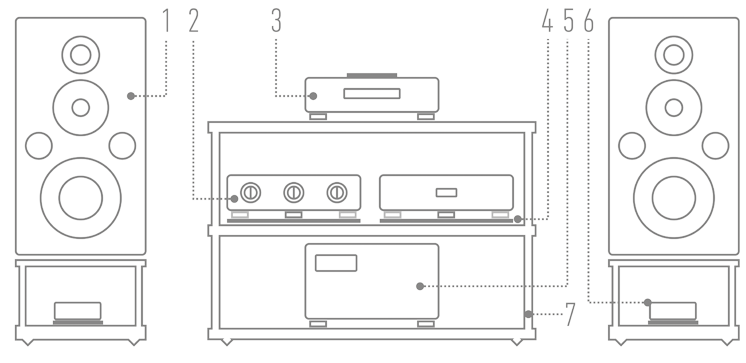 1) Loudspeakers: HARBETH M40.1 |REVIEW| 2) Line preamplifier: AYON AUDIO Spheris III Linestage |REVIEW| 3) Super Audio CD Player: AYON AUDIO CD-35 HF Edition No. 01/50 |REVIEW| 4) Stands (loudspeakers): ACOUSTIC REVIVE (custom) |ABOUT| 5) Power amplifier: SOULUTION 710 6) Loudspeaker filter: SPEC REAL-SOUND PROCESSOR RSP-AZ9EX (prototype) |REVIEW| 7) Hi-Fi rack: Hi-Fi rack: finite elemente MASTER REFERENCE PAGODE EDITION Mk II, more → HERE |
|

|
Cables Analog interconnect SACD Player - Line preamplifier: SILTECH Triple Crown (1 m) |ABOUT|» ANALOG INTERCONNECT Line preamplifier → Power amplifier: Siltech ROYAL SINLGE CROWN RCA; review → HERE Speaker cable: SILTECH Triple Crown (2.5 m) |ABOUT| |

|
AC Power Power cable | Mains Power Distribution Block - SACD Player: SILTECH Triple CrownPower (2 m) |ARTICLE| » POWER CABLE Mains Power Distribution Block → Line preamplifier: Acoustic Revive ABSOLUTE-POWER CORD, review → HERE » POWER CABLE Mains Power Distribution Block → Power amplifier: Acoustic Revive ABSOLUTE-POWER CORD, review → HERE Power cable | Power Receptacle - Mains Power Distribution Block: ACROLINK Mexcel 7N-PC9500 (2 m) |ARTICLE| Power Receptacle: Acoustic Revive RTP-4eu ULTIMATE |REVIEW| » ANTI-VIBRATION PLATFORM under Acoustic Revive RTP-4eu ULTIMATE: Graphite Audio CLASSIC 100 ULTRA, review → HERE Power Supply Conditioner: Acoustic Revive RPC-1 |REVIEW| Power Supply Conditioner: Acoustic Revive RAS-14 Triple-C |REVIEW| Passive filter EMI/RFI: VERICTUM Block |REVIEW| |

|
Anti-vibration Speaker stands: ACOUSTIC REVIVE (custom)Hi-Fi rack: finite elemente MASTER REFERENCE PAGODE EDITION Mk II, more → HERE Anti-vibration platforms: ACOUSTIC REVIVE RAF-48H |ARTICLE| » ANTI-VIBRATIONAL FEET: |

|
Analogue Phono preamplifier: Phono cartridges:
Clamp: PATHE WINGS Titanium PW-Ti 770 | Limited Edition Record mats:
|

|
Headphones » HEADPHONE AMPLIFIER: Leben CS-600X, review → HEREHeadphones: Headphone Cables: Forza AudioWorks NOIR HYBRID HPC |