


|
INTEGRATED AMPLIFIER SOULNOTE
Manufacturer: CSR INTERNATIONAL Ltd. |

 |
 |
 |
 |
|
Review
text by WOJCIECH PACUŁA |

|
No 263 April 1, 2026 |
FOR MANY YEARS, I HAVE BEEN WITNESSING changes in audio products. These changes share many common elements, regardless of whether we’re talking about “artistic” or “engineering” companies. This is an important distinction. The former are the result of the passion of individual enthusiasts – one might even say, fanatics of good sound. The latter is based on the organized activity of a larger team. Both are equally important, and both contribute to the development of our industry, each in its own way. 
“Artists” rely on listening sessions. This is a classic method of research, a branch of science known as “research by observation.” Based on the results they receive, they adjust the given system and listen to it again. And so on until the desired result is achieved, often for years on end. This is an extremely costly way of conducting research, and time-consuming to boot, which is why it is unacceptable to “engineering” firms. These, in turn, begin their work with a concept, but immediately enter “measurement” mode. It is not what sounds good that is good, but what measures well, because – as they assume – good measurement = good sound; this is how one could summarize this approach. From these two extreme approaches, intermediate models also emerge, combining observation and measurement, listening, and measurable parameters. The best “artists” rely on technical knowledge, often in-depth, while “engineers,” after completing the initial “technical” phase, sit down with the prototypes and put the finishing touches on them based on listening sessions. Both approaches can result in products that are sonically mature and measure well. ▓ A-2 ver. 2 THE JAPANESE COMPANY SOULNOTE (the name is stylized as SoulNote) was founded by an engineer from a large, well-known company (Marantz), who moved from the corporate world to the realm of small manufacturers. He had thus been exposed to the “engineering” approach that shaped him, after which he entered a world closer to the “artistic” one. It seems that by choosing Mr. Hidei Kato as his successor, he wanted to preserve the work ethic that was dear to him, but also to open up to solutions characteristic of manufacturers focused exclusively on sound. In this company’s devices, we find solutions that are implemented with technical expertise but are also part of something that can be called “intuition.” This applies to both circuit and mechanical solutions. FEATURES • The A-2 ver. 2 is a new version of the A-2 amplifier, originally designed by Mr. Kato and released in 2017, one year after he took over as head of Soulnote’s research department. It is an integrated, solid-state amplifier with a push-pull output stage. It offers substantial output: 2 × 80 W. Equally important, however, is that when the impedance drops by half, we get twice the power, 2 × 160 W (4 Ω). This demonstrates that the power supply is capable of handling large and sudden current draws. Interestingly, the older version offered higher output (100 and 200 W). More on this in the section on technical specifications. From a user perspective, the device is a “pure” “old school” amplifier. It consists simply of an input selector, a discrete transistor attenuator, and a power amplifier. It features no phono preamp, headphone amplifier, DAC, or Bluetooth. Instead, it features as many as six line inputs. Three of them are unbalanced RCA inputs, and three are balanced XLR inputs. There is a single speaker output. On the side, there are three small switches that expand the device’s functionality. The first two allow you to connect an external preamplifier, a file player, or a CD player with an adjustable output to the A-2 ver. 2, or to integrate the Soulnote into a home theater system. The third option allows you to bridge the power amplifier, resulting in a preamplifier with a monoblock designed to drive a single channel in a bi-amp system (with separate amplifiers for the tweeter and mid-bass sections of the speakers). To take full advantage of this solution, however, you need a second identical amplifier, also operating in “mono/bi-amp” mode – a solution also used by Marantz. The device is very pleasant and stress-free to operate. The front panel features two knobs for volume control and the input selector. The first works with a row of red LEDs, and the second with a red LED display. The display can be turned off using the remote control. The knobs turn smoothly, with a slight, noticeable resistance. The device can also be controlled using the remote. It is really nice and has acrylic buttons with a distinct click. This is not a remote control purchased from a specialized supplier in China. It is manufactured by the Austrian company Ruwido, founded in 1969, and it is almost a work of art. On its website, we read:
Our award-winning remote controls are designed developed, and manufactured in Austria – with 100% renewable energy; → RUWIDO.com, accessed: 30.12.2025.
This company has twice received the prestigious Red Dot Award for its products, in 2018 and 2025, as well as awards for other brands for which it has designed remote controls. I saw the exact same remote control in the Wadax Studio Player, which was featured on our February cover (HF ‖ № 262; more → HERE). ELECTRONICS • The basic parameters of the circuit proposed in A-2 remain more or less the same in version 2. But not quite the same, and it is precisely these minor changes that reveal a great deal about the direction Mr. Kato has taken. It is still a circuit operating without negative feedback, and thus has higher THD distortion than in classic amplifiers. The designer assumed, however, that these distortions have a less intrusive effect on sound quality than TIM distortions introduced by negative feedback. As I mentioned, it’s interesting that the new amplifier has lower output than the previous version: 80 vs. 100 W at 8 Ω and 160 vs. 200 W at 4 Ω. This isn’t a major change, but it indicates that a different point on the gain curve – perhaps a more linear one – was chosen for the output transistors. This circuit is based on Sanken bipolar transistors that are “precisely matched in terms of hFE,” as the manufacturer assures, “it eliminates the sound distortion typical of parallel push-pull designs.” TO3Ptransistors, identical to those in the output stage, are also used in the driver stage. We read:
By maintaining a high standing current in the drivers, hFE fluctuations caused by current changes in the output stage are instantly compensated, delivering exceptionally strong drive capability.
This marks the key difference from the original model and represents a technological breakthrough.
⸜ A-2 ver. 2, → www.SOULNOTE.co.jp, accessed: 9.02.2025. As in this manufacturer’s previous amplifiers, volume control is handled by a discrete resistor ladder. Instead of a resistive potentiometer or an integrated circuit with resistors, this design features a matrix of resistors switched by mechanical relays. This solution is associated with better sound quality. The input selector is also implemented using relays. 
Compared to the previous version, the power supply has also been improved. It is based on a large toroidal transformer with several secondary windings. By lowering the output voltage compared to the original model, the A-2 ver. 2 “prioritizes the ability to deliver instantaneous current at low impedances.” The lower output power is therefore intended to ensure faster, more dynamic reproduction of signal changes than in the previous version. MECHANICAL DESIGN • The mechanical design of Soulnote devices is just as important as the electrical design. For Mr. Kato, these are two equally important aspects of the design. The chassis is therefore composed of rigid aluminum plates and steel beams (as in Accuphase devices). Furthermore, the amplifier stands on spikes rather than feet, and the top plate is not rigidly fixed but is supported at only three points. What visually distinguishes ver. 2 from the previous version is the front panel. Previously, it was heavily ribbed, while the new version features only three horizontal elements. The higher-end “3” series was designed this way, and perhaps the intention was for the new amplifier to echo that design. To be honest, I liked the earlier version better, but that might just be a matter of habit. In any case, the front panel is rigid and resistant to resonance. The top panel is supported in three places and isn’t rigidly attached to the chassis. As we’ve mentioned before, this type of design is seen in audio equipment from time to time, though rarely. For example, Esoteric uses products in its mastering center where the top panels are unscrewed and rest on spacers; Marantz does something similar (more on Esoteric → HERE). 
In the new version, the gap between the chassis and the top panel is slightly larger than in the previous one. And even such a small detail has changed the sound, as the manufacturer assures us: “The increased clearance of the top cover ensures a more open sound character.” Unlike in the company’s more expensive products, all sockets are “rigidly” connected to the chassis. The company explains:
SOULNOTE products place the highest emphasis on sound quality, so the top cover, chassis, and other components do not employ vibration isolation.
⸜ Ibidem. The amplifier stands on three metal spikes – one at the front and two at the back. The front spike is not attached directly to the bottom panel, but to a “platform” on which the transformer is mounted. A hole has been cut in the bottom panel, through which a section of the amplifier is exposed. This design is intended to help dissipate vibrations and prevent transformer vibrations from affecting the electronics. The package does not include any pads/washers. I recommend Acoustic Revive SPU-8 brass discs or those made of rock crystal. 
The device is superbly crafted, looks very nice, and exudes both dignity and “approachability.” Two color versions are available – black and silver; in both, the knobs are silver. ▓ SOUND HOW WE LISTENED • The Soulnote A-2 ver. 2 integrated amplifier was assessed in the HIGH FIDELITY reference system. It was compared to a set consisting of the Ayon Audio Spheris Evo preamplifier and the Soulution 710 power amplifier. 
The A-2 ver. 2 was placed on the top (carbon fiber) shelf of the Finite Elemente Master Reference Pagode Edition MkII rack. I used two sources: (1) the Ayon Audio CD-35 HF Edition SACD player via a Siltech Triple Crown RCA interconnect, and (2) the Sforzato DSP-05EX file player with a PMC-05EX clock via a Siltech Single Crown RCA interconnect. |

The amplifier under review was powered using an Acrolink Mexcel 7N-PC9500 cable. It was connected to the Harbeth M40.1 speakers via Crystal Cable Art Series Da Vinci cables. Note that the speakers were equipped with SPEC RSP-901EX filters, which the manufacturer describes as a “Real-Sound Processor.” » RECORDINGS USED FOR THE TEST ⸜ a selection
→ FILES I HAVE BEEN FOLLOWING THE CHANGES taking place at Soulnote for twelve years. I am fascinated by the company itself and its products because, in so many ways – truly many – we share a common perspective on sound. So I am extremely encouraged when I hear another product that, through small steps, moves in the direction chosen in previous generations of devices. 
It is no different with the new A-2 ver. 2 amplifier. Its sound is not easy to characterize briefly in a single sentence. Because when I’ll say that this device primarily emphasizes the midrange, I’ll be telling the truth and yet missing the mark. When I’ll add that it’s a warm, dense sound, I’ll be right, but again, not quite. When I’ll use the term “fullness,” I’ll accurately convey what I heard through the Harbeths. And yet it won’t be – nomen-omen – a complete description. Listening to MEI SEMONES, a Brooklyn-based singer-songwriter, on the Kurayami/Get used to track, I heard an open sound with a strong “here and now” feel and an emphasis on the upper midrange. In contrast, in OUT OF/INTO’s Familar Route and FERGUS McCREADIE’s Wayfander, I heard softness and richness. It was as if the Japanese amplifier was changing its approach to the music in question, while at the same time remaining “true to itself.” Looking at the A-2 ver. 2, one might expect a powerful sound, especially when the specs indicate it delivers 80 watts at 8 ohms and the same at 4 ohms. That’s a lot, and current output matters too. And indeed, the unit under review drove a pair of large British speakers – with a not-entirely-ideal combination of impedance and sensitivity – very nicely. It’s often said that “BBC” speakers are easy to drive – that’s a myth. And yet, the tracks I’m referring to were played with power and punch. However, it was a controlled punch, not uncoordinated bursts of energy. The Soulnote is a master of smoothness, which is why ELLA EYRE’s excellent track Everything In Time was delivered, on the one hand, with power and a “groove,” while on the other, everything in it was in its place, delivered “on time.” This applied to both tone and soundstage. Yes, the soundstage with this device was exceptionally delightful. It offered precise instrument placement, but it didn’t flaunt that precision; it didn’t draw attention to the sound sources in isolation from their context. The amplifier plays with panache, so there is no sense of the sound being “boxy.” This happens quite often – devices confine the sound within a certain “volume,” preventing it from opening up. And if they do open it up, it’s chaotic and therefore tiring. Nothing is tiring or chaotic in Soulnote’s sound. There is an inner calm. One might say it is “Zen,” but I wouldn’t want to overuse that term – combined with a confident, powerful drive. 
This precision in the presentation is evident even in a track as “lo-fi” as HATCHIE’s Only One Laughing. Harriette Pilbeam, an Australian singer-songwriter of the younger generation known by this stage name, presents a world remarkably similar to what the Cocteau Twins offered in the 1980s. That is, dreamlike music woven around soft, fairly high vocals with electronic backing tracks and guitars that lack a distinct “center.” The tested amplifier fits this aesthetic very well. Because it is very “empathetic” toward the music, in the sense that it reveals every type of music and every recording style in a distinctive way. It doesn’t blend everything into a single mass (which is why it’s hard to say it sounds “warm”). And yet it lends all recordings a sort of “imprimatur.” As if it were endorsing what it receives and striving to present it in the most honest way possible. But always – empathically. That is why the recordings from BILL EVANS’ albums released in the box set Haunted Heart: The Legendary Riverside Studio Recordings, remastered last year by Paul Blakemore, and PAT METHENY’s latest album Side-Eye sounded so different. Both are jazz albums, that’s true, but they are different types of jazz recorded in different ways. Evans sounded incredibly smooth and soft. It was a warmth generated by the Soulnote exactly as I heard it on my reference system. Metheny, on the other hand, sounded bright and fast and had an open sound. And only the guitar, placed quite far back in the mix, had a warm character. I’m not sure if I’ve made this clear enough, but if not, I’ll say it plainly now: this Japanese amplifier is an incredibly musical component. In other words, it captures the details of a recording not for their own sake, but to weave a narrative. A story, meaning a coherent narrative with a beginning, an end, and an engaging middle. It can deliver deep bass, but it doesn’t weigh down the sound. I Feel It Coming from THE WEEKND’s album Starboy, recorded with Daft Punk, energized the air in my room without overwhelming it. It was a warm, dense, low sound – exactly as it should be. There was enough treble to define the attack of the sound and convey the atmosphere, but not so much that one could call the sound bright. The A-2 ver. 2 offers a truly good tonal balance, provided you’re not looking for a very selective sound. You won’t get that here. The sound is distinct and nuanced, but not “detailed.” But when we play something recorded as perfectly as Art Pepper meets The Rhythm Section and when the rhythm section, consisting of Paul Chambers and Philly Joe Jones, kicks in on the right channel, it sounds fresh and powerful. What I mean is that the Japanese amplifier, while producing a soft, room-filling sound, is also very fast in all of this. So we get a sound with very high dynamics, whether it’s a kick drum beat, a snare drum shot, or – as in this case – a saxophone blast. The presentation is always lively, with every kind of music, and somehow internally organized. 
And all of this means that this device encourages us – even “persuades” us – to utilize long listening sessions. It excels at balancing what needs to be conveyed instantly and with energy with long reverberations and melancholy, as in the voice of the young CHET BAKER singing on the album – what else but – It Could Happend To You - Chet Baker Sings from 1958; he tragically passed away in 1988 at the age of fifty-nine. And on it, he sounds as if he were nineteen. There is a gentleness, melancholy, and sadness in it, as in ˻ 2 ˺ I’m Old Fashioned. But there is also wonderful music. This is a recording with rolled-off treble and bass, warm and rich. And not very selective. Soulnote played this album without boosting anything. It was dark, it was warm, it lacked detail. But it was also wonderfully rich and exquisitely tangible – that’s the kind of recording it is. ▒ Summary THIS JAPANESE AMPLIFIER will bring you plenty of joy. It’s a device that plays “with us,” not “against us.” Generally speaking, it offers a warm sound with a focus primarily on the midrange. But that’s because that’s how most music is recorded. When it comes to electronic or rock music, everything opens up and brightens. But it doesn’t cross the line of good taste; it’s not a bright sound. This device’s frequency response is very wide, and its extremes are remarkably resolving. This is something that has been significantly improved compared to the previous generation of SoulNote amplifiers. The whole presentation is very well controlled, better than before as well. And yet it is still a sound we associate more with small tube amplifiers – perhaps even those using EL84 tubes – than with a transistor. When needed, it provides really good bass extension, but it won’t overwhelm you with it. 
The best phrase to describe this amplifier is “good taste.” I would also add features such as “restraint” and “engagement,” but then we would have three leading features instead of one… But so be it, let there be three. Soulnote shows us a beautiful world in a precise way. The precision is achieved through “love,” not exclusion. Add to that superb mechanical design and excellent craftsmanship, and you get a product with soul – one you’ll want to spend more time with than you might expect. ● ▒ Technical specifications (according to the manufacturer)
Nominal output: 2 × 80 W (8 Ω) ‖ 2 × 160 W (4 Ω) 
THIS TEST HAS BEEN DESIGNED ACCORDING TO THE GUIDELINES adopted by the Association of International Audiophile Publications, an international audio press association concerned with ethical and professional standards in our industry, of which HIGH FIDELITY is a founding member. More about the association and its constituent titles → HERE. |
 |
|
Reference system 2026 |
|
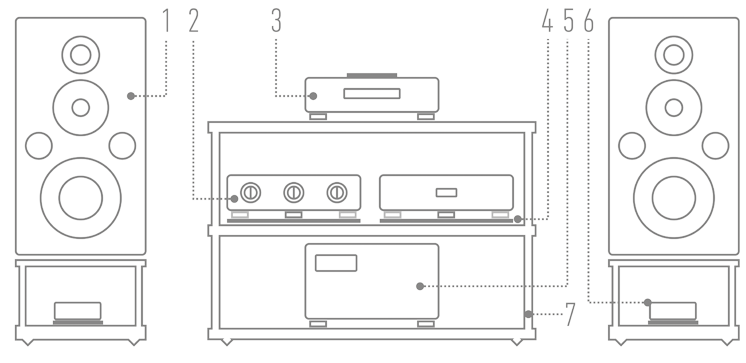 1) Loudspeakers: HARBETH M40.1 |REVIEW| 2) Line preamplifier: AYON AUDIO Spheris III Linestage |REVIEW| 3) Super Audio CD Player: AYON AUDIO CD-35 HF Edition No. 01/50 |REVIEW| 4) Stands (loudspeakers): ACOUSTIC REVIVE (custom) |ABOUT| 5) Power amplifier: SOULUTION 710 6) Loudspeaker filter: SPEC REAL-SOUND PROCESSOR RSP-AZ9EX (prototype) |REVIEW| 7) Hi-Fi rack: Hi-Fi rack: finite elemente MASTER REFERENCE PAGODE EDITION Mk II, more → HERE |
|

|
Cables Analog interconnect SACD Player - Line preamplifier: SILTECH Triple Crown (1 m) |ABOUT|» ANALOG INTERCONNECT Line preamplifier → Power amplifier: Siltech ROYAL SINLGE CROWN RCA; review → HERE Speaker cable: SILTECH Triple Crown (2.5 m) |ABOUT| |

|
AC Power Power cable | Mains Power Distribution Block - SACD Player: SILTECH Triple CrownPower (2 m) |ARTICLE| » POWER CABLE Mains Power Distribution Block → Line preamplifier: Acoustic Revive ABSOLUTE-POWER CORD, review → HERE » POWER CABLE Mains Power Distribution Block → Power amplifier: Acoustic Revive ABSOLUTE-POWER CORD, review → HERE Power cable | Power Receptacle - Mains Power Distribution Block: ACROLINK Mexcel 7N-PC9500 (2 m) |ARTICLE| Power Receptacle: Acoustic Revive RTP-4eu ULTIMATE |REVIEW| » ANTI-VIBRATION PLATFORM under Acoustic Revive RTP-4eu ULTIMATE: Graphite Audio CLASSIC 100 ULTRA, review → HERE Power Supply Conditioner: Acoustic Revive RPC-1 |REVIEW| Power Supply Conditioner: Acoustic Revive RAS-14 Triple-C |REVIEW| Passive filter EMI/RFI: VERICTUM Block |REVIEW| |

|
Anti-vibration Speaker stands: ACOUSTIC REVIVE (custom)Hi-Fi rack: finite elemente MASTER REFERENCE PAGODE EDITION Mk II, more → HERE Anti-vibration platforms: ACOUSTIC REVIVE RAF-48H |ARTICLE| » ANTI-VIBRATIONAL FEET: |

|
Analogue Phono preamplifier: Phono cartridges:
Clamp: PATHE WINGS Titanium PW-Ti 770 | Limited Edition Record mats:
|

|
Headphones » HEADPHONE AMPLIFIER: Leben CS-600X, review → HEREHeadphones: Headphone Cables: Forza AudioWorks NOIR HYBRID HPC |