


|
LINE PREAMPLIFIER & POWER AMPLIFIER REGA
Manufacturer: REGA RESAEARCH Ltd. |

 |
 |
 |
 |
|
Review
text by WOJCIECH PACUŁA |

|
No 263 April 1, 2026 |
NEVER BEFORE has Rega had in its lineup an amplifier as mechanically and electrically refined as this two-box system, consisting of the Mercury line-level preamplifier and the Solis stereo power amplifier. 
Based on the experience gained with the Osiris integrated amplifier (2010), the separation of the preamplifier and power amplifier into separate enclosures is intended to result in “lower distortion” and ensure a “cleaner signal.” You can find the Osiris review → HERE ˻PL˺. As stated in the press materials accompanying their launch in November 2025, the Mercury and Solis are “the culmination of Rega’s nearly forty years of experience in electronic engineering in the development of solid-state amplifiers” and were designed to “deliver uncompromising sound quality.” ▓ Towards high-end REGA IS PRIMARILY ASSOCIATED with budget-friendly products. However, as early as 2007–08, it began to feel significant pressure from its distributors, who were pushing for it to introduce “high-end” equipment. In his monograph on the company, titled A Vibration Measuring Machine, Bill Philpot quotes Roy Gandy, Rega’s founder and director, who consistently replied that he liked to produce affordable equipment and that developing something more expensive just for the sake of “exercise” would be contrary to his ethos. As we have written before, even Gandy had to admit, however, that the Elicit and Elex amplifiers, launched in 1990, required changes. The idea for new flagship products emerged exactly twenty years later. This new reference system can therefore be viewed as the culmination of those efforts. When we look at the press materials, we see that the company’s approach has not changed since those very first “top-of-the-line” amplifiers, about which we read:
So, the decision was made to design flagship hi-fi products that would showcase the company’s technological capabilities. It was a bold move. From the very beginning, Rega had positioned itself in the budget segment, and breaking through that price barrier was no easy feat. The new products had to be something truly exceptional to justify their existence.
⸜ BILL PHILPOT, Paul MESSENGER, ROY GANDY, A Vibration Measuring Machine, Independent Publishing Network 2016, p. 115. The Mercury preamplifier was designed to – as the manufacturer states – “deliver ultra-low noise levels,” which is said to result in “exceptional dynamic range” and the reproduction of even “the most subtle details.” Rega claims that although the origins of this circuit can be traced back to the first Rega Elicit amplifier from the 1990s, the current preamplifier is the “most complex” electronic product the company has ever developed. While the Mercury is an object “orbiting” the center of the Solar System, the Solis power amplifier, designed alongside it, is its center – the Sun itself. It features a fully symmetrical circuit based on transistors and – as the manufacturer claims – guarantees sufficient drive “even for the most demanding speakers with minimal distortion.” Rega claims that its engineering team “has spent the last four years obsessively developing and fine-tuning the circuit to achieve the most immersive and precise sound.” It’s worth noting the design of this pair. Their enclosures are made of thick, really thick aluminum plates and are sleek and simply attractive. Their fronts feature acrylic panels. In the preamplifier, a display showing device status and settings is hidden beneath it, while the power amplifier features only a single LED and the logo. As far as I can tell – or at least that’s how it appears – the same team responsible for the Osiris amplifier is also behind the design of the Mercure and Solis. Initially, the company approached several independent design firms, asking them for design concepts. However, the results deeply disappointed them. The design was ultimately created through a collaboration between Rega’s founder and Colin Dilliway (lead designer), who joined the company in 1999. 
The goal was to combine what is “classic” with what is “timeless,” what fits “Rega’s legacy,” and what was meant to have “class.” The designers first worked with 2D models, then created color 3D renders and pinned about a dozen different ideas to a large wall for every employee to evaluate. After narrowing the options down to a few, the selected designs were taken to France to Rega’s distributor (GT Audio), where the form we know today was created. ▓ Mercury THE MERCURY IS A LINE PREAMP with a built-in digital-to-analog converter. It features five line inputs and four digital inputs: two coaxial RCAs, two optical Toslinks, and an asynchronous USB Type-B input. The latter is said to be galvanically isolated. A downside is that it only accepts signals up to 192 kHz. Unusually for this company, it does not include a phono preamp. This device is intended to work with the flagship Rega Aura MC external phono preamp, which is itself recommended for use with the Rega Naia turntable; see the review → HERE ˻PL˺ . The company states:
The main development objective for the Mercury was to create a no-compromise audio pre-amplifier. The Mercury is handcrafted to reveal the true potential of your hi-fi system, thanks to an ultra-low noise floor that delivers exceptional dynamic range. The Mercury pre-amplifier, like the Solis, is the culmination of almost four decades of Rega electronics engineering experience in solid-state amplifier development.
⸜ Mercury, → www.REGA.co.uk, accessed: 10.02.2026. Some of the device’s design elements were borrowed from other components in Rega’s current lineup, such as the use of the same volume control found in the Osiris integrated amplifier and the analog filter stages following the digital-to-analog converter from the Saturn CD player. The device was conceived from the outset as a reference model – the manufacturer’s website lists it under the “REF” designation. As mentioned, it is a line preamplifier, but it also features a digital-to-analog converter. It offers five RCA line inputs, including a loop with an input and output for recording, an XLR line input, and a pair of preamp outputs – XLR and RCA. There is also a recording output, and one of the inputs can be “bypassed” to integrate the Rega system into a home theater setup. The audio signal’s path is fully balanced. Each stage features a complementary pair of Class A transistors at the output. We read:
Critical amplification stages use Linear Systems ultra-low noise FET (Field Effect Transistor) transistors in the differential quad pair input stages. This is the same circuit topology as that used in the second stage of the Aura MC amplifier.
⸜ Ibidem. The Mercury’s D/A section uses digital-to-analog converter chips from the British company Wolfson Microelectronics, with which Rega has been collaborating for years, and that are capable of handling PCM signals up to 24-bit/192 kHz and DSD64. Rega acknowledges that the Wolfson chips it uses are an older generation than those currently in use, but claims they were chosen for their “technical and sonic capabilities.” The amplifier and analog filter utilize FET field-effect transistors from Linear Systems with ultra-low noise levels and a differential pair in the input stage. The asynchronous USB input is galvanically isolated via its own dedicated power supply and features extensive re-clocking for both PCM and DSD clocks, as well as data retrieved from the USB input. The USB input features two oscillator modules, providing “low-jitter clocks for both professional and home sampling rates.” The S/PDIF input utilizes a Wolfson digital interface receiver and a PLL loop designed to recover low-jitter data as well as clocks from incoming S/PDIF data. Particular attention has been paid to clock and data integrity in both PCM and DSD modes throughout the DAC’s input circuitry. On the front panel, you can see a 6.3 mm TRS headphone output. This isn’t just a simple module, but a full-fledged headphone amplifier. The company assures us that it paid close attention to its integration with the rest of the preamplifier. According to the company, this amplifier functions like a Solis mini power amplifier because it uses the same balanced driver stage circuit. It is characterized by high output voltage and current, allowing the “headphone output to easily drive both low- and high-impedance headphones.” ▓ Solis REGA SOLIS is the company’s flagship stereo power amplifier. It operates in AB Class in push-pull mode. According to the manufacturer, “the Solis is designed to drive even the most difficult-to-drive speakers.” The device is said to have very low distortion, at 0.015%, and is equipped with numerous safety features: a thermal cut-off, DC protection, a microprocessor-controlled soft start, as well as a “standby” mode with no signal detection. Solis offers high output for its size, reaching 168 W per channel at an 8 Ω load and 305 W at 4 Ω. That is indeed quite a lot. And although the power at 4 ohms isn’t twice as high as at 8 ohms, experience shows that this company’s devices deliver high currents during fast transients. In other words, we shouldn’t worry about speakers with difficult impedance characteristics. It’s also known that the output transistors are high-current components from Sanken. This is a configuration with three parallel multi-emitter transistors in each channel and branch (a total of twelve transistors) rated at 130 W/15 A. According to the manufacturer, the amplifier circuit is fully balanced and is based exclusively on transistors. It also features an “extensive, low-noise power supply” and is designed “for high current reserve and service life.” The device is equipped with two types of line inputs: balanced (XLR) and unbalanced (RCA), as well as a 12 V trigger and an independently activated (from the front panel) “Mute” function. As we mentioned earlier, Rega places great emphasis on a robust power supply section. The reviewed amplifier features two toroidal transformers, each rated at 330 W, and a large number of Rega K-Power capacitors, providing a total capacitance of 40,000 µF per channel. The AC voltage is rectified by fast diodes characterized by – as the company claims – “low switching noise.” The voltage for the input stages is additionally stabilized. 
The signal path features high-quality components, including Nichicon capacitors, ICEL polypropylene capacitors in the signal path, and HTR non-inductive resistors. The protection circuitry – including a microprocessor-based soft-start circuit – protects the circuit from overloads, limits inrush currents, and implements automatic shutdown/standby in accordance with environmental standards. Both the preamplifier and the power amplifier were designed and handcrafted in England. They feature minimalist enclosures made of CNC-machined aluminum, equipped with IPS LCDs hidden behind acrylic panels and large heat sinks (in the power amplifier). They are available exclusively in a black finish. The units come with high-quality AC power cables featuring robust shielding, as well as RCA interconnects branded by Rega. ▓ SOUND HOW WE LISTENED • The Mercury preamplifier and Solis power amplifier were placed on the top shelves of the Finite Elemente Pagode Edition Mk II rack, resting on their own feet. They were compared to the my reference system, consisting of the Ayon Audio Spheris Evo preamplifier and the Soulution 710 power amplifier. They drove the Harbeth M40.1 speakers via a Crystal Cable Da Vinci cables. 
The devices feature balanced inputs, and the preamp is designed that way. As always, however, I connected them using an unbalanced cable. As I’ve been saying for years, this is – in my opinion – the better way to connect audio components. Rega’s engineers seem to think similarly because, in the section dedicated to the Solis amplifier, they write:
For normal domestic Hi-Fi, Rega recommends the use of unbalanced connections for optimum sound quality. The Mercury and Solis core circuits are unbalanced. Because of this, additional circuitry is needed to create a balanced system. Although the balanced input and output circuits in the Mercury are very high-performance, additional circuits will always add some inherent noise/distortion to the signal. True balanced systems are widely used in professional audio equipment because they provide better noise rejection. Balanced circuits do not offer an intrinsic increase in sound quality over unbalanced circuits, as is sometimes perceived within the Hi-Fi Industry.
⸜ Ibidem. |

The signal between the preamplifier and the power amplifier was transmitted via a Siltech Single Crown unbalanced cable, while power was supplied via Acrolink Mexcel 7N-PC8500 and Harmonix X-DC350M2R Improved-Version cables, respectively. The main source was the Sforzato DSP-05 EX file player with a PMC-05EX clock, controlled by the Jplay program and connected via a Siltech Single Crown unbalanced interconnect. » RECORDINGS USED FOR THE TEST ⸜ a selection
⸜ JULIAN LAGE, Scenes From Above, Blue Note Records | UMG Recordings/Tidal, FLAC 24/96 ⸜ 2025. ONE THING I'VE ALWAYS ADMIRED about Rega products is how effortless their presentation is. It's hard to describe in technical terms. On the one hand, it’s related to the power supply’s ability to handle fast, high-power draws, and on the other, to the speed of signal rise – and these things can be designed and measured. But on the other hand, there are plenty of devices that would seem to meet these criteria, with powerful power supplies, yet they sound as if they were wrapped in a blanket. 
This ability to freely transfer energy applies not only to the company’s turntables but also to its electronics and speakers. At audio shows, where good sound is hard to come by, Rega’s systems almost always shine, and that’s where the crowds gather. Even though – usually – they are based not on expensive components, but rather on budget ones, led by the Rega Brio (now in the Mk 7 version) and the Planar 3 turntable. It is truly remarkable how consistently and coherently this philosophy is scaled up throughout the lineup. I heard the same thing with a system consisting of the Mercury preamp and the Solis power amp. There is no “push” in this sound. There are high dynamics and fullness; there is density and richness. But without exaggeration. When the Hammond organ comes in stronger on Night Shade, a beautiful track from JULIAN LAGE’s latest album, released by Blue Note, it is powerful and resonant. But it doesn’t overpower the guitar, which is, after all, the most important instrument here. It’s as if the musicians were looking at each other and sensing each other’s intentions (as befits good improvisation). This focus on the “flow” of the music is also evident in heavily compressed recordings, such as ANNISSE’S Constellations, a classically trained, American gospel-inspired pop/soul singer-songwriter based in Atlanta. Rega entered this world softly, a bit like a cat, but also in a very organized manner. The softness I’m talking about was the result of rounding out the attack and smoothing it out. And yet, as I said, the energy transfer is excellent. So what is it really like – is it a fast sound or not? Dynamic or not? And that is the thing that surprises me every time with this manufacturer’s amplifiers. Because it is a fast and dynamic sound, the response is immediate, and the differentiation is very good. Even with heavily pop-oriented tracks, like the aforementioned Constellations or the one I listened to right after, Orange County, an idyllic, bucolic composition by Gorillaz. Both tracks stuck in my memory thanks to their melodiousness, fluidity, but also – I’ll repeat – their freedom. In the sound offered by a system consisting of the Mercury preamplifier and the Solis power amplifier, there is nothing mechanical. Yes, the lower bass, though rich, isn’t particularly tightly controlled. The amplifier doesn’t prolong its decay, but its contours are more suggestive than distinct. When playing acoustic music, such as SEASICK STEVE’s Somebody, i.e., roots blues, this doesn’t matter at all; It even helps. The softness with which the Rega blends into the sound creates a broad soundstage. Yes, these two things go hand in hand here. It’s a system that, while delivering a warm sound, doesn’t bring the sound closer to the listener. The vocals and guitar in Somebody were positioned just behind the line connecting the speakers and were placed deeper into the soundstage, rather than in front. And when the drums and bass hit hard at 2:53, when the electric guitar appears in the left channel, everything suddenly grows; the volume suddenly expands. This transition from “small” (guitar + vocals) to “big” (the full, roaring band) was dynamic and powerful. But it wasn’t thrown in the listener’s face. It was as if the goal was to deliver greater dynamics and pressure, but without being intrusive. That’s why the band was presented powerfully, but “there,” on stage, and not right in our laps. This demonstrates very good control over the sound. The soft bass without distinct contours is therefore not the result of a lack thereof, but an aesthetic choice by the designers. This worked out great with the electronic music of MARCONI UNION. Cloudsurfing, a track from their new remix EP, was blasted across the room, both wide and deep. It was a panoramic, stereoscopic performance at high volume. And this is yet another distinctive feature of the Rega system, alongside its energy transfer and warm sound. It produces a sound that isn’t “tight” or constricted, but rather emotionally open. That’s how I interpret it – as a lack of nervousness, a sense of confidence, and a feeling of ease. Even though Rega is neither a master of selectivity nor is it focusing on details. The thing is, when we listen closely, when we’re looking for something “in there,” inside, it’s all there. But it isn’t obvious when we’re simply listening to the whole, when we’re “chilling.” Then it’s as if all of that recedes, leaving us with the melody. And perhaps that is exactly what the Rega designers intended – to demonstrate the primacy of music over its components? It is a detailed sound; let there be no doubt about that. But this resolution is hidden. When the strings opening ˻ 2 ˺ Young At Heart in FRANK SINATRA’s version from the album Ultimate Sinatra come in, they aren’t intrusive; they don’t impose themselves on us. The attack is, as I said, rounded, which gives this track a smooth, pleasant sound and fluidity. 
It is not a “dulled” presentation. There was a good rhythm in it, and it was “swinging.” And truly exquisitely nuanced, nuanced internally. After the rather detached vocals in Young… on the aforementioned compilation, the track In The Wee Small Hours was included, in which Sinatra’s voice is right there within reach. In the sense that it was recorded that way, and that’s how Rega presented it. In a warm, sensual, melancholic way, yet clear. DIGITAL INPUT • If you’d like to achieve an even warmer sound, I suggest using the digital input featured in the Mercury. This unit’s DAC has a distinctly warm character. Sinatra’s voice gained a bit more depth, became even more intimate, and took on a richer quality. The string section in the background had a lower tonal balance, as did the overall sound. Seasick Steve’s guitar, quite biting and sharp, was softened and rounded out. At the same time, however, everything was ultra-smooth and incredibly coherent internally. The warmth offered by the built-in converter is not an uncontrolled scattering against a warm background, but an orderly stream of images that we receive in a sort of “halo” around the sounds. The warmth in question isn’t exaggerated if the music itself is presented this way. The Julian Lage track mentioned at the beginning had an extra “something” to it, as if another layer of depth. It was still, however, a clear-cut performance by four guys, with a distinct leader. The drums and bass grew slightly in presence, but not “at the expense” of the guitar or organ; rather, but “alongside” them. I have to say that while the DAC in the Mercury isn’t quite as “transparent” as the preamp itself, it has something that audiophiles often seek: intimacy and density. And then there’s the full, low, and even very low bass with fantastic energy, as demonstrated by GOGO PENGUIN’s Call to the Void. Oh, how wonderfully it sounded! Listen for yourselves and decide whether it isn’t the case that audiophile talk pales in comparison to musical expression… HEADPHONES • The headphone amplifier in the Mercury is very powerful and can drive even demanding headphones. It had no trouble at all with the Hifiman HE-1000 v2, even though they are planar design. It also delivers very deep, rich bass. It was fun, exciting. And enjoyable. What we won’t get is the same level of focus as through the speakers. The sound is slightly „loose.” In the sense that there is no distinct “center” of the soundstage, even when listening to Sinatra’s monaural recordings. The headphone amplifier operates in a more “stereoscopic” manner here, widening the soundstage. That’s cool, but it also doesn’t provide the clear imaging that is so perfectly achieved with speakers. ▒ Summary REGA’S REFERENCE AMPLIFIER offers a distinct sound; it follows a clearly defined direction. In short, it’s warm. Without hesitation or pretense, it plays in a dense and rich manner that encourages long listening sessions and immersing oneself in the sound rather than analyzing it. This is a distinctive sound, very much so. But it is not a distinction that is outward-facing; rather, it is “inward-facing.” You have to focus to get it all. This British integrated amplifier delivers a low sound, yet it doesn’t shift the weight of the soundstage toward us as if through a “mirror,” leaving the instruments behind the line connecting the speakers. The soundstage width is good; it’s a cool and spacious sound. More important here, however, are the relationships between neighboring instruments, the clear differences in playing intensity, and the “pressure” on the air, rather than exaggerated stereoscopy. This is a system that has no problem with difficult speakers – it handles them with ease. It does so not by disciplining them or shortening their decay, but by delivering a big sound with panache that never gets out of control. The lower bass is rounded, as is the upper treble. And yet we don’t get the impression of a rolled-off frequency response, nor does this system sound “mid-focused.” And the dynamics are excellent. 
Isn’t that a cool combination? Add to that a truly solid mechanical build quality and an eclectic design, plus a brand-new DAC and a decent headphone amp as a bonus. ‖ WP ▒ Technical specifications (according to the manufacturer)
‖ MERCURY 
THIS TEST HAS BEEN DESIGNED ACCORDING TO THE GUIDELINES adopted by the Association of International Audiophile Publications, an international audio press association concerned with ethical and professional standards in our industry, of which HIGH FIDELITY is a founding member. More about the association and its constituent titles → HERE. |
 |



|
Reference system 2026 |
|
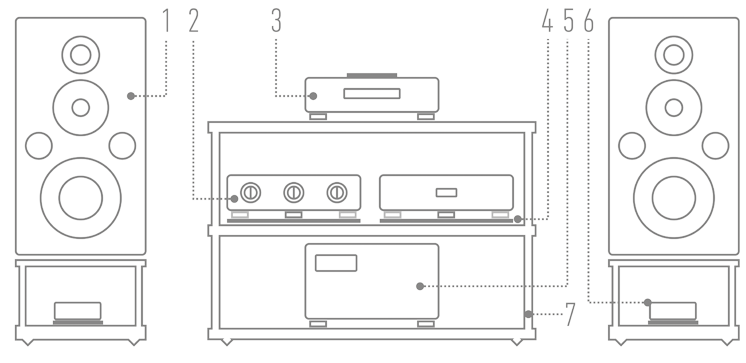 1) Loudspeakers: HARBETH M40.1 |REVIEW| 2) Line preamplifier: AYON AUDIO Spheris III Linestage |REVIEW| 3) Super Audio CD Player: AYON AUDIO CD-35 HF Edition No. 01/50 |REVIEW| 4) Stands (loudspeakers): ACOUSTIC REVIVE (custom) |ABOUT| 5) Power amplifier: SOULUTION 710 6) Loudspeaker filter: SPEC REAL-SOUND PROCESSOR RSP-AZ9EX (prototype) |REVIEW| 7) Hi-Fi rack: Hi-Fi rack: finite elemente MASTER REFERENCE PAGODE EDITION Mk II, more → HERE |
|

|
Cables Analog interconnect SACD Player - Line preamplifier: SILTECH Triple Crown (1 m) |ABOUT|» ANALOG INTERCONNECT Line preamplifier → Power amplifier: Siltech ROYAL SINLGE CROWN RCA; review → HERE Speaker cable: SILTECH Triple Crown (2.5 m) |ABOUT| |

|
AC Power Power cable | Mains Power Distribution Block - SACD Player: SILTECH Triple CrownPower (2 m) |ARTICLE| » POWER CABLE Mains Power Distribution Block → Line preamplifier: Acoustic Revive ABSOLUTE-POWER CORD, review → HERE » POWER CABLE Mains Power Distribution Block → Power amplifier: Acoustic Revive ABSOLUTE-POWER CORD, review → HERE Power cable | Power Receptacle - Mains Power Distribution Block: ACROLINK Mexcel 7N-PC9500 (2 m) |ARTICLE| Power Receptacle: Acoustic Revive RTP-4eu ULTIMATE |REVIEW| » ANTI-VIBRATION PLATFORM under Acoustic Revive RTP-4eu ULTIMATE: Graphite Audio CLASSIC 100 ULTRA, review → HERE Power Supply Conditioner: Acoustic Revive RPC-1 |REVIEW| Power Supply Conditioner: Acoustic Revive RAS-14 Triple-C |REVIEW| Passive filter EMI/RFI: VERICTUM Block |REVIEW| |

|
Anti-vibration Speaker stands: ACOUSTIC REVIVE (custom)Hi-Fi rack: finite elemente MASTER REFERENCE PAGODE EDITION Mk II, more → HERE Anti-vibration platforms: ACOUSTIC REVIVE RAF-48H |ARTICLE| » ANTI-VIBRATIONAL FEET: |

|
Analogue Phono preamplifier: Phono cartridges:
Clamp: PATHE WINGS Titanium PW-Ti 770 | Limited Edition Record mats:
|

|
Headphones » HEADPHONE AMPLIFIER: Leben CS-600X, review → HEREHeadphones: Headphone Cables: Forza AudioWorks NOIR HYBRID HPC |