


|
ANTI-VIBRATION FEET NO VIBRATION
Manufacturer: NO VIBRATION |

 |
 |
 |
|
Review
text by WOJCIECH PACUŁA |

|
No 269 October 1, 2026 |
|
˻ THE FIRST TEST ˼
THE NO VIBRATION brand made its official debut at the Audio Video Show 2025 in Warsaw. As its founder, Mr. Lucjan Szurlej, told us, work on its development and the construction of the first products had been underway since early 2022. The company specializes in products that minimize vibrations and uses its own proprietary solutions, making it one of the most interesting manufacturers of this type of accessory. 
The foundation of the technology it has developed is a proprietary system for dynamic vibration dispersion based on freely suspended membranes. The patent was filed in Poland in 2023 under number P.448153 and received the highest ratings in the innovation category. In 2025, the European patent application process was also initiated. We recently tested the first product from its lineup - in fact, just this past July. The Evo E75-SZZ & BMZ feet - which incorporate two types of metal - were designed to work with spikes. In the “High Fidelity” reference system, there are virtually no spikes. The exceptions are the side spikes on the Finite Elemente rack and the cones under the platform supporting the AC power strip. That is why we tested them with optional coupling elements on which the electronics could be placed. The same applies to the Duo feet, which are the focus of this review. They are intended for heavier products, such as turntables and speakers (stands). They are much larger than the Evo and feature not one, but two diaphragms. We also tested them without spikes, placed directly under the Acoustic Revive stands on which the Harbeth M40.1 speakers rest. ▲ A few simple words… LUCJAN SZURLEJ 
‖ The intermediate discs can be made of steel, brass, or aluminum; they can also feature different contact surface THE DUO SERIES IS AN EVOLUTION of the Evo design. Simply put, in a single base we combined two systems derived from the Evo, oriented in opposite directions. However, these are not two bases stacked on top of each other. Rather, both sections share a common base, creating a single, integrated anti-vibration system. The idea for the Duo emerged during our own tests with so-called “difficult” floors - floating floors, structures on joists, and ceilings prone to resonance. The immediate impetus came from problems with controlling low frequencies in a system with Acoustic Zen Crescendo speakers. These are large speakers that use a transmission line, extending down to about 20 Hz. With such deep bass, problems related to the mechanical behavior of the floor and the building’s structure become very apparent. In our case, the floating floor and the ceiling beneath it clearly responded to the energy generated by the speakers. The most audible consequence was a lack of adequate control of the lowest bass. The anti-vibration solutions we had used previously helped, but it was only the idea of creating a base that works both from the speaker side and from the floor side that brought about a breakthrough. This is how the Duo bases were created. 
‖ The recommended configuration is to use spikes, not discs; during the test, for logistical reasons, this was not possible Each one has two independent damping sections. Their core components are chambers filled with layered quartz, in which we use carefully selected quartz grain sizes that work in conjunction with the membranes and other components of the system. The upper and lower parts of the base do not have to be configured identically. We can select them to suit the device or speakers as well as the floor they stand on. Currently, the series includes three bases. All have a diameter of 90 mm, but differ in height and chamber volume: • Duo 75 – height of 48 mm, The Duo 75 and Duo 150 are symmetrical designs - both chambers for layered quartz have the same volume. The Duo 75 features two smaller chambers, while the Duo 150 has two larger ones. The Duo 110 is an asymmetrical design, combining a smaller and a larger chamber in a single base. This is precisely the configuration we use, for example, under our turntable: the smaller section is on the turntable side, and the larger one is on the floor side. Regardless of the Duo’s size, both of its parts can be configured individually. 
‖ Three versions of Duo feet: 75, 110 and 150 in various configurations – „150” with a wooden disc Duo can be provided as a ready-made configuration or customized for a specific system. The starting point can be tests using the No Vibration test kit or a custom design that takes into account, among other things, the mass, its distribution, the type of device (and even the specific model), and the structure of the surface it stands on. In the future, this process will be further simplified by the configurator available on our website. Duo thus remains an extension of the basic Evo concept, but offers greater capabilities in situations where a single stage of damping proves insufficient, particularly with large speakers, challenging surfaces, heavy stands, and equipment that is especially sensitive to vibrations, such as turntables. ‖ LSz ▒ Duo DUO are anti-vibration feet designed for heavy products. From the outside, they resemble two Evo feet joined at the bottom - and, simply put, that is exactly what they are. In this case, the company opted for a multi-material design. The choice of materials was not random but resulted from many years of experience in controlling and dissipating vibrations across various frequency ranges. These include various types of cast iron, aluminum, brass, exotic wood, and steel. The interior of the bases is filled with various types of mineral aggregates, including specially selected varieties of quartz, as well as proprietary elements that enhance performance, provide insulation, ensure symmetry, and stabilize the operation of the entire system. These solutions work in conjunction with a system of freely suspended membranes and are designed to manage vibration energy as evenly as possible throughout the entire base structure. 
The bases are designed for use under speakers, audio stands, and turntables; there is also a version intended for stone surfaces. As the designer says, speakers were the first application for the Duo and remain one of the most important. The company has also found excellent applications for them under audio racks and turntables - devices that are particularly sensitive to vibrations arriving from the surrounding environment. In his system, he uses these feet in an asymmetrical configuration: the smaller chamber is on the record player side, and the larger one is on the floor side. For very hard surfaces, especially stone, the company has developed the option of using an intermediate ring made of walnut wood with a larger chamber:
Its purpose is to subtly alter the character of the sound - in our tests, it imparted greater organic quality, fluidity, and a smoother decay. Initially, we experimented with more wood and different types of wood. However, we found that the effect became too strong. That is why, ultimately, the wood appears only as an intermediate ring that is part of a larger chamber. One such insert is more than enough.
CONCEPT • The manufacturer offers ready-made sets in the configuration of your choice. Once you’ve put them together, you can purchase attractive wooden boxes to go with them. However, it’s important to know that this will be the final result, similar to what you’ll find in most other solutions. It is only by adapting the product to the weight and nature of the vibrations that unlocks its full potential. This is precisely where No Vibration differs from all other companies of this type that I know of. The top of the housing is always made of anodized aluminum (black, silver, or in a few select colors). But there are quite a few modifications available: the material of the spike socket, the rings that are screwed to the bottom of the equipment (made of various materials), the spikes - also made of various materials - as well as three different membranes; the membranes are a key component of the patent. Mr. Szurlej explains:
In the Duo, the diaphragms in both sections are interchangeable. This allows for very precise adjustment of the base’s operation, but it is an optional feature - the starting point remains the basic configuration we have prepared. The second area of adjustment is the way the base makes mechanical contact with the ground or the supported element.
In the standard configuration, we use a conical ring made of hard-anodized aluminum. Its role is not limited to simply providing stable support. The conical geometry reduces the contact surface, concentrating the pressure over a much smaller area than with full support. In practice, this results in a more pronounced response from the damping system and more intense operation of the entire base. Therefore, even the standard conical ring is a functional part of the Duo system, not merely a finishing element. This principle is further developed by optional tuning elements. We can modify both the material and the contact geometry by using conical rings with different support configurations, and - where the design allows - spikes as well. All of these solutions share a common feature: they reduce the contact area, though to varying degrees. The more point-like the contact, the more concentrated the mechanical coupling with the base is, and the more clearly its damping system is stimulated. This gives us another level of tuning. We no longer change the DUO’s design itself, but rather decide how energy will be introduced into it and how intensely the base will operate. The test kit also includes washers to make the replacement easier, wrenches, and double-sided tape, which we can use to temporarily attach the rings and spikes to the bottom of the device if we don’t want to screw them in right away. However, Mr. Szurlej believes that the best approach is to replace the existing feet and screw in spikes - or rings, if necessary - in their place. After trying out various options, the customer receives the new products they’ve selected and returns the test kit. 
TECHNOLOGY • The design of the Duo feet is almost identical (just kidding - the Duo consists of two Evo feet) to what we saw in the Evo model. The differences lie in the number of layers and the addition of a second diaphragm. The description will therefore, necessarily, be a repetition of what we already know. |
The feet in this version are really heavy and large; in the smallest version, they have a diameter of ø 90 mm and a height of 38 mm. They consist of: a body, a socket for a spike or ring, and two diaphragms with filled chambers, which are at the heart of the patent we mentioned. The body, made of aluminum and various types of cast iron, consists of several layers. At the top is the actual base - a socket with a recess for a spike or ring. It can be made of aluminum, cast iron, or manganese brass. Regarding the spikes and rings, the manufacturer states:
We took brass as our starting point; minus is still steel, plus is soft-anodized aluminum (which was previously hard-anodized), but its performance was too similar to that of steel. In terms of color: steel is black, brass is brass-colored, and soft aluminum is silver. Research in this area is still ongoing, but this setup is the clearest for now.
Between the two sections of the housing lies the aforementioned membrane. It is made of ultra-thin sheet metal (steel) and is in contact from above with a chamber filled with specially selected materials in the form of aggregate, similar to the Acoustic Revive bases. The aggregate consists of several layers, each with different grain sizes and compositions. These were selected based on listening tests and measurements. As Mr. Szurlej explains that the goal is not to maximize vibration damping, but rather “conscious management of mechanical energy over time.” 
The diaphragm can vary in thickness and stiffness, which - as the manufacturer assures us and as we have tested ourselves - significantly affects the performance of the damping system. The set includes three different diaphragms - one thicker and one thinner than the one installed in the feet - labeled “-1” and “+1.” To change it, you need to unscrew the base, carefully replace the diaphragm, and screw the base back on. It’s complicated, but if you want the feet to be specifically tailored to your system and your requirements, there’s no other way to do it. To make the decision easier, the company is currently working on an online configurator powered by artificial intelligence. Ultimately, the system is designed to allow users to select a configuration not only based on the type of device or its weight, but also on the specific model of the device. This will make it possible to take into account the individual design of the devices, the distribution of mass, and the nature of the vibrations generated. Once you become familiar with its capabilities, this system is much easier to use than it might seem, even though the number of possible combinations is truly vast. The feet themselves are professionally made, with superb precision, and they look great. The company owner makes his money manufacturing metal parts, so he knows how it’s done (see the case of J. Sikora). ▓ SOUND HOW WE LISTENED • The No Vibration Duo feet were tested in the “High Fidelity” reference system. During the test, they were placed on an Acoustic Revive platform, which is part of a set of speaker stands custom-made for me by Mr. Ken Ishiguro, the company’s owner. I placed the speaker stands - which normally rest on Divine Acoustics Newton Diamond feet - on top of the tested feet. 
Mr. Lucjan recommended to place the Duo 110 directly on the floor because, as he explained, “that’s when they perform at their best.” Unfortunately, I couldn’t do that - in a comparative test, you can only change one element - in this case, the feet, and not two - the feet and the platform. The system we’re testing offers many customization options. Based on my experience with the Evo 75, I chose the brass socket base, brass washers, and the “0” diaphragm for this test. The test took the form of an AA/BB/AA comparative listening session, with A and B being known. I listened to short excerpts - about 1 minute long - four per comparison. 
» RECORDINGS USED FOR THE TEST ⸜ a selection
• THE BEATLES,Michelle (Take 1), Parlophone/Apple Corps./Tidal, SP, FLAC 16/48 ⸜ 1965/2026. I ALREADY KNEW THE EFFECT of the No Vibration stands on my system; I had tested their Evo 75 version under my SACD player. However, the speakers are on a different scale of vibration, with a different weight - in short: a whole different story - which is why it was difficult to predict how those experiences would translate to this new test. And they did carry over, almost literally, in fact. Mr. Lucjan’s feet, in the configuration in which they were tested, soften the sound (all subsequent observations refer to this specific configuration). And significantly so. All systems struggling with dryness and thinness: take note! This message is for you: No Vibration has a solution. It will be a significant, consistent, and long-awaited change. We’ll hear it right away, without needing to listen closely to the system’s sound. All I needed was the beginning of the: “Michelle, Take One” heard in the Abbey Road studio during the first take of this song. The version I’m referring to comes from a new mix - or rather, a de-mix and re-mix of Michelle, a preview of THE BEATLES’ Rubber Soul box set, which is set to be released very soon. The preview I’m talking about had a lower and deeper sound than when I played it on the Divine Acoustics feet. Also, the sound of the drums and McCartney’s guitar had a deeper timbre. That doesn’t mean it sounded better than with the reference feet. It was different, but on the same level. The Newton Diamond, which have been part of the “High Fidelity” system for some time now, is indeed an excellent product. The No Vibration, while remaining in the same class, offers a different perspective and will therefore fit into different systems and meet different expectations. The sound will feature less emphasis on selectivity and more on fullness. The deeper bass extension will put your system and room to the test, but they won’t overwhelm them. They will steer the sound in a distinct direction and enhance it towards rich, full-bodied sound. However, this will happen without overdriving the system or pushing it beyond its comfort zone. 
That is why, when I listened to RON CARTER and YOTAM SILBESTIEN in ˻ 1 ˺ Nova Ilusão from the album Duets - which vividly reminded me of another collaboration, that of Charly Haden and Pat Metheny on Missouri Sky, it sounded wonderful - rich, warm, and full-bodied. The Diamonds didn’t make it sound shallow, but they offered a clearer attack and better selectivity. The Duo 110, on the other hand, boosted the lower midrange and turned up the heat - even though it was 41°C outside… In recordings with truly deep bass, such as IRMA’s Black Sun or ARIANA GRANDE’s Stay, the No Vibration stands preserved their structure, slightly calming and smoothing it out. The bass was stronger than before, but the highs didn’t get muted in the process. Irma’s vocals, quite bright and dry, were presented exactly as they were. Ariana Grande, on the other hand, had a warm, rounded voice - which, it seems, was exactly what the producers of this track were going for. This effect - the richness and depth of sound - will be useful for recordings that are bright and dry by design, as it will add something they lacked without altering their overall character. As they did, or example, for ˻ 1 ˺ Floodland, the opening track of the SISTERS OF MERCY’s second album. It was in this track that I also heard something that would later recur in the purist recordings of the AKIRA TANA TRIO and Jazz in the Pawnshop: a focus on the bodies of the sounds rather than their edges. The No Vibration stands (feet) revealed a common thread between Andrew Eldritch’s vocals and the New York Choral Society choir positioned behind him. Not on the same plane - the stands perfectly differentiated the layers and scaled them nicely - but connected by a shared space, a shared DNA, their energies intertwining. The reference feet did something different. While maintaining scale and fullness, they separated these elements into slightly different acoustic spaces. This seems to be closer to what’s actually on the album. The only thing is, every time I played a new track, and right after came the bombastic, powerful ˻ 8 ˺ Never Land (a fragment), with that wonderful fretless bass by Patricia Morrison, the band’s newest addition, and then ˻ 10 ˺ Emma with Eldrich’s truly deep vocals, it was the stands I was testing that rounded it out, gave it a boost, and “lifted” it. The No Vibration Duo 110 is a product that enhances the sound. It does what cool KT88-based tube amplifiers do. And it doesn’t slow things down. The sound is detailed and dynamic. It may not be quite as selective or as precise in shaping the attack as with the reference feet, but you can’t have it all. It also pushes the foreground slightly toward us. Both the lead singer of Sisters of Mercy and Seth MacFarlane from the Lush Life had full, warm voices, and those voices felt close to me. They didn’t jump out of the mix - No Vibration tends to bring elements together rather than scatter them across the soundstage - but that “presence” was undeniable. We’ll hear a similar effect in terms of the spatial aspects of recordings. The tested feet convey reverberations and reflections in such a way that the whole experience feels tangible. They don’t dampen the tails of the reverberations, but they aren’t overly pronounced either. The acoustics and space are rather filled in, which also makes the whole sound grow - the No Vibration create a large and dense soundstage. The bass is powerful yet soft, and the high frequencies are sweet rather than sharp. The Akira Tana Trio from the A New Picture I was presented in an exceptionally refined and distinguished manner, as if they were playing just for us, right now, and right here. ▒ Summary IT SEEMS TO ME that this is a fairly accurate description of what I heard and what the tested stands bring to the sound. First and foremost, deeper bass and lower midrange, along with the removal of any muddiness. The sound is big with them, the volume is spacious, and the soundstage is tangible. The foreground is close to us, and the back of the soundstage is slightly pulled forward. The selectivity is really good, so nothing blends together, yet we get the impression of sound coming in blocks rather than as individual, tiny impulses. The Duo 110 delivers an exceptionally well-structured and pleasant sound. This quality was evident across all the albums I listened to with them, from the special edition of Jazz at the Pawnshop on Crystal Disc to the standard remaster of Floodland, a gothic rock album featuring drum machines. It really doesn’t matter what we listen to or how we do it, because the No Vibration feet will always do “their job.” 
That’s why they’ll be an incredibly pleasant, handy, and helpful addition to any system, enriching, complementing, and warming it up. And they’ll deliver a big, expansive sound with excellent texture. It’ll also be a sound that’s internally well-organized and simply beautiful. It’ll be something else! ‖ WP » The text contains an affiliate link to the CD JAPAN online store |
 |
|
Reference system 2026 |
|
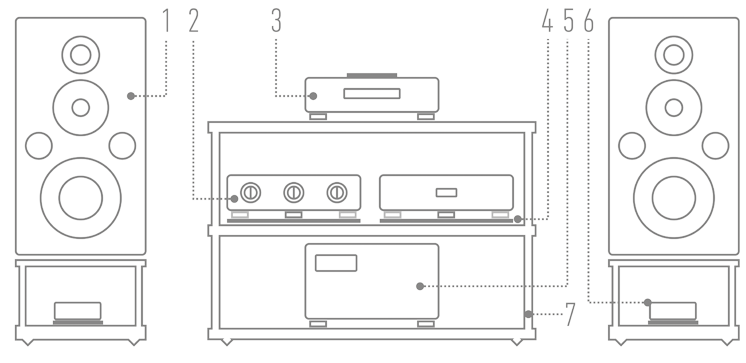 1) Loudspeakers: HARBETH M40.1 |REVIEW| 2) Line preamplifier: AYON AUDIO Spheris III Linestage |REVIEW| 3) Super Audio CD Player: AYON AUDIO CD-35 HF Edition No. 01/50 |REVIEW| 4) Stands (loudspeakers): ACOUSTIC REVIVE (custom) |ABOUT| 5) Power amplifier: SOULUTION 710 6) Loudspeaker filter: SPEC REAL-SOUND PROCESSOR RSP-AZ9EX (prototype) |REVIEW| 7) Hi-Fi rack: Hi-Fi rack: finite elemente MASTER REFERENCE PAGODE EDITION Mk II, more → HERE |
|

|
Cables Analog interconnect SACD Player - Line preamplifier: SILTECH Triple Crown (1 m) |ABOUT|» ANALOG INTERCONNECT Line preamplifier → Power amplifier: Siltech ROYAL SINLGE CROWN RCA; review → HERE Speaker cable: SILTECH Triple Crown (2.5 m) |ABOUT| |

|
AC Power Power cable | Mains Power Distribution Block - SACD Player: SILTECH Triple CrownPower (2 m) |ARTICLE| » POWER CABLE Mains Power Distribution Block → Line preamplifier: Acoustic Revive ABSOLUTE-POWER CORD, review → HERE » POWER CABLE Mains Power Distribution Block → Power amplifier: Acoustic Revive ABSOLUTE-POWER CORD, review → HERE Power cable | Power Receptacle - Mains Power Distribution Block: ACROLINK Mexcel 7N-PC9500 (2 m) |ARTICLE| Power Receptacle: Acoustic Revive RTP-4eu ULTIMATE |REVIEW| » ANTI-VIBRATION PLATFORM under Acoustic Revive RTP-4eu ULTIMATE: Graphite Audio CLASSIC 100 ULTRA, review → HERE Power Supply Conditioner: Acoustic Revive RPC-1 |REVIEW| Power Supply Conditioner: Acoustic Revive RAS-14 Triple-C |REVIEW| Passive filter EMI/RFI: VERICTUM Block |REVIEW| |

|
Anti-vibration Speaker stands: ACOUSTIC REVIVE (custom)Hi-Fi rack: finite elemente MASTER REFERENCE PAGODE EDITION Mk II, more → HERE Anti-vibration platforms: ACOUSTIC REVIVE RAF-48H |ARTICLE| » ANTI-VIBRATIONAL FEET: |

|
Analogue Phono preamplifier: Phono cartridges:
Clamp: PATHE WINGS Titanium PW-Ti 770 | Limited Edition Record mats:
|

|
Headphones » HEADPHONE AMPLIFIER: Leben CS-600X, review → HEREHeadphones: Headphone Cables: Forza AudioWorks NOIR HYBRID HPC |