


|
INTEGRATED AMPLIFIER VINNIEROSSI
Manufacturer: VINNIEROSSI |

 |
 |
 |
|
Review
text by WOJCIECH PACUŁA |

|
No 268 September 1, 2026 |
IN OCTOBER 2021, the American manufacturer Vinnierossi rewrote the history of its company. It was then that it unveiled the Brama series - in Italian, the word “Brama” means a strong longing or desire - which not only looks perfect, and different from much of the high-end audio products, but also features solutions that make you pause and wonder for a moment whether perhaps all others have been doing something wrong… 
In the press releases published at the time, we read:
In a world full of mediocrity and conventionality, Vinnie Rossi is driven by a passion for designing the best-sounding two-channel audio components, characterized by truly innovative engineering. After 17 years of perfecting our craft through a series of products that have achieved commercial success and been recognized by critics, Vinnie Rossi proudly presents the Brama collection. Brama opens a new chapter in our brand’s history and showcases to the world our strong commitment to designing and manufacturing innovative, reference-class audio components of the highest caliber.
When developing a new series comprising an integrated amplifier, a preamplifier, and a stereo power amplifier, Vinnie Rossi teamed up with an industrial designer from Montreal, Olivier Raymond, whose portfolio includes projects for Porsche Design and Mercedes-Benz, among others. Vinnie’s goal was to achieve what Raymond describes as “a timeless stylistic statement that is utterly free of embellishments and impervious to passing trends, re-defining luxury in the most elegant and enduring way.” For a company that started out modifying iPods (iMod) and producing battery-powered amplifiers, designed to isolate devices from power grid interference, this change is nothing short of one of a cosmic scale. When Red Wine Audio, the predecessor to Vinnierossi, was founded, its founder was twenty-four years old, had completed his studies in electrical engineering, worked at Lucent and Bell Labs, where he participated in the design of test equipment for high-speed optical circuits, and had saved up ten thousand dollars. Today, one of his integrated amplifiers costs nearly four times as much. ▓ Brama Integrated Amplifier THE BRAMA INTEGRATED AMPLIFIER looks simply perfect. It’s a solid block of aluminum with rounded edges, integrated into a base that can be considered an anti-vibration stand. And, of course, it features a distinctive round „window” in the center of the front panel. 
We’re familiar with all of this from countless iterations in other audio devices. And yet, the combination of individual details, the choice of materials, and the proportions in the amplifier under review deliver a whole new level of quality. That’s precisely why good design is expensive, and that’s precisely why it has no chance of emerging from small companies where the owners dictate the design. Vinnie Rossi is well aware of this:
For discerning listeners who seek the simplicity and elegance of fewer components without compromise, the Brama Integrated Amplifier offers a seamless blend of artistry and engineering.
It delivers the same exquisite musicality and refinement found in our Brama separates, masterfully crafted into a single enclosure. Balancing emotional immediacy with commanding power, it provides a richly immersive experience with effortless control and timeless grace. We see it as a truly singular expression of pure analog performance. ⸜ Brama Integrated Amplifier, → VINNIEROSSI.com, accessed: 20.07.2026. The Brama is a hybrid design integrated amplifier. Hybrid means it combines two technologies: tube and solid-state. In this case, the tubes are used in the input, and transistors in the output. This is a design that Vinnie brought over from his previous company. There, he used classic 6922 and 12AX7 tubes in the preamps, and in the output stage, alongside Class AB, you could also find Class D amplifiers based on Tripath technology. It was a bold combination that earned the admiration of many audiophiles. Just like the visual design, the approach to these components in the new brand has been taken much further than usual. The preamplifier is based on directly heated 300B triodes, typically used in high-end power amplifiers. The output stage, in turn, is a classic Class AB amplifier, but based on a proprietary circuit and featuring a single pair of MOSFETs per channel. FEATURES • Despite its compact size, the Brama delivers as much as 200 W per channel at an 8 Ω load and 400 W at 4 Ω. It owes such high output to clever engineering and a chassis milled from a solid block of aluminum, which functions as a single large heat sink. On the front panel there are only three elements: two knobs and a window with an output power indicator. The knob on the left is a 24-position Swiss rotary encoder with a magnetic sensor and a power on/off button. There are five line inputs and a loop, which allows you to integrate the amplifier into a home theater system or, this is my own idea, connect it to a room correction device, such as those from Trinnov or Accuphase. There are no RCA inputs. There’s also a pair of analog RCA outputs and 6.35 mm TRS jacks. The former allow you to send a level-controlled signal to external power amplifiers, while the latter let you integrate them into a single functional unit, controlled by the same remote. The signal is sent to the speakers via a single pair of WBT Nextgen 0710-Ag speaker terminals. The knob on the right is a 48-step, also from Switzerland, connected to a mute button. Volume control is handled by a 100-step integrated resistor ladder. This is a product refined down to the last detail. It’s no surprise, then, that the meter glass is a sapphire crystal lens that ensures - as the manufacturer claims - “clarity and long-lasting durability.” The meter displays RMS power in watts at 8- and 4-ohm loads. These are analog meters specially designed for this project, featuring air-core mechanisms, milled aluminum pointers, and adjustable backlighting. There are also two LEDs indicating changes in volume and input selection. The backlight can be turned off using the remote control. The device is microprocessor-controlled. The microprocessor handles both safety features and other functions. For example, it allows you to adjust the balance in twelve steps and set the gain for each input. There are three levels available (low, medium, and high), which allow you to balance the volume of connected devices. Gain and balance settings are saved independently for each input. The device is protected against over-voltage, under-voltage, overheating, and over-current on all outputs. Diagnostic data is transmitted to the Brama Remote device, which makes it easier to monitor. Part of the experience of using the Vinnierossi amplifier, and I say this sincerely, without irony, is the Brama Remote control. It is equipped with an LCD. On it, you can read the selected volume level and input, as well as the settings for additional functions. It would be nice if the display were larger. The remote features adjustable backlighting, Bluetooth connectivity, an ambient light sensor, an accelerometer, and a USB-C port for charging the battery and updating the firmware. Its casing is machined from a solid block of aluminum. It reads:
Each one begins as a solid billet of AL6063 alloy. It is sculpted to precise tolerances on a 5-axis CNC machine, then glass bead–blasted for a fine texture that feels both satin-smooth and substantial to the touch. The surface is anodized for lasting elegance and durability, while the VinnieRossi® logo is laser-engraved on the top, adding a subtle signature of authenticity that will never fade. (Ibidem)
I agree, it looks stunning. TECHNOLOGY • Vinnierossi is a brand built on Mr. Rossi’s many years of experience. Drawing on that experience, he modifies the designs in a way he could only afford to do with adequate funding (read: without limitations). As we mentioned, the preamp uses 300B tubes mounted horizontally. These are modern replicas of the Western Electric tubes, matched in pairs. The manufacturer states that the preamp, including the volume control, and the driver operate in a balanced configuration. So I’m not sure exactly where in the amplification chain the tubes are located. There is one tube per channel, and the 300Bs are single-ended tubes. Their lifespan is estimated to be significantly longer than in power amplifiers, since they operate only on voltage signals. The manufacturer estimates a lifespan of up to ten years. In the output, there is a single pair of MOSFETs operating in Class AB, with low negative feedback. However, the circuits for these sections have been assembled “in a modern style,” that is, on printed circuit boards, using high-quality SMD (surface-mount) components. The preamp, driver, and power amp boards are stacked one on top of the other, with the output transistors positioned directly beneath them. As stated in the company’s materials, the goal was to shorten the signal path as much as possible and thereby improve its rise time. This reminds me of a very similar approach taken by the Soulution engineers. Vinnie Rossi writes:
Why use a stacked design? Because it keeps the signal and power paths exceptionally short. It also isolates the more delicate input and driver stage circuitry from the power output stage. Components are mounted on both sides of each PCB, eliminating the need for long PCB traces and internal cable runs. The result is lower noise, tighter control, and a level of transparency that simply isn’t achievable with more sprawling layouts. In Brama, this remarkable layout approach directly serves the purity of the music.
In addition to the hybrid design, one of the key features of Vinnie Rossi’s amplifiers, perhaps even the “most important” one, was the power supply circuitry. His amplifiers were initially battery-powered and later also powered by super-capacitors. It seems that in the Brama series, the power supply is given as much attention as the amplification stage. I would even say more. Its circuit is enclosed in a module milled directly into the chassis. It delivers a power output of 2,400 W and dual secondary windings, independently powering, in a dual-mono configuration, both the preamp and power amp boards. The filament and microprocessor circuits have separate power supplies. It utilizes ultra-fast diodes with a smooth return to the quiescent state and a bank of high-quality filtering capacitors from Kemet. And now: it is a switching power supply. It is thanks to this solution that the amplifier is so compact. 
The amplifier comes in a sturdy, high-end shipping case. And there’s also a user manual. Unlike in most cases, this isn’t a hastily photocopied printout from a computer, but a proper, stapled booklet with thick covers. The website is also top-notch and looks great. So - it can be done. ▓ SOUND HOW WE LISTENED • The Vinnierossi Brama integrated amplifier was tested in the “High Fidelity” reference system. It was compared to a system consisting of the Ayon Audio Spheris Neo tube preamplifier and the Soulution 710 transistor power amplifier. During the test, I used the Ayon Audio CD-35 HF Edition SACD player and the Sforzato digital media player with an external clock as sources. 
In this test, the signal between the Ayon player and the amplifier was transmitted via an XLR interconnect Acoustic Revive Absolute- the amplifier offers only balanced inputs - and the signal to the speakers was delivered via a Crystal Cable Da Vinci speaker cable. The amplifier drove Harbeth M40.1 speakers. It was powered by an Acrolink Mexcel 7N-PC9500 power cable. It stood on the metal cones it comes with, which in turn rested on Acoustic Revive SPU-8 stands and RKI-5005 pads from the same company. » RECORDINGS USED FOR THE TEST ⸜ a selection
• MIKE OLDFIELD, Five Miles Out, Mercury/Universal Music LLC UICY-75879, 2 x SHM-CD + DVD ⸜ 1982/2013. BRAMA is not just another amplifier like the ones you’ll hear at an audio showroom. Its distinctive design is one thing, but its sound is another. We already know that it uses tubes in the input stage and MOSFET transistors in the output. Usually, designers draw warmth from both of these amplifying elements. Not this time. Here, it’s all about differentiation. I often refer to this category, usually to say that something is well-differentiated or not quite so. Rarely, as in this case, can I speak of “excellent differentiation,” differentiation that is nothing short of exemplary. That’s why listening to ˻ 5 ˺ Five Miles Out track from MIKE OLDFIELD’s album of the same title was so fascinating. I listened to it, and I’m not exaggerating, as if I were hearing it for the first time in my life. |
I’m not talking about the best listening experience I’ve ever had, but one so interesting that I went back several times to certain passages to try to remember what was happening there. Like at the start of the second minute, when you hear bagpipes spread across the channels, with delicate bass and percussion in the background, and right in front of us, actually from our “cockpit”, a distorted voice from the air traffic control tower. The separation of these elements was perfect. At the same time, however, they all formed a cohesive panorama - it was a true flight through sound. 
This track has very varied dynamics, because the transitions on the timpani, which come in every so often and give the impression of being overdubbed, are presented here very strongly, dynamically, and loudly. Most systems reproduce them quite harshly. My system and the Brama amplifier do not do this. The harsh attack typically generated by amplifiers is simply the dynamics that they compress, and that compression turns into harshness and a “stiff” attack. Here it was incredibly fast and clear. The Brama, therefore, plays in an extremely dynamic and fast manner. It is a remarkably versatile device - in terms of tone, dynamics, and stereophony. On Oldfield’s album, it demonstrated a shift in scale from a small radio to a powerful crash on the timpani in a single moment. In other words, the stereo image extends not only laterally and into the depth, but also within the soundstage itself. It remains composed during very loud playback and with intense musical material, and it is also remarkably focused on the task at hand when it comes to small ensembles. That’s why, just as I did with the album Five Miles Out, I spent some time rediscovering Pat Metheny’s album What’s It All About. The baritone guitar in ˻ 2 ˺ Cherish and ˻ 3 ˺ Alfie burst through the speakers suddenly and powerfully, without warning. It had high volume and perfectly defined reverberations. It didn’t have a distinct “center,” but it did have a powerful “aura.” This was one of the differences compared to the Ypsilon Phaedon Neo amplifier reviewed for the same issue. The Greek device is more selective and brings out the edges of instruments more clearly; it is more distinct in this fundamental sense. But it’s also darker. And, nevertheless, not quite as dynamic as the Brama. So similar in class, yet so different… Mastering engineer, Ted Jensen of Sterling Sound in New York gave the sound of What's It All About depth and body that you wouldn’t expect from a solo instrument. That’s what a guitar sounds like, but more like an electric one, and one that’s heavily amplified. But that’s exactly why this is such a brilliant album. Recording isn’t about capturing the sound “just as it is live” - that’s impossible to do. It’s about capturing the sound in such a way that we “feel” as if we were at the performance. Those, ladies and gentlemen, are two completely different things. This album demonstrates this wonderfully, and the Brama has allowed me to appreciate it anew. This isn’t an amplifier that saturates the sound, much less deepens it. It dispenses low frequencies rather sparingly; it doesn’t play in a sweeping manner. And yet, both the soundstage and the scale are outstanding with it, and these are among the main “markers” of good bass. In the tracks from Metheny’s album, the high and low strings of his guitar resonated beautifully and fully, but never overshadowed what the musician was playing higher up the scale. The tested amplifier demonstrated how it should be done, without deepening the midrange or saturating it. It’s more of an elegant, restrained sound than a saturated one, if you know what I mean. But perhaps that’s exactly why the guitar sounded so clear and yet so spacious - the Jensen highlighted all the effects applied to it, which is why it’s such a pleasure to listen to. Thanks to this, the vocals will be just as fascinating. 
Taketho, ugh this probably comes as no surprise, FRANK SINATRA from the Come Swing with Me! album. I own several versions of it, but sooner or later I always come back to the digital remaster that Larry Walsch prepared in 1991 at Capitol Studios. It’s almost a century old, in digital terms, yet it still delights with its dynamics and tonal richness. It could be even more saturated and detailed, but you can’t have it all. And here and now with the tested amplifier I got Sinatra’s beautiful voice on it. With Brama it is superbly positioned in the soundstage, with clear instruments behind him and a well-defined reverb. Reverb is one of the elements that varies from remaster to remaster and remix to remix. Sinatra’s sessions, recorded at the time on three-track tape recorders, sometimes added more reverb to the voice, sometimes less. Here, there’s just the right amount. And the voice is clear without being overpowering. The brass section has excellent clarity and punch, yet doesn’t make listening unpleasant with excessive noise. ▲ Our albums ANNA MARIA JOPEK Universal Music Polska 016 299-2 
Bosa was the fifth album by Anna Maria Jopek, a Polish singer, composer, songwriter, and music producer. It was released in 2000 by Universal Music Polska, and two years later it was re-released internationally under the title Barefoot. It achieved Gold Record status, selling over 50,000 copies. As Anna Maria Jopek said in one of her interviews, bossa nova is her favorite musical style. However, because she doesn’t like what pop culture has done with it today, “she lost the desire to record in that style.” Bossa nova turned into Bosa; instead of a dose of Latin fire, we got, as the publisher wrote, “idyllic, close to nature and the earth, ethereal magic.” Bosa was another album, following Szeptem, recorded almost live. The artist was supported by a constellation of outstanding jazz musicians. On it, we’ll hear Leszek Możdżer, Jacek Urbaniak, Darek Oleszkiewicz, Tomasz Stańko, and Henryk Miśkiewicz. Anna Maria Jopek included cover songs on this album. Alongside her original song Nim słońce wstanie and the song Jeżeli chcesz, written by her husband, Marcin Kydryński, the album features her own interpretations of songs such as the opening track, the incredible, nine-minute Bukowina by Wojciech Bellon. 
Sonically, this is a perfect album. It offers a remarkably open and detailed sound, as well as powerful stereo imaging. The attack is a bit harsh, perhaps due to slight compression. But the richness of the tones is stunning, even so many years after its release. Jopek’s voice is presented close to the listener and has great volume. It isn’t particularly three-dimensional, but that probably wasn’t the intention - it’s part of a larger whole. Tadeusz Mieczkowski, an outstanding Polish sound engineer and music producer, was responsible for the recording, mixing, and mastering. The album was recorded live in August 1999 at Polish Radio and Television’s S-4 studio in Warsaw, with additional tracks recorded in November and December 1999 at Polish Radio’s M-1 studio. The album was originally released on CD and cassette - this was a time of sharp decline in the vinyl market. However, it was an Enhanced CD. In addition to the eleven main tracks, shared with the cassette, the digital version included two bonus tracks, one of which - Szept i łzy, was also released as a music video. As a reminder, an Enhanced CD (also known as CD-Extra or CD Plus) is a compact disc standard that combines traditional audio with computer data. In an audio player, the disc functions like a regular music CD, but when inserted into a computer’s drive, it launches CD-ROM content: music videos, song lyrics, wallpapers, and exclusive websites. 
In 2002, a reissue was released by EmArcy, intended for the international market. However, if you have the chance, try to find the 2001 version, intended for promotional purposes. It’s beautiful. It’s almost like a booklet (21 x 29.5 cm), with three photos. I highly recommend it - it’s a gem both musically and as a release. ● THE CLARITY combined with elegance that the Brama offers reminds me of listening in a good recording studio, as if the American amplifier were a tool. Not a scalpel, but something more, something that doesn’t cut things into pieces, yet allows you to see them in action. Everything it demonstrated with Come Swing with Me! had class, and at the same time was incredibly clear and distinct. This isn’t a warm amplifier - oh no! And yet it’s an incredible pleasure to listen to it both loudly and for a long time. You simply couldn’t stand something that lacks internal tonal balance, something that can’t shape the attack of the sound for a longer time. But with this amplifier, you can enjoy the music for a long time at high volume. There’s something about this amplifier that almost “compels” you to listen. The clarity of each frequency band is outstanding, and it’s this clarity that allows you to listen to one recording after another in an almost obsessive way. This was particularly evident on ANNA MARIA JOPEK’s album Barefoot, mentioned above. I think this was the first time, outside of my own system, that I heard that the double bass was supported by something else, that you could hear very low timpani underneath it, and perhaps even a guitar amp through which the signal was additionally routed. That’s how clear this amplifier is. ▒ Summary WHEN I MENTIONED EARLIER THE AMPLIFIER’S RESTRAINT in the low-frequency range, I didn’t mean that it “doesn’t produce” bass, but that it doesn’t overdo it. Listen to this recording on a good set of speakers, and you’ll know you’re dealing with something absolutely exceptional. That’s how it was for me. I didn’t mention it, but Vinnie and I have known each other for years via email. This year, in Vienna, at the High End 2026 show, we met in person for the first time. But we’d been emailing back and forth, and he was a loyal reader of “High Fidelity.” 
In the archives, I found an email from him from 2013, in which he wrote about the excellent review of the Harbeth M30.1 speakers and asked what difference switching to the M40.1 model from this manufacturer - whose review I’d written and which he’d also enjoyed - would make. What can I say, thirteen years later, I hear that the Brama was tuned specifically for this type of full-range, ultra-dynamic design in mind. I can assure you that with speakers like these, they don’t have to be Harbeths, an amplifier from the U.S. will open up an incredible world of sound for you. Rich and diverse - one that never gets boring. It will be a true, to reference the Polish meaning of this series’ name, gate, a portal through which you’ll pass into a better world. ‖ WP ▒ Technical specifications (according to the manufacturer)
Nominal output: |
 |



|
Reference system 2026 |
|
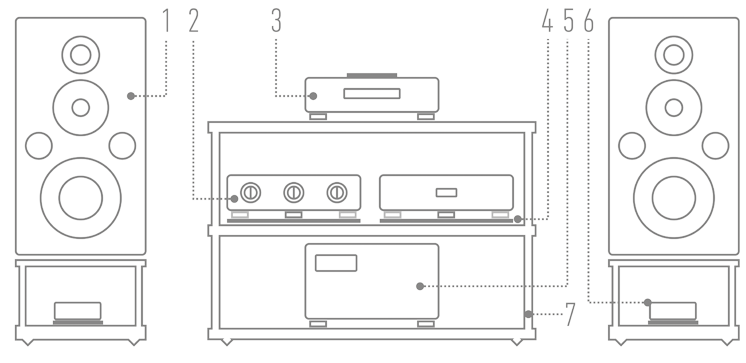 1) Loudspeakers: HARBETH M40.1 |REVIEW| 2) Line preamplifier: AYON AUDIO Spheris III Linestage |REVIEW| 3) Super Audio CD Player: AYON AUDIO CD-35 HF Edition No. 01/50 |REVIEW| 4) Stands (loudspeakers): ACOUSTIC REVIVE (custom) |ABOUT| 5) Power amplifier: SOULUTION 710 6) Loudspeaker filter: SPEC REAL-SOUND PROCESSOR RSP-AZ9EX (prototype) |REVIEW| 7) Hi-Fi rack: Hi-Fi rack: finite elemente MASTER REFERENCE PAGODE EDITION Mk II, more → HERE |
|

|
Cables Analog interconnect SACD Player - Line preamplifier: SILTECH Triple Crown (1 m) |ABOUT|» ANALOG INTERCONNECT Line preamplifier → Power amplifier: Siltech ROYAL SINLGE CROWN RCA; review → HERE Speaker cable: SILTECH Triple Crown (2.5 m) |ABOUT| |

|
AC Power Power cable | Mains Power Distribution Block - SACD Player: SILTECH Triple CrownPower (2 m) |ARTICLE| » POWER CABLE Mains Power Distribution Block → Line preamplifier: Acoustic Revive ABSOLUTE-POWER CORD, review → HERE » POWER CABLE Mains Power Distribution Block → Power amplifier: Acoustic Revive ABSOLUTE-POWER CORD, review → HERE Power cable | Power Receptacle - Mains Power Distribution Block: ACROLINK Mexcel 7N-PC9500 (2 m) |ARTICLE| Power Receptacle: Acoustic Revive RTP-4eu ULTIMATE |REVIEW| » ANTI-VIBRATION PLATFORM under Acoustic Revive RTP-4eu ULTIMATE: Graphite Audio CLASSIC 100 ULTRA, review → HERE Power Supply Conditioner: Acoustic Revive RPC-1 |REVIEW| Power Supply Conditioner: Acoustic Revive RAS-14 Triple-C |REVIEW| Passive filter EMI/RFI: VERICTUM Block |REVIEW| |

|
Anti-vibration Speaker stands: ACOUSTIC REVIVE (custom)Hi-Fi rack: finite elemente MASTER REFERENCE PAGODE EDITION Mk II, more → HERE Anti-vibration platforms: ACOUSTIC REVIVE RAF-48H |ARTICLE| » ANTI-VIBRATIONAL FEET: |

|
Analogue Phono preamplifier: Phono cartridges:
Clamp: PATHE WINGS Titanium PW-Ti 770 | Limited Edition Record mats:
|

|
Headphones » HEADPHONE AMPLIFIER: Leben CS-600X, review → HEREHeadphones: Headphone Cables: Forza AudioWorks NOIR HYBRID HPC |