


|
POWER AMPLIFIER ⸜ stereo/mono LAIV
Manufacturer: LAIV AUDIO Pte. Ltd. |

 |
 |
 |
|
Review
text by WOJCIECH PACUŁA |

|
No 267 August 1, 2026 |
A POWER AMPLIFIER is a device used to convert low-amplitude voltage signals into a current signal. It is either part of an integrated amplifier, along with the preamplifier, or a separate device to which the signal from the preamplifier must be sent. A power amplifier can be a stereo (two-channel) or mono (single-channel) design; in the latter case, it is referred to as a monoblock. Maciej Feszczuk, in what was essentially the “bible” for electronics engineers in the late Polish People’s Republic – the book Electroacoustic amplifiers (pol. Wzmacniacze elektroakustyczne) writes: 
Electroacoustic amplifiers serve as an intermediate link between the signal source and the speaker. To achieve the highest possible fidelity of the transmitted sound, the entire electroacoustic path of the manufactured devices must have sufficiently good performance characteristics. Special standards have been developed for classifying consumer electronic devices (…). The highest class consists of Hi-Fi devices (short for high fidelity). These standards also apply to low-frequency amplifiers. (p. 8)
The third edition I own was published in 1986, and even back then, the old hi-fi standards seemed insufficient. Suffice it to say that a frequency response between 40 Hz and 16 kHz was considered “sufficient,” and harmonic distortion was supposed to be below 1%. Today, these requirements are more than met by a Class D amplifier module that - together with its power supply - is no larger than a pendrive. However, specifications aren’t everything. That is to say - they would be everything if we could measure them all (every single one with perfect precision) and correlate them all with one another (in a perfectly sufficient manner). Today we cannot do that; it’s just an idea - we know only snippets of fragments. Nevertheless, they are a good starting point for further experimentation. As a result, it’s now possible to build an amplifier with very good measurable specifications and good sound quality for a reasonable price. Laiv adds one more thing to this list, namely an exceptional design. ▓ Crescendo Chorus PART OF THE CRESCEND CHORUS SERIES, this is only the second device belonging to it, following the D/A converter and the Verse preamplifier; review → HERE. It is also the latest amplifier from this Singapore-based company. It is a Class D stereo power amplifier, powered by a switching power supply, with an output power of 2x50 W at 8 Ω and 2x80 W at 4 Ω. 
The Chorus is a stereo amplifier, but it can be bridged (“bridge” mode is switched on using a small switch on the rear panel), transforming it into a higher-power mono amplifier. Its power output will then reach as much as 120 W at 8 Ω (stable down to 2 Ω, peak power up to 165 W). And all this from a unit measuring 168 × 180 × 60 mm - barely larger than a Compact Disc. For the record, in accordance with Hi-Fi standards, I’ll add that its specified frequency response is 20 Hz–80 kHz, and total harmonic distortion plus noise (THD+N) is below 0.005%. ▲ A few simple words… WENG FAI HOH 
‖ Mr WENG FAI HOH, Laiv’s owner and designer • photo courtesy of Laiv WE NAMED OUR NEW AMPLIFIER CHORUS because a great power amplifier is not a soloist. It is the many voices of a recording held in balance, each one clear, none fighting to be heard. Our goal was an amplifier with the strength to command almost any loudspeaker, yet the grace to step out of the way the moment the music begins. To get there, we built the CHORUS around modern GaN technology. GaN switches faster and cleaner than traditional silicon, and paired with a precise digital control engine it delivers high power with very low distortion and a wonderfully quiet background. The power feels effortless rather than strained, an ease you hear most clearly in the quietest passages. It can serve as a refined stereo amplifier or be bridged into mono for even more authority, so the system can grow with the listener. 
‖ GaN transistors used in the Crescendo Chorus • photo courtesy of Laiv But the numbers were never the point. From the first prototype we kept asking one question in the listening room: does it move us? We listened late into many nights until the CHORUS could carry a full orchestra without congestion and a single voice without losing its soul. That is its heart. Real power, real refinement, and above all, music that feels truly alive. ‖ WFH LAIV DEVICES are excellently crafted and look great. They inspire genuine confidence. Their design clearly bears the mark of someone who knows what they’re doing. The enclosures, made of thick-walled extruded aluminum, are perfectly designed. For the amplifier we tested, the left edge has been chamfered, and the model name is engraved on the chamfer. A gold standby switch is located on the chamfered corner. The device operates in Class D, so when it’s not in use, it doesn’t draw much power - just 20 W. And it doesn’t get hot, as is typical for Class D. The manufacturer notes that this means it can be left on all the time. We quote:
CHORUS is a trickle-down design from the LAiV Harmony GaNM, carrying the same core GaN amplification technology to the Crescendo series at a significantly more accessible price point. Bringing this elite technology to the more affordable price point of the Crescendo series has resulted in an amplifier with a compact design and uncompromising performance. The Chorus easily becomes the heart of both advanced two-channel home theater systems and purist desktop setups.
⸜ Crescendo Chorus, → www.LAIV.audio, accessed: 18.06.2026. There are three LEDs on the front panel: power, “bridge” mode, and one for the protection system. The latter is a sophisticated design based on a digital micro-controller. It verifies the circuit’s operation immediately after power-on and provides triple protection (DC, over-current, and thermal). Its performance can also be improved by flashing new firmware. A sealed slot on the bottom panel is provided for this purpose; simply insert a microSD card with the new firmware into it. It reads:
• DC Offset Protection: detects DC offset at the output and disconnects the speaker terminals to prevent driver damage.
• Over-Current Protection: monitors output current and limits drive to prevent damage during sustained high-level playback. • Over-Temperature Protection: triggers automatic shutdown if internal temperatures exceed safe thresholds, protecting components and extending service life. (ibidem) There’s much more going on the back panel. Here you will find high-quality, gold-plated Neutrik input jacks, including both XLR and RCA connectors. The amplifier’s circuitis unbalanced. However, using the XLR input is supposed to offer the benefit of lower noise. The Chorus becomes a fully balanced device in mono mode. There is a single speaker output. Since space is limited, these outputs are smaller than standard WBT connectors. Above the IEC power socket (which includes a fuse - you can replace it later with a specialized one) is a small switch used to select the operating mode. TECHNOLOGY • The most important technical solution used in the reviewed amplifier is the implementation of GaN transistors. Their defining feature is the ability to switch ultra-fast, which, according to the manufacturer, guarantees “a smooth, analog-like sound.” GaN transistors - that is, gallium nitride semiconductors (Gallium Nitride - GaN) - thus enable very fast switching, as well as minimal energy loss and lower distortion than in traditional FET or Field-Effect Transistor. Transistors of this type were developed throughout the second half of the 20th century, but their practical application did not begin until 2010, and power integrated circuits, such as those used in the Chorus, have only been available since 2018. In the world of high-end audio, Laiv is not the first manufacturer to adopt this solution. The American company Mytek also offers an amplifier of this type - the Ganfet model - as does the French company ArgentPur with its Gan 1 model, and the Korean manufacturer HiFi Rose has as many as two such amplifiers. Other companies offering such devices include AGD Productions (Albert Gladen Design), Atma-Sphere, and Peachtree Audio. However, Mr. Weng Fai Hoha did not rely on off-the-shelf solutions; instead, he incorporated these transistors into a circuit of his own design. 
The Chorus amplifier operates in analog Class D. This circuit was designed by Laiv, as was the switching power supply. The entire unit was built on a multi-layer PCB with thick, gold-plated traces. In the reconstruction filter in the circuit’s output stage - which is key to achieving good sound - a combination of several different capacitors was used. That’s how the best manufacturers do it. The unit stands on four small, gold-plated feet secured with silicone (so they don’t slip). It all looks fantastic: perfection, precision, and good taste. ▓ SOUND HOW WE LISTENED • The Laiv Crescendo Chorus amplifier was assessed in the “High Fidelity” reference system and was compared to the Soulution 710 stereo power amplifier (transistor, Class AB). The audio source was the Sforzato PMC-05 EX file player with the DSP-05 EX clock. The test involved a blind comparison (AA/BB/AA), with known A and B references, using short, two-minute samples from a given album. The breaks lasted approximately 40 seconds. 
|
The amplifier was placed on its own feet on the upper carbon platform of the Finite Elemente Master Reference Pagode Edition Mk II rack and was powered by Essential Audio Tools Current Conductor HC cables. I fed the signal to it using an unbalanced interconnect - the Crystal Cable Absolute Dream - from the Ayon Audio Spheris Evo preamplifier. The signal was fed to the Harbeth M40.1 speakers via a Crystal Cable Da Vinci speaker cable. 
This review covers the use in stereo version. However, at the end, you will find a description of the listening test of two amplifiers operating in mono mode. » RECORDINGS USED FOR THE TEST ⸜ a selection
• JOHN COLTRANE, JOHNNY HARTMAN, John Coltrane & Johnny Hartman, Impulse!/Universal Music LCC UCGQ-9042, „Verve Acoustic Sounds SACD Series 3”, SACD/CD ⸜ 1963/2023. I DON'T KNOW HOW, I DON'T KNOW WHY, but the sound of the Laiv amplifier reminded me, almost instantly, of what I remembered from listening to the Clones Audio 25iRX amplifier; more → HERE. Since I listened to that unit a long time ago, it was likely an emotional memory rather than a detailed one. But still, the Crescendo Chorus amplifier paired with the Ayon Audio Spheris Evo preamplifier sounded very similar to how I remember the 25iRX from my listening sessions. Not exactly the same, but close enough. 
When I played the ˻ 11 ˺ Zero Gravity track, a collaboration between JEAN-MICHEL JARRE and Tangerine Dream, I saw a clear image before me, stretching widely around me, and occasionally even behind me. The soundstage depth wasn’t particularly great; this isn’t an amplifier that creates much depth. However, what the device did with the sounds along the line connecting the speakers was exceptional in its scale and tangibility. Scale is what sets this amplifier apart. What I mean is that the sound isn’t so much “big”, though it is, but rather that it is powerful, clear, expansive, and resonant, all at once. It’s a tiny unit, practically “desktop-sized,” yet it doesn’t sound that way at all. The synthesizer sounds were projected all around me, and when the main theme kicks in at 1:35, it suddenly took the scale up another notch. All of this was conveyed in a pleasant and calm way, which showed me something else: the Laiv isn’t an amplifier that “over-exaggerates” recordings. Its ability to differentiate tonal nuances is really cool, it’s what makes recordings come alive from within and keeps them interesting. However, when it comes to attack selectivity and the clarity of textures, the device takes a step back, as if to say, “I’ve done my part.” Intrigued by this combination of scale, tonal differentiation, and a gentle attack, I listened to a few albums to understand what this was all about. With ˻ 2 ˺ Hakai To Jojyo, a track from TAKEHIRO HONDA’s trio album titled The Trio, I realized that the Laiv isn’t trying to hide anything. The snare drum hits in the solo opening this track, the powerful cymbals in one channel right after, and above all that expressive piano, played somewhat in the style of Tsuyoshi Yamamoto, all of it struck with force, clarity, and energy. It was a fantastic expression of the passion that bursts forth from every moment of this recording. So it seems that while the device isn’t particularly precise when it comes to rendering details, it performs excellently on a macro scale. In short, it sounds like a big amp. This also applies to its bass reproduction. In a track from Jarre’s album, I heard the synthesizers go really low - and I mean really low. Their control wasn’t outstanding, this is where a large Class AB amplifier really comes into its own, but there were no issues with it either. It didn’t drag or linger. The Chorus has no trouble filling out the lower midrange and upper bass, and that seems to me to be the most important thing. It doesn’t overdo it or drag things out, because this isn’t that “overdriven” sound typical of tube amplifiers. And yet, we can still find some of that silkiness and depth in it. Listening to JOHNY HARTMAN’s voice on an album recorded with JOHN COLTRANE, I could easily turn up the volume knob to get a wide soundstage and deep vocals. I remember that once, maybe twenty years ago, when I heard the opening track on that album, ˻ 1 ˺ They Say It’s Wonderful World, I thought something had broken and the CD player had slowed down, like a cassette tape. I laugh about it today, but back then I really thought there was something wrong with my player. And it was just Hartman with that drawn-out phrasing and his laid-back style… The amplifier from Singapore demonstrated this feature nicely, smoothly, and seamlessly. Without overemphasizing anything, but also without hiding any details. These details are presented with a certain restraint in terms of definition, as I mentioned, but there are plenty of them. So we don’t get the impression that anything is “missing.” I assume this is due to the nice integration of all the frequency sub-bands. The fluidity I mentioned is a manifestation of this same seamless blending of sounds into a single, harmonious whole. 
So it is a good-looking amplifier, somewhat gentle in its attack and warm at the top end of the frequency range. An amplifier that brilliantly renders vocals. The vocals are warm and rich. But it’s also an amplifier that conveys the energy of the recordings very well - not through a strong attack (which it lacks), but through temporal coherence. Just as with the drums on Honda’s album earlier, the drums in the ROBERTA FLACK’S track ˻ 1 ˺ Killing Me Softly from the album of the same title sounded just as exciting. Do you remember the scene from the All About a Boy (dir. Chris Weitz, Paul Weitz, 2002) movie starring Hugh Grant? The one where they “closed their eyes”? For years, whenever I heard Killing Me Softly, on one hand I’d picture Toni Collette, playing the mother here, and Nicholas Hoult, playing the son, and on the other, I’d have Faithless’s version of the song in my head. And yet the original is even better. What’s more, in Kevin Gray’s remaster for Coherent Audio, on the SACD released by Atlantic to mark the label’s 70th anniversary, it’s outstanding. And it was precisely that kick drum beat, countered by the sound of the bells, that the amplifier under review rendered superbly, because it was low and deep, yet resonant. MONOBLOCK • Let me put it this way: wow! It’s not exactly eloquent or sophisticated, but it hits the nail on the head - it perfectly captures the moment when the first notes of Killing Me Softly began to play. In mono mode, the amplifier sounds much more detailed and clear. Everything I mentioned earlier remains - the silkiness and fluidity, with a slight hint of warmth in the treble. But everything opens up suddenly, without warning. And without any brightening. This is a sound that’s not only large-scale, because it was already like that before, but also significantly more energetic. From Flack to Honda to Jarre, all the albums seemed to come alive anew. The biggest change concerned the openness of the sound - not through brightening, but simply by “cleaning up” the attack -though the improved tonal differentiation was equally important. Selectivity - that “jumped” up two notches. The bass also became cleaner, and the soundstage was clearer and more tangible. There were also aspects that seemed to me more enjoyable in the stereo version. These included greater smoothness and a slightly greater sense of distance from the sounds. The monaural version is more “forceful” and expressive. The sound is still slightly warm, but in the monaural version it is more sharply defined and less “flowing.” ▒ Summary LAIV HAS DEVELOPED a sound that is, on the one hand, soft and silky, and on the other, clear. The new Crescendo Chorus amplifier sounds exactly like that. It’s compact, yet the scale of its sound is truly surprising. When Laurie Anderson’s vocals - another guest on Jarre’s album - suddenly emerge between the speakers, they are clear, powerful, and beautifully differentiated in tone and spatial depth from the electronic backdrop. The unit sounds powerful, yet also gentle. In the sense that it delivers a rounded attack. This changes when we listen to the two amplifiers in mono mode. Then, suddenly, everything opens up and becomes energized. Before, the attack seemed a bit hazy, but now it’s very clear. And yet it is the stereo version that captures something of the romanticism and melancholy of tube amplifiers. Perhaps, then, it will be “the one” for some users. 
Regardless of which variant we choose, you’ll get a full-blooded sound with great momentum. The bass will be deep and rich, truly powerful. Its edges will be rounded - this isn’t a device that’s selective at the lower end of the spectrum. However, that didn’t matter much to me, because the whole presentation was ultra-coherent and smooth. And it conveyed a wealth of emotion - which is, after all, what music is all about. ‖ WP ▒ Technical specifications (according to the manufacturer)
Nominal output: 
THIS TEST HAS BEEN DESIGNED ACCORDING TO THE GUIDELINES adopted by the Association of International Audiophile Publications, an international audio press association concerned with ethical and professional standards in our industry, of which HIGH FIDELITY is a founding member. More about the association and its constituent titles → HERE. |
 |



|
Reference system 2026 |
|
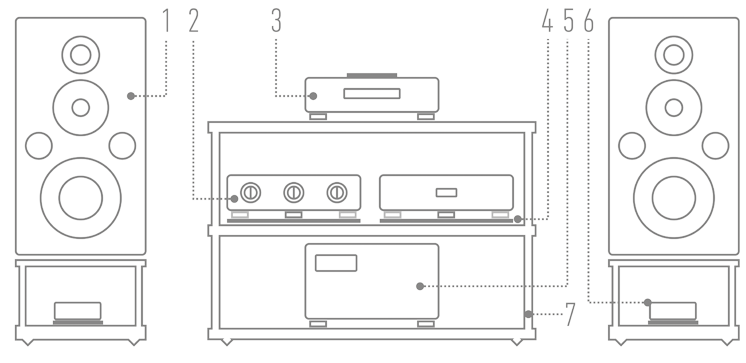 1) Loudspeakers: HARBETH M40.1 |REVIEW| 2) Line preamplifier: AYON AUDIO Spheris III Linestage |REVIEW| 3) Super Audio CD Player: AYON AUDIO CD-35 HF Edition No. 01/50 |REVIEW| 4) Stands (loudspeakers): ACOUSTIC REVIVE (custom) |ABOUT| 5) Power amplifier: SOULUTION 710 6) Loudspeaker filter: SPEC REAL-SOUND PROCESSOR RSP-AZ9EX (prototype) |REVIEW| 7) Hi-Fi rack: Hi-Fi rack: finite elemente MASTER REFERENCE PAGODE EDITION Mk II, more → HERE |
|

|
Cables Analog interconnect SACD Player - Line preamplifier: SILTECH Triple Crown (1 m) |ABOUT|» ANALOG INTERCONNECT Line preamplifier → Power amplifier: Siltech ROYAL SINLGE CROWN RCA; review → HERE Speaker cable: SILTECH Triple Crown (2.5 m) |ABOUT| |

|
AC Power Power cable | Mains Power Distribution Block - SACD Player: SILTECH Triple CrownPower (2 m) |ARTICLE| » POWER CABLE Mains Power Distribution Block → Line preamplifier: Acoustic Revive ABSOLUTE-POWER CORD, review → HERE » POWER CABLE Mains Power Distribution Block → Power amplifier: Acoustic Revive ABSOLUTE-POWER CORD, review → HERE Power cable | Power Receptacle - Mains Power Distribution Block: ACROLINK Mexcel 7N-PC9500 (2 m) |ARTICLE| Power Receptacle: Acoustic Revive RTP-4eu ULTIMATE |REVIEW| » ANTI-VIBRATION PLATFORM under Acoustic Revive RTP-4eu ULTIMATE: Graphite Audio CLASSIC 100 ULTRA, review → HERE Power Supply Conditioner: Acoustic Revive RPC-1 |REVIEW| Power Supply Conditioner: Acoustic Revive RAS-14 Triple-C |REVIEW| Passive filter EMI/RFI: VERICTUM Block |REVIEW| |

|
Anti-vibration Speaker stands: ACOUSTIC REVIVE (custom)Hi-Fi rack: finite elemente MASTER REFERENCE PAGODE EDITION Mk II, more → HERE Anti-vibration platforms: ACOUSTIC REVIVE RAF-48H |ARTICLE| » ANTI-VIBRATIONAL FEET: |

|
Analogue Phono preamplifier: Phono cartridges:
Clamp: PATHE WINGS Titanium PW-Ti 770 | Limited Edition Record mats:
|

|
Headphones » HEADPHONE AMPLIFIER: Leben CS-600X, review → HEREHeadphones: Headphone Cables: Forza AudioWorks NOIR HYBRID HPC |