


|
DC POWER FILTER & DC POWER SUPPLY THUNDER MELODY
Manufacturer: INNOVACOM sp. z o.o. |

 |
 |
 |
|
Review
text by WOJCIECH PACUŁA |

|
No 267 August 1, 2026 |
|
˻ PREMIERE TEST ˼
THUNDER MELODY is an interesting example of how a tiny, literally two-person company, thanks to its knowledge, experience, and clever technical solutions, has achieved a position for itself that allows it to carve out a slice of the pie, so to speak, of the perfectionist audio industry. With almost no advertising, almost no reviews, and relying solely on word-of-mouth recommendations from customers, who are clearly satisfied with the results of their work. Work, it should be noted, that doesn’t come cheap. 
And this is the second part of the curiosity I mentioned at the beginning. Thunder Melody products are very expensive; they’re truly in the stratosphere of the audio world. For example, the LVPC-ACDC Monument DC power supply filter under review, which is, after all, just an accessory, costs 25,700 PLN in its cheapest Bronze version (followed by Silver and Gold), rising to 65,000 PLN for the Black Monument version. And if you also want to replace the DC power supply you’re currently using, which is likely a switching (“plug-in”) model, you’ll have to add 26,900 PLN for the Bronze version of the DC power supply and an even more impressive 57,600 PLN for the Black version. However, there is something that serves as a bonus and changes the way we think about costs. In fact, both of these products are also Monument anti-vibration platforms. The first version, six years ago, when we tested it, cost 24,000 PLN, and today, in a completely different version, it costs 50,000 PLN; review → HERE. So, both the filter under review and the power supply can be treated as full-fledged anti-vibration platforms in which both devices are mounted. Welcome to the top high-end world! ▲ A few simple words… KONRAD RAŚ 
TOGETHER WITH PREVIOUS PRODUCTS tested in “High Fidelity,” we have presented you with a wide range of products that reflect our approach to the topics of reproduction quality management in audio-video equipment. These included devices designed to address micro-vibration issues, such as the Monument platform and the Estacade stands. There were Atto speaker cables, Atto ground cables, and the Ground Hub conditioning and grounding management system; there were Femto power cables; and there were also Graal anti-vibration power conditioners and signal accelerators. Now it’s time to showcase our capabilities in electronics manufacturing. We propose addressing these issues with two devices: a low-voltage power conditioner we’ve named the LVPC-ACDC and a linear power supply we’ve named the LPSU. These are abbreviations for Low Voltage Power Conditioner and Linear Power Supply Unit, respectively. 
The first step was a conversation with the editor-in-chief of “High Fidelity,” during which we determined the environment in which our devices would be operated. We suggested to start with conditioning the supply voltage with the LVPC-ACDC conditioner, using the power supply that comes standard with the LAN switch and/or router to which the digital streaming system is connected. This will demonstrate just how significantly a switching power supply can be improved, reducing its noise level to a level much lower than that of even high-quality linear power supplies. You’ll also be able to hear the conditioner in action in a version without a ground connection, as well as with a ground connection, whether using the one already available in the system or a separate one plugged into a wall outlet via the PE terminals. This is yet another demonstration of the immense potential of this conditioning when combined with grounding. In our setup, we’ll use the Ground Hub ground conditioner connected to our best grounding device, such as the Atto. 
The second step in the final setup is replacing the power supply- swapping out the existing power supply for our LPSU, configured for 12 VDC, which is the minimum voltage required by the router to which it will be connected. This will not only allow us to compare it with the currently used power supply, but also demonstrate just how important the power supply is for the streaming system and the home network, and how much can it improve the sound quality. » We suggest listening to music not only from a chosen streaming service but also using a CD Player, which may seem counter-intuitive as you may not expect any improvement. For this review, we provided the top-of-the-line models, specifically from the Black series. This also means that they serve as smaller versions of the Monument Black anti-vibration platforms. As the icing on the cake, we recommend placing one of your devices on them - such as a switch, router, or the power supply for your entire streaming setup (it might even fit on the larger LPSU). For the price, you’ll also receive a high-quality anti-vibration platform. Of course, in consultation with the customer, its size can be customized, including for standard-sized equipment, e.g., 50 x 50 cm, or even larger. 
The cables included in the set are “Castorama-class” or generic cables. One serves as a ground cable running from the wall outlet to the device; it is three meters long and terminated with a WBT Ag banana plug, and there are two additional cables - one two meters long and one three meters long - which are our own ground cables from the Silver series, terminated with silver WBT banana plugs. This will be useful for setups with barrel-type power supplies, a reference power supply, or our LPSU. It is best to connect the ground cable to the LPSU’s power input or to draw the ground from your existing ground conditioning system. ‖ KR ▒ LVPC-ACDC & LPSU BOTH DEVICES IN THE TEST are rectangular boxes, made of panzerholz. The filter is smaller, while the power supply looks like a sizable amplifier. In fact, such a device is also in the works… 
Panzerholz (also known as waterproof hardwood plywood or high-density plywood) is an extremely durable wood-based material. It is characterized by very high resistance to mechanical damage, bending, and harsh weather conditions. Its a primary choice of this manufacturer for its products. It really good, unusual, and, apparently, it works. The units are very heavy for products of this type, and we know it’s not just air inside the housing. The LVPC-ACDC filter is referred to by the manufacturer as a “low-voltage conditioner for direct or alternating current.” The maximum voltage that can be “passed through” is 80 VDC/80 VAC and up to 10 A. The configuration of the unit we received for testing features two types of sockets at the input and output. One is the classic 5.5 x 2.1 mm “barrel” connector, which is the standard plug used for two-wire connections. The other is a connector block that allows for the use of a shielded cable with a 5.08 mm pitch. Brass plates are screwed onto the bottom of the enclosure. They feature the purpose of the connectors and describe clearly how to connect the cables to the block. Only the positive and negative signals are brought out of the “barrel,” while in the screw-on block, in addition to the positive and negative signals, the shielding, which is electrically connected to the ground terminals, is also fed in and brought out. If we use cables that, in addition to positive and negative signals, also connect shielding, we create a “virtual chassis,” as the manufacturer describes it, with the devices that the conditioner connects. If, on the other hand, the cables are not shielded, such as standard “barrel-type” cables, we can - and indeed should - ground the WBT Ag input terminal; we can also route this ground connection from the conditioner’s output further to the receiver or its cable. There are plenty of optimization options. 
The second device we test is a 12 VDC linear power supply with a 10 A output current limiter, utilizing a 250 VA toroidal transformer with a current reserve of up to 20 A. There are several options for connecting devices to the PSU’s output. These range from a 5.5 x 2.1 mm “barrel” connector, through a 5.08 mm screw-on connector (both identical to those in the filter), to an M12 screw-on hermetic connector with “T” coding. You can use several outputs at once, but keep in mind that all outputs share the same power transformer; they are not isolated from one another. Therefore, be careful to ensure that these devices do not form a ground loop with each other. Ideally, these additional devices should be freestanding units, such as Schumann generators, etc. |
▓ SOUND HOW WE LISTENED • This time, we’re testing two products designed to provide DC power and condition that voltage, namely the LPSU power supply and the LVPC-ACDC filter (conditioner). The manufacturer notes that - unusually - the latter is more important. It will therefore be the main focus of our attention. We will describe the impact of changing the power supply at the end of the test. 
The filter and power supply were evaluated in the “High Fidelity” reference system and were used to power a single component - the Mikrotik Hap ax3 router. This router operates exclusively within the audio system and receives a signal from the “home” router via an RJ45 cable. From the Mikrotik, the signal travels via an Acoustic Revive LAN-Quadrant Triple-C WB RJ45 cable to the Lumin L2 LAN switch/NAS. From the Lumin, an Acoustic Revive LAN-Quadrant Absolute cable connects to the file player. In the HF system, this is a split Sforzato PMC-05EX system with an external DSP-05EX clock. 
» RECORDINGS USED FOR THE TEST ⸜ a selection
• CHRIS POTTER, Alive With Ghosts Today, Edition Records/Tidal, FLAC 24/96 ⸜ 2026. I KNOW HOW THE POWER SUPPLY AFFECTS THE SOUND. I’ve listened to dozens of power supplies, both in my own system and at shows and demonstrations, and almost always, a good power supply improves aspects such as selectivity, depth, and resolution. This is the first time, however, that I’ve heard all these improvements together in a single product. It might seem that the LVPC-ACDC is just a filter, merely something designed to improve poor-quality voltage. Its use, however, had a greater impact on the sound than switching from a switching power supply to a linear one. 
What I heard with CHRIS POTTER on Sawatomi Brown was an expansion of the soundstage, a deepening of the soundstage, and a filling of the space in front of me with sound. I think the latter made the biggest impression on me. The system I use to test equipment is, in and of itself, full, dense, deep, and rich across the entire frequency range. The Thunder Melody filter doubled that. Maybe I’m exaggerating, but I’m speaking from the heart. And my feelings clearly indicate that with the filter in the signal path, the sound was incomparably better. And again - that’s an exaggeration. But only a slight one, and used in good faith. Because it probably wasn’t twice as good at all, just a little better; perhaps these weren’t dramatic changes, but rather subtle adjustments. That’s probably the case. In my mind, however, they’ve grown to proportions worthy of Gargantua. With the filter the sound becomes richer, in terms of dynamics, tone, and expression. As a result, it sounds more natural. The cymbals in the remix of Ella Fitzgerald’s The Girl in Love with You (belooped RMX), performed by the DE-PHAZZ, were thus, on the one hand, stronger and more distinct, and on the other, they filled the space in front of me more gently. Fitzgerald’s vocals came from greater depth and were clearer. Clearer, yet warmer; more selective, yet deeper. Depth is, in fact, something the filter under review gives us right off the bat, without any preamble. The sound grows bigger and thickens. All of this happens regardless of the type of music or the quality of the recording. It might therefore seem that the filter imposes something on the system. That is not the case. Rather, the filter reveals what is inherent in a given recording while remaining in the background itself. So when I played a new track Eye Of The Storm by the groove-metal band FIVE FINGER DEATH PUNCH, which holds an important place on my list of guilty pleasures, the sound wasn’t at all overemphasized or boosted, as it had been before. Instead, I heard something like a shift in perspective. Before, the vocals were almost right up front, while the guitars were somewhat buried in the mix. With the filter engaged, the vocals receded, and the guitars came to the forefront (even though they’re positioned on the sides) and sounded sharper. This track sounded more powerful and clearer. It was still a fairly warm sound - that’s how this type of music is recorded these days - but it was better balanced dynamically. Dynamics, incidentally, is another aspect that changes with a filter as part of the setup. The simplest way to put it would be to say that the dynamics are greater and the transients are better defined in time, and that would be true. However, it would be an incomplete truth and therefore flawed. The dynamics with the Thunder Melody filtering the voltage from the wall outlet are indeed greater, by far. What seems more important to me, however, is that selectivity also increases along with it. The incredibly well-recorded drums from the CHRISTIANA JORMINA 3’s ˻ 7 ˺ Pärlor Sköna. Hymn 583 gained “body” and expanded. The individual beats were now clearer and brighter. And yet, at the same time, less intrusive, less “forceful.” Impressive? – Oooo, yes! Much more so. I realized just how significant this change was as I moved from track to track. While listening to them, I note the volume level at which I’m listening, and when playing them back in the new configuration, I set it to the same value. With the filter, the changes I’m talking about turned out to be much clearer and better defined than without it. Potter has fairly low compression, just like Jormin, so I didn’t touch the volume knob, and even then, it seemed to me that the Swede’s album was slightly more dynamic. In contrast, DOROTHY ASHBY’s Soul Vibrations, a track from the Afro-Harping album, a wonderful example of the fusion of jazz and African musical influences - has higher compression in this new version of the album, which is why I had to turn the volume down by as much as 2 dB for this track. With “Thunder Melody,” this difference - objectively identical (2 dB) - seemed greater, as if the effect of compression on the sound was more pronounced with the filter. 
And finally, the timbre. It is deeper and more nuanced. But it’s also more saturated, and thus “sweeter.” Contrary to the stereotype, “sweeter” in this case means “more distinct” and “heavier in weight,” not “rounded.” The sound from the system without a filter in the router’s power supply was less distinct and more muted, both at the extremes of the frequency range and in the sound’s attack. Thunder adds energy and joy to the sound while also deepening the soundstage. POWER SUPPLY • I’d like to say that the LVPC-ACDC filter does almost all the work, and the power supply is just the finishing touch, or the “cherry on top.” And, come to think of it, if I were to say that, it wouldn’t be all that far from the truth. Because the fact is that all the improvements the filter brings to the sound - namely, better tonal and dynamic differentiation, deeper tones, a more defined and deeper soundstage (i.e., perceived sound sources in space), higher energy, and enhanced detail across all frequency bands - are “carried over” to the power supply. The power supply doesn’t alter them. With the LPSU instead of a switching wall power supply, the sound is top-notch, just as it was top-notch earlier with the filter alone. In the vast majority of systems, the conditioner - as the manufacturer calls it - LVPC-ACDC will therefore be absolutely sufficient. However, there will also be that few percent of cases where the change I heard after plugging it into the system will be so significant and valuable that their owners will be unable to think of anything other than the Thunder Melody “system” - two devices that form a whole. The linear power supply tempered my file player’s tendency to deepen the sounds - all of them. Now they were better differentiated within that depth. The warmth and silkiness remained, delivered instantly and swiftly. Both now had more breathing room, however, and felt less forced. Not that I had complained about that forced quality before - or I should rather write: “forced”, because we’re talking about nuances, not volume. The power supply, however, shifts the perspective enough that even those microscopic adjustments, which in most systems would likely go unnoticed, place the sound in a slightly different spot - simply a better one. ▒ Summary MICROCOMPANIES LIKE Thunder Melody remind me of artisans-specialists from Japan. I think what they have in common is their approach to the product, as well as modus operandi. They choose a technique that is widely available and familiar to everyone else, and find something in its application that others have overlooked - or something they’ve dismissed as unimportant. And it is precisely this element that becomes the “cornerstone” - to quote a classic - of their products. 
I hear this every time I test a new product from this company. And now, too. The DC power supply filter brings changes to the sound that I would expect after changing the cabling, the amplifier, or perhaps even the speakers. Without changing the overall character of the system’s sound. We get better dynamics, tonal differentiation, and selectivity. The power supply also helps eliminate warm tonal colorations. Both products belong to the top high-end category and make sense only in the very best systems -specifically, those where everything is already set up and we just want “more” of everything. And that’s exactly what you’ll get: more sound, more music, and more fun. Because with this company’s products, fun is guaranteed. Not in the heavy, serious way that many companies in this industry operate - and whose products replicate that in their sound - but in a relaxed and effortless way. And that’s exactly how our industry and our music listening should be - after all, it’s supposed to be fun. ‖ WP 
THIS TEST HAS BEEN DESIGNED ACCORDING TO THE GUIDELINES adopted by the Association of International Audiophile Publications, an international audio press association concerned with ethical and professional standards in our industry, of which HIGH FIDELITY is a founding member. More about the association and its constituent titles → HERE. |
 |
|
Reference system 2026 |
|
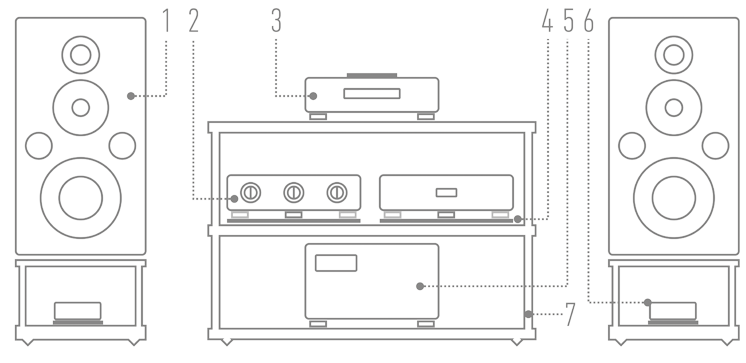 1) Loudspeakers: HARBETH M40.1 |REVIEW| 2) Line preamplifier: AYON AUDIO Spheris III Linestage |REVIEW| 3) Super Audio CD Player: AYON AUDIO CD-35 HF Edition No. 01/50 |REVIEW| 4) Stands (loudspeakers): ACOUSTIC REVIVE (custom) |ABOUT| 5) Power amplifier: SOULUTION 710 6) Loudspeaker filter: SPEC REAL-SOUND PROCESSOR RSP-AZ9EX (prototype) |REVIEW| 7) Hi-Fi rack: Hi-Fi rack: finite elemente MASTER REFERENCE PAGODE EDITION Mk II, more → HERE |
|

|
Cables Analog interconnect SACD Player - Line preamplifier: SILTECH Triple Crown (1 m) |ABOUT|» ANALOG INTERCONNECT Line preamplifier → Power amplifier: Siltech ROYAL SINLGE CROWN RCA; review → HERE Speaker cable: SILTECH Triple Crown (2.5 m) |ABOUT| |

|
AC Power Power cable | Mains Power Distribution Block - SACD Player: SILTECH Triple CrownPower (2 m) |ARTICLE| » POWER CABLE Mains Power Distribution Block → Line preamplifier: Acoustic Revive ABSOLUTE-POWER CORD, review → HERE » POWER CABLE Mains Power Distribution Block → Power amplifier: Acoustic Revive ABSOLUTE-POWER CORD, review → HERE Power cable | Power Receptacle - Mains Power Distribution Block: ACROLINK Mexcel 7N-PC9500 (2 m) |ARTICLE| Power Receptacle: Acoustic Revive RTP-4eu ULTIMATE |REVIEW| » ANTI-VIBRATION PLATFORM under Acoustic Revive RTP-4eu ULTIMATE: Graphite Audio CLASSIC 100 ULTRA, review → HERE Power Supply Conditioner: Acoustic Revive RPC-1 |REVIEW| Power Supply Conditioner: Acoustic Revive RAS-14 Triple-C |REVIEW| Passive filter EMI/RFI: VERICTUM Block |REVIEW| |

|
Anti-vibration Speaker stands: ACOUSTIC REVIVE (custom)Hi-Fi rack: finite elemente MASTER REFERENCE PAGODE EDITION Mk II, more → HERE Anti-vibration platforms: ACOUSTIC REVIVE RAF-48H |ARTICLE| » ANTI-VIBRATIONAL FEET: |

|
Analogue Phono preamplifier: Phono cartridges:
Clamp: PATHE WINGS Titanium PW-Ti 770 | Limited Edition Record mats:
|

|
Headphones » HEADPHONE AMPLIFIER: Leben CS-600X, review → HEREHeadphones: Headphone Cables: Forza AudioWorks NOIR HYBRID HPC |