


|
ANTI-VIBRATION FEET NO VIBRATION
Manufacturer: NO VIBRATION |

 |
 |
 |
|
Review
text by WOJCIECH PACUŁA |

|
No 267 August 1, 2026 |
|
˻ PREMIERE TEST ˼
SOMEHOW IT SEEMS that Poland has become one of the most interesting places on Earth when it comes to products designed for vibration reduction. There are quite a few of them in our country, and the most interesting ones have their own patents, which they continue to develop and refine. Historically speaking, and also close to my own heart, the first company to offer a complete technology - and one that’s still on the market today - was Paweł Skulimowski’s Franc Audio Accessories (2009). 
I used their Ceramic Disc feet for many years, and a special version of them was used for the Ayon Audio CD 35 High Fidelity Edition (SACD) and CD-35 Mk II High Fidelity Edition (CD) players. The second manufacturer that made a big impression on me was Pro Audio Bono (2010). Their feet were also part of the “High Fidelity” system and remain under the Acoustic Revive speaker stands to this day. Let’s also mention Graphite Audio, with resins containing a high graphite content (2020); Avatar Audio’s proprietary anti-vibration systems (2010); and let’s not forget - it would be a mistake to do so - Rogoz Audio, which focuses on platforms, stands, and racks (2007). These aren’t all existing Polish manufacturers, but they are all those that have been featured in the pages of “High Fidelity” for years. And there’s also the Divine Acoustics, the oldest of them all (2003), though it has long focused on floor-standing speakers. Each of these companies has its own solutions (often also a genuine patent) for how to decouple two surfaces from each other and how to manage vibrations. Franc Audio Accessories builds on Finite Elemente’s concept, which involves supporting a surface with balls in a specially shaped bed. Pro Audio Bono uses roller bearings for this purpose - but lateral ones, consisting of many balls, while Divine Acoustics has opted for complex systems made of many various materials, among which precious minerals, rubies, and diamonds play the most important role (similar to that of the balls). No Vibration chose yet another way to go about dealing with vibrations, namely spikes. ▓ Spikes THE THREE COMPANIES MENTIONED at the beginning have moved away from the first - and, it would seem, simplest - method of decoupling, namely the use of spikes. A spike is a sharp, metal cone placed under speakers, speaker stands, or, less commonly, under audio equipment - Yamaha was an exception in this regard. It serves two main purposes: mechanical stabilization (e.g., it pierces through a thick carpet, stabilizing the speaker on a hard floor) and vibration reduction. A spike is a mechanical diode, which, due to its shape, forces vibrations to be dissipated in one direction. It acts like a one-way valve, isolating the speaker and preventing vibrations from the surroundings and the floor from being transmitted back into the speaker or the device. To ensure it functions properly, stands/pads were eventually developed for it, which, together with the spike, form a cohesive mechanical system. Since most manufacturers seem to think that a spike is just a spike and there’s nothing to dwell on, they equip their products - almost always speakers - with a spike-like product made of the cheapest metal of unknown composition, sometimes adding a pad to it. Such a system works, but not quite the way the manufacturer intended. More often than not, this is an improper application of this technology, causing more problems than it solves. 
Perhaps that is why I have such a strong aversion to spikes. I’ve eliminated them from my system wherever possible, replacing them with solutions based on ball bearings or hybrid ball-and-damping designs. The exceptions are the two tops of the Finite Elemente rack - which use horizontal spikes - as well as the graphite resin spikes on the Graphite Audio platform, on which the AC power strip for my system sits. In hindsight, I realize that it was something in the sound of the spikes that caused the sound to lose energy, become thinner, and grow sharper - and in extreme cases become shrill. And I can’t stand shrillness. Mr. Lucjan Szurlej, founder of No Vibration, seems to have an answer to these concerns and a solution to these problems. He offers mechanically sophisticated bases for the spikes that can also function without them. Importantly, this isn’t just another “me-too” company; it’s a manufacturer that has grown out of its own experiences and has developed its own patent (Pat. – P448153). ▲ A few simple words… LUCJAN SZURLEJ 
‖ Mr Lucjan Szurlej, Owner & Chief Designer of the company THE BRAND MADE ITS OFFICIAL DEBUT at the Audio Video Show 2025, but work on its creation and the development of its first products had already been underway since early 2022. In reality, however, the source of the entire project is a much longer, nearly fifty-year passion for music and sound, which began in childhood with the first encounters with audio equipment and was followed by many years of searching for the best sound. A natural consequence of this passion was experimentation aimed at improving listening quality in my own audio system. Many years of professional experience in industrial manufacturing across various industries, as well as working with materials and vibration-damping issues, also played a significant role. It was this combination of the audio passion and technical expertise that led to the development of our own anti-vibration solutions. From the very beginning, the goal was clear: rather than refining existing products, the company focused on proprietary solutions and the use of materials and technologies previously known from other industrial sectors. 
‖ Components of No Vibration anti-vibration pads • Photo: Press materials Based on our many years of experience, we have concluded that instead of “fighting vibrations,” it is far more effective to manage them. The goal is not to completely eliminate vibrational energy, but to consciously control its flow and character. In our opinion, completely damping all resonances does not always lead to the best musical result. The key is to properly control their nature and skillfully distribute the energy throughout the entire audio system. Initially, most of our work relied primarily on listening tests and repeated comparisons of various materials and configurations. Over time, the process also incorporated vibration measurements, measurement microphones, and proprietary systems for analyzing the behavior of audio equipment and anti-vibration systems. The research very quickly showed that changing the diaphragms and contact materials does indeed affect the distribution of vibration energy and the nature of the resonances occurring in audio equipment. 
‖ The measurement system used by No Vibration • Photo: Press materials Our technology was developed based on a proprietary system for dynamic vibration dissipation using freely suspended membranes. The patent was filed in Poland in 2023 under number P.448153 and received the highest ratings in the innovation category. In 2025, the European patent application process was also initiated. For the construction of the anti-vibration base housings, the company opted for a multi-material design. The selection of materials was not random but resulted from many years of experience in vibration control and dissipation across various frequency ranges. These include various types of cast iron, aluminum, brass, exotic wood, and steel. The interior of the bases is filled with various types of mineral aggregates, including specially selected varieties of quartz, as well as proprietary components that enhance performance, provide insulation, ensure symmetry, and stabilize the operation of the entire system. These solutions work in conjunction with a system of freely suspended diaphragms and are designed to manage vibration energy as evenly as possible throughout the entire base structure. 
‖ A final version of the case containing a set of stands and spikes for testing within your own system • photo: press materials During many years of testing, it became clear that there is no such thing as a single, universal anti-vibration product for all audio devices, since each one generates a different type of vibration. Equally important is the type of surface on which the device is placed. A system behaves differently when placed on a high-end audio stand than it does on granite or glass. For this reason, the company has also categorized its solutions based on the type of surface - into solutions designed for wooden surfaces and hard surfaces, referred to colloquially as “stone” surfaces. Many NV bases also incorporate elements of exotic wood, which help give the sound a more natural and organic character. This is particularly useful with “stone” surfaces. ‖ LSz ▓ Evo 75 NO VIBRATION’S PRODUCT NOMENCLATURE resembles the way Japanese companies name their products. It is utilitarian and based on abbreviations describing the series and design. Their common name is “Evo 75,” and within this group, there are various versions and ways in which they can be used. The feet offered by this company (the company consistently uses the term “stands”) are designed to be adapted by the user to a specific product and a specific system. The number 75 refers to the volume of the chamber. Thus, there are: Evo 35, 75, 110, 150, and Duo 75, 110, 150. For the Evo 75 models, this covers most applications. The Evo 110 and 150 are better suited for speakers and racks. The same applies to the Duo, with the exception of the 75 and 110 models, which the manufacturer uses in turntables. CONCEPT • The manufacturer offers ready-made sets in configurations of your choice. Once you’ve put them together, you can purchase attractive wooden boxes to go with them. However, it’s important to know that it will yield the final result, as you’ll find in most other solutions. Only by adjusting to the weight and nature of the vibrations can a product’s full potential be unlocked. This is precisely where No Vibration differs from all other companies of this type that I know of. A similar philosophy can be found in the approach of companies such as → DIVINE ACOUSTICS and → CARBIDE AUDIO, as they both allow users to modify the mechanical properties of their feet/stands. However, even they do not come close to what Mr. Szurlej has devised. The first step is to select the materials and configure the feet. They come with a carrying case, which contains: • feet with a spike socket and a conical ring made of manganese brass (4) and black cast iron (4), The top of the body is always made of anodized aluminum (black, silver, or in several select colors). But there are quite a few modifications available: the material of the spike socket, the rings that are screwed onto the devices from the bottom (made of various materials), the spikes - also made of various materials - as well as three different diaphragms; the diaphragms are a key component of the patent. The kit includes washers to make the replacement easier, wrenches, and double-sided tape, which can be used to temporarily secure the spikes underneath the device if you don’t want to screw them in right away. Mr. Szurlej, however, believes that the best approach is to replace the existing feet and screw the spikes - or possibly rings - into their place. After trying out various options, the customer receives the new products they selected and returns the case. TECHNOLOGY • Let’s start the description, however, with the basics. The feet used in the test were developed as a result of experimentation with Acoustic Revive SPU-8 pads, drawing on solutions used by that company in its anti-vibration platforms and RCI-3H cable stands. The company’s owner is a long-time customer of Nautilus, a distributor of Acoustic Revive products, as well as Ayon equipment, which is part of the manufacturer’s system. The feet are heavy and large; in their smallest version, they have a diameter of ø 90 mm and a height of 38 mm. They consist of: a body, a socket for a spike or ring, and a special membrane with a filled chamber, which are at the heart of the patent we mentioned. The body, made of aluminum and various types of cast iron, consists of several layers - there may be more or fewer, depending on the feet’ intended use. At the top is the actual base - a socket with a recess for a spike or ring. It can be made either of manganese brass - in which case it is the Evo E75-BMZ model - or cast iron, in which case it is the Evo E75-SZZ. |
This is one of several possible variations. Regarding the spikes and rings, the manufacturer states:
Aluminum serves as the starting point for the entire tuning system. Stainless steel represents the “minus” direction - providing greater control and shorter decay - while manganese brass represents the “plus” direction, associated with greater musicality and effortlessness of sound.
The aforementioned diaphragm is located between the two lower sections of the body. It is made of ultra-thin sheet metal (usually steel) and is in contact from above with a chamber filled with specially selected materials in the form of aggregate, similar to the Acoustic Revive stands. The aggregate consists of several layers with varying grain sizes and compositions. These were selected based on listening tests and measurements. As Mr. Szurlej explains, the goal is not maximum vibration damping, but rather the deliberate management of mechanical energy over time. 
The diaphragm in question, can vary in thickness and stiffness, which significantly affects the performance of the damping system. The set includes three different membranes - one thicker and one thinner than the one installed in the feet - labeled “-1” and “+1.” To replace it, you need to unscrew the base, carefully swap out the membrane, and screw the base back on. The case also includes a user manual, though - as I learned myself - it could use some illustrations. Ideally, everything would be available in the form of instructional videos that would guide us through the procedure step by step. Unless, of course, the salesperson does it for us. This is set to change - the company is currently working on an online configurator powered by artificial intelligence. Ultimately, the system is designed to allow users to select a configuration not only based on the type of device or its weight, but also on the specific model of the device. This will make it possible to account for the individual design of the devices, the distribution of masses, and the nature of the vibrations generated. Once you become familiar with its capabilities, this system is much easier to use than it might seem, even though the number of possible combinations is truly vast. The feet themselves are professionally made, with super-high precision, and they look great. The company owner makes his money manufacturing metal parts, so he knows how it’s done (see the case of J. Sikora). The carrying case in its final form - we tested a prototype - is also impressive. ▓ SOUND HOW WE LISTENED • The No Vibration Evo 75 feet were tested in the “High Fidelity” reference system. During the test, they were placed on the top shelf of the Finite Elemente Master Reference Pagode Edition Mk II rack. The test involved listening to a player placed on Franc Audio Accessories feet and, separately, on Divine Acoustics Galileo feet, in the form of an AAA/BBB/AA comparative listening test, with the known A and B references. I listened to both short excerpts (about 1 minute) and entire tracks. 
The system we’re testing offers many options or modification. To keep from going crazy and stay within a reasonable time frame, I focused on a few of them: ① SPIKES, ② MATERIALS (sockets) for spikes/rings, and ③ MEMBRANES. For the test, I selected brass and aluminum spikes, both types of sockets - brass and cast iron - as well as all three types of membranes. However, the preliminary test was conducted not with spikes, but with rings. This allowed me to switch the player from its own feet to the tested ones. » RECORDINGS USED FOR THE TEST ⸜ a selection
• SHOTA OSABE PIANO TRIO, Happy Coat, Lasting Impression Music LIM K2HD 031, K2HD CD ⸜ 2002. The CERAMIC DISC CLASSIC feet by Franc Audio Accessories, which come standard with the Ayon Audio player, are, for me, something of a “industry standard” in the field of vibration reduction and control. There are more complex - and thus better - solutions on the market, but the feet in question never fail and serve as my benchmark for comparing all new products of this type. 
One of their characteristics is deep, low bass. Often - really, very often - anti-vibration feet shorten the bass and strip it of its “body.” It seems better; it’s cleaner and more transparent. But somewhere along the way, the energy in this frequency range and its identity disappear. The No Vibration feet also shorten the bass. However, they do this not by reducing its mass, but by shaping it in such a way that it strikes faster and decays more quickly. In this respect, they are completely unlike products that “slim down” the sound. The tonal balance seems similar, yet the feet tested this time present the music in a more pastel and more nuanced way. As I said, the very lowest end isn’t as meaty as with the Ceramic Disc Classic, but it’s not missing at all - it seems “just right.” On the other hand, what’s happening in the other end of the frequency range is more internally complex and richer. The timbre, as I said, doesn’t change much, yet we get the impression that the high frequencies are better differentiated and, at the same time, silkier. As in ˻ 1 ˺ Willow Weep for Me, a classic written in 1932 by Ann Ronell and performed on the Shota Osabe’s Happy Coat, who’s accompanied by Ray Brown and Harold Jones. Brown’s opening double bass had precise “pitch” with the tested feet - that is, clear focus and “direction” of attack - significantly better than with the FAA feet. This does not mean the sound becomes harsher. As it turns out, one of the most important features of the tested feet is their ability to reveal a wealth of information without brightening the tone. I would even say that the upper midrange and treble are silkier with them, even compared to such an excellent product as the Franc Audio Accessories feet. Compared to the feet that come standard with most products, this will be a revelation. The “stands” we’re testing deliver a wide and deep soundstage. Only the Divine Acoustics Galileo stands can do something like this, going even further in that direction, but not by much. With the stands we’re discussing here, the sound of the drums in ˻ 2 ˺ Fastlove, a track from GEORGE MICHAEL’s album Older, was, on the one hand, clearer, and on the other, there were fewer bright elements, which are really prominent in this track with its open upper end. Mr. Szurlej’s feet lend the music style and refinement. Resolution is excellent with them, and sound focus is also improved. The bass is powerful and dense, and only Paweł Skulimowski’s feet (FAA) do something “more” in that regard. However, this does not affect the tonal balance, which is very good. And then there’s the sense of space - an element that, with the feet under review, is above average, both in terms of the size of the stereoscopic soundstage and its clarity. ‖ MODIFICATIONS① SPIKES • Spikes aren’t something I associate with anything positive. This is likely due to a rather primitive approach still prevalent among speaker manufacturers, for whom any sharply pointed cone is a “spike.” Technically speaking, that’s true, but in terms of sound - it isn’t. A spike is, in fact, part of a vibrating system along with the base. That’s why I’ve had Acoustic Revive SPU-8 spike pads on hand for so many years. I use them whenever possible. The similarity between the SPU-8 and the socket in the NV bases stems from the need to adapt to the spike and is a common design feature. The socket is a contact element, just like the spike. The bases from the Polish company are much more sophisticated, so it’s no surprise that they perform significantly better. When I attached spikes to the bottom of the Ayon player and used them instead of the conical rings with which the feet had been tested, the sound improved even further. It was denser, deeper, and more detailed. Selectivity and transparency were more pronounced with them, yet the sound as a whole gained in body and density. In other words, the effect was the exact opposite of what spikes usually do - they notoriously thin out the sound. Adding the spikes to the stands/pads also improved the rhythmic quality of the performance. Although this aspect of the sound was already excellent, these cones took it one step further. The same goes for the sense of stereophony. The cones made the foreground sound denser and closer, while the background remained in place, just as clear as before. Again, completely different from usual. 
② MATERIAL • It’s interesting how the materials work - ultimately, only a small part of the entire assembly changes: the spike’s socket and the spike itself. Instead of the manganese brass I’d used to test the spikes earlier, I now used spikes with a black cast-iron socket. The sound of this configuration is significantly different from that of the brass version. It’s less forceful, more subdued, and slightly relaxed. It retains high resolution, and the stereo image is also very good. However, the character of the music - whether jazz, classical, or rock - was different. Everything sounded more pastel-like, primarily due to a gentler attack. With the cast-iron version, the upper treble was gentle and less resonant. It sounded great, truly great, and I’m sure that for many systems, this combination will be just right. Personally, though, I preferred the brass version. The cast-iron version has a slightly airy sound, with a solid bass foundation, but it lacks the same amount of energy and, at times, the same wildness as the brass version. ③ MEMBRANE • Matching the diaphragm to the weight of a specific product appears to have the least impact on the sound among the three modifications in question. And yet, that’s where I would start my listening sessions. You’ll see that this seemingly minor adjustment to the mechanical design translates into something special. And it’s thanks to adjusting this part that the other changes will come through in a stronger, more distinct way. In my case, switching to “-1” resulted in an improvement in the richness of the sound and its energy. The slight sense of distance in the sound that I had previously experienced with the cast-iron feet was largely eliminated. It still wasn’t quite the same sense of closeness, that “presence,” provided by the brass feet. However, in systems where the expressiveness of the brass feet is too pronounced, the more restrained and composed sound of the cast-iron feet, combined with the proper adjustment of the diaphragm, will yield similar energy, though the sound will still be different. In contrast, with the brass feet, I achieved an even deeper sound with an even darker background. ▒ Summary THE ANTI-VIBRATION SYSTEM - as that’s probably what No Vibration’s product should be called - is surprising. It surprises with the maturity of its sound and the fact that spikes aren’t a necessary evil at all; when properly configured they deliver what they promised: fullness, excellent focus, and energy. A unique feature of the tested feet, namely fine-tuning their performance to a specific device - is something that, on the one hand, will put off many audio system owners who don’t want to “tinker” with their systems, but on the other hand, will be an opportunity for those who are truly “into” their sound. The hours spent exploring the possibilities offered by the No Vibration system will not be wasted. The most important element that needs to be adjusted is the membrane. Although it contributes the least to the sound overall, it allows subsequent changes to manifest themselves more precisely. The second choice should be the material of the spikes and sockets. I was won over by the density and energy of brass. However, this doesn’t have to be a rule - for you, cast iron, with its more refined sound, might be the best choice. And finally, I would decide whether or not to use spikes. Although they’re what bring about the most significant changes in sound, these changes are so pronounced that they can either throw the entire system’s sound off balance or bring it back into line. With spikes, everything is faster, denser, closer to us, and more powerful. And more energetic, too. Because these are simply exceptional “component stands,” among the best on the market. 
They’ll find their place alongside the renowned Franz Audio Accessories, Pro Audio Bono, and Divine Acoustics. Each is slightly different, each is based on different concepts, but that’s precisely why you can adapt them to your system and fine-tune them to fit perfectly. Without such support, your components and speakers will sound good - really good. And yet, something will be missing from their sound. And that “something” is exactly what the No Vibration stands provide and they do it exceptionally well. ‖ WP » The text contains an affiliate link to the CD JAPAN store. 
THIS TEST HAS BEEN DESIGNED ACCORDING TO THE GUIDELINES adopted by the Association of International Audiophile Publications, an international audio press association concerned with ethical and professional standards in our industry, of which HIGH FIDELITY is a founding member. More about the association and its constituent titles → HERE. |
 |



|
Reference system 2026 |
|
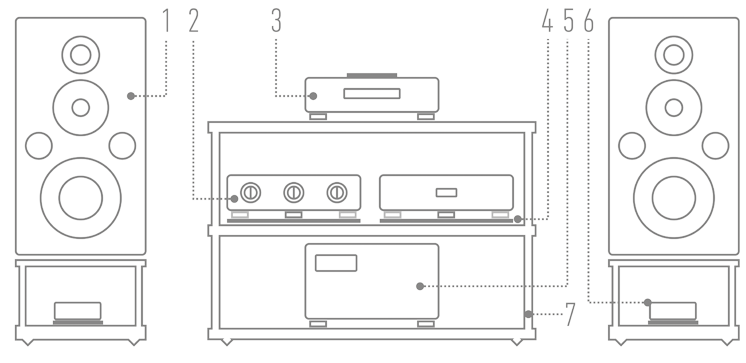 1) Loudspeakers: HARBETH M40.1 |REVIEW| 2) Line preamplifier: AYON AUDIO Spheris III Linestage |REVIEW| 3) Super Audio CD Player: AYON AUDIO CD-35 HF Edition No. 01/50 |REVIEW| 4) Stands (loudspeakers): ACOUSTIC REVIVE (custom) |ABOUT| 5) Power amplifier: SOULUTION 710 6) Loudspeaker filter: SPEC REAL-SOUND PROCESSOR RSP-AZ9EX (prototype) |REVIEW| 7) Hi-Fi rack: Hi-Fi rack: finite elemente MASTER REFERENCE PAGODE EDITION Mk II, more → HERE |
|

|
Cables Analog interconnect SACD Player - Line preamplifier: SILTECH Triple Crown (1 m) |ABOUT|» ANALOG INTERCONNECT Line preamplifier → Power amplifier: Siltech ROYAL SINLGE CROWN RCA; review → HERE Speaker cable: SILTECH Triple Crown (2.5 m) |ABOUT| |

|
AC Power Power cable | Mains Power Distribution Block - SACD Player: SILTECH Triple CrownPower (2 m) |ARTICLE| » POWER CABLE Mains Power Distribution Block → Line preamplifier: Acoustic Revive ABSOLUTE-POWER CORD, review → HERE » POWER CABLE Mains Power Distribution Block → Power amplifier: Acoustic Revive ABSOLUTE-POWER CORD, review → HERE Power cable | Power Receptacle - Mains Power Distribution Block: ACROLINK Mexcel 7N-PC9500 (2 m) |ARTICLE| Power Receptacle: Acoustic Revive RTP-4eu ULTIMATE |REVIEW| » ANTI-VIBRATION PLATFORM under Acoustic Revive RTP-4eu ULTIMATE: Graphite Audio CLASSIC 100 ULTRA, review → HERE Power Supply Conditioner: Acoustic Revive RPC-1 |REVIEW| Power Supply Conditioner: Acoustic Revive RAS-14 Triple-C |REVIEW| Passive filter EMI/RFI: VERICTUM Block |REVIEW| |

|
Anti-vibration Speaker stands: ACOUSTIC REVIVE (custom)Hi-Fi rack: finite elemente MASTER REFERENCE PAGODE EDITION Mk II, more → HERE Anti-vibration platforms: ACOUSTIC REVIVE RAF-48H |ARTICLE| » ANTI-VIBRATIONAL FEET: |

|
Analogue Phono preamplifier: Phono cartridges:
Clamp: PATHE WINGS Titanium PW-Ti 770 | Limited Edition Record mats:
|

|
Headphones » HEADPHONE AMPLIFIER: Leben CS-600X, review → HEREHeadphones: Headphone Cables: Forza AudioWorks NOIR HYBRID HPC |