


|
ANTI-VIBRATION FEET DIVINE ACOUSTICS
Manufacturer: DIVINE ACOUSTICS |

 |
 |
 |
|
Review
text by WOJCIECH PACUŁA |

|
No 267 August 1, 2026 |
|
˻ PREMIERE TEST ˼
LAST MONTH’S ISSUE OF “High Fidelity” was dedicated to a review of the Divine Acoustics Gravity Diamond anti-vibration platform. The review, the cover, and the interview with Piotr Gałkowski - the company’s CEO and designer - were all intended to give readers a sense of the kind of manufacturer, product, and technologies we’re dealing with. The manufacturer - innovative, precise, and honest. The product - innovative, precise, and excellent. The technology - innovative, requiring precision, and very interesting. 
The platform in question is a more affordable version of the top-of-the-line Cassini model. And yet, as we mentioned in our review, it is currently the most technologically advanced product from this company. This is thanks to the use of a mechanical decoupling system in the handles, into which the feet are screwed, a system that has just been introduced in the Newton Diamond feet and will gradually be incorporated into other models as well. We’re talking about Ceragem D technology (the company stylizes the name as: CeraGem D). ▓ Newton Diamond NEWTON DIAMOND are anti-vibration feet that the manufacturer describes as: “The benchmark anti-vibration feet for top-of-the-line audio systems.” This “reference” designation is an interesting term, because - strictly speaking - in the manufacturer’s lineup, they are positioned below the Galileo feet, which are part of the HIGH FIDELITY reference system. So, does this mean that even though they’re nominally from a lower series, the Newton Diamond feet would actually be better than the Galileo ones? We’ll find out. For now, however, it’s worth noting that this was the first Divine Acoustics product in which the company implemented a new decoupling technology, the most important element of which is components made of diamond that replaced previously used rubies. ▲ A few simple words… PIOTR GAŁKOWSKI THE NEWTON DIAMOND anti-vibration feet feature our latest technology Ceragem D, which, in addition to the materials previously used, employs the hardest substance known to man - diamond - to disperse and dampen unwanted vibrations. 
‖ Piotr Gałkowski and his Newton Diamond feet at “High Fidelity’s” headquarters 
Newton Diamond feet are also the answer to many questions from users of Galileo feet: “Can they be used under speakers?” Due to the way Galileo feet are tuned - which is not the same as leveling - they were not designed as speaker feet. That is why it was necessary to introduce plug-and-play feet to the lineup - feet that are versatile enough to be used under both audio equipment and speakers - with a quality comparable to that of the Galileo. These feet must function even under a light load of around 1 kg, while also being durable enough to support a 120-kg speaker resting on four feet. 
‖ To adjust the height of the support, unscrew the nut The Newtons were also supposed to be impact-resistant - for example, when they’re sitting on the floor and we accidentally kick them or run a vacuum cleaner over them. They were also supposed to work on a variety of surfaces - hardwood floors, “floating” floor panels, carpet, wall-to-wall carpeting, and wooden shelves. As usual, they work least effectively when placed on glass or granite - in my opinion, these aren’t materials that should be used in audio setups, for example as tabletop shelves. 
The design of the Newtons also coincided with the development of an anti-vibration system for another Polish brand affiliated with Divine Acoustics. There, a heavy, high-end device required a comprehensive approach without any half-measures. It was necessary to “go all out.” New solutions were developed, and as a result, among other things, a new technology was developed that is now making its debut in the Newtons. And the device itself is still in development - we’re going all out… 
‖ Comparison between Kepler Evolution (on the left) and Newton Diamond feet By design, the Newtons were not intended to compete with the Galileo. These are two distinct projects that differ in technology and focus on different aspects of sound. However, the Newton Diamond wins out in terms of versatility - it can also be used under speakers. For me, this is the first choice for where to place them in a system, and I often repeat this in phone calls and emails, because many people are still reluctant to do so, even though they have no qualms about using anti-vibration components under the source or amplifier. I hope that the new Newton Diamond models will find their way into many audio systems. ‖ PG NEWTON DIAMOND ARE THEREFORE anti-vibration feet. Their role is to reduce vibrations reaching the product resting on them, as well as to minimize and “manage” vibrations originating from the product itself. They are designed for use with electronics, turntables, and speaker cabinets. The manufacturer states:
They operate by reducing the noise generated by vibrations. Newton DIAMOND does not alter the character of the sound - it neither warms it up nor sharpens it. Instead, they reveal what was previously hidden: fine details, subtle spatial cues, and the natural dynamics of the recording. The result is a clearer, more open, and more organized sound, with better-controlled frequency extremes.
⸜ Newton Diamond, → DIVINEACOUSTICS.com, accessed: 25.05.2026. TECHNOLOGY • From the outside, the Newton Diamond feet resemble their predecessor, the Kepler Evolution model; the Keplers are still in production. When we take a closer look, we can notice some differences in the arrangement of the individual components and their appearance. Inside, as Piotr mentioned, there are even more differences. 
The manufacturer’s website states that each Newton Diamond foot is a “precise system consisting of over 60 components.” A key role is played by fifteen damping layers, made of materials with “diverse physicochemical properties - ranging from metals and non-metals, through ceramics and wood, to precious stones.” These layers are enclosed in specially designed chambers within the housing made of stainless steel and acrylic. All components are laser-cut and hand-finished, and the entire structure remains non-magnetic, which further eliminates the risk of interfering with the operation of audio equipment. The whole unit looks very nice and well-made. The Newton Diamond feet are based on the manufacturer’s new proprietary technology, known as Ceragem D. It is described as a “groundbreaking solution developed in response to the limitations of traditional damping materials.” And further:
Through research and listening tests, we concluded that further development in the field of vibration reduction requires the use of the hardest known material - diamond. This led to the creation of a unique system that uses micro-diamonds as the active element for controlling vibration energy. The result is the most advanced micro-vibration control system we have ever developed. (Ibid.)
The feet are surprisingly compact, at least for such a complex system. Their outer diameter is 67 mm, and they weigh 330 grams. Despite this, each foot is rated for a thirty-kilogram load, which works out to ninety divided by three and as much as one hundred twenty divided by four; the feet are sold in sets of three or four. At the top, they feature a threaded spindle that can be screwed in or out, thereby adjusting the system’s performance to the weight placed on it. A similar “tuning” system can be found in the Galileo feet. The user manual for the latter states:
• As the feet are adjusted upward, the presentation will gradually become more open and revealing. If it begins to lose its natural tonal richness and body, you have moved beyond the optimum setting.
• Likewise, lowering the setting will gradually increase weight and tonal density. However, if the presentation becomes excessively warm, slower, or loses its natural rhythmic flow, the optimum point has also been passed. ⸜ Galileo. User manual, → DIVINEACOUSTICS.com, accessed: 25.05.2026. The threaded shaft be screwed into the holes in the device or loudspeakers (stands, racks), as they are available in various sizes from M4 to M12 and in inch sizes. You can also simply place the device on them - special end caps are included. Their minimum height with the nut is 52 mm, and the maximum is 57 mm. 
The feet come in simple blue boxes, which also contain a small wrench for loosening the nut. Important - for listening tests it should be loosened, and the shaft should flex slightly in all directions. ▓ SOUND HOW WE LISTENED • The Newton Diamond anti-vibration feet were tested in the “High Fidelity” reference system. During the test, they were placed on the top shelf of the Finite Elemente Master Reference Pagode Edition Mk II rack. 
|
The test consisted of listening to the Ayon Audio CD-35 HF Edition SACD player, which was first placed on its own feet - Franc Audio Accessories Ceramic Disc Classic - and then on the feet under test. Separately, I compared them with the Galileo and Kepler Evolution feet. The test took the form of an AAA/BBB/AA comparative listening session, with the known A and B references. I listened to both short excerpts, lasting about one minute, and entire tracks. 
I devoted a separate listening session to the feet used under the Acoustic Revive speaker stands that support my Harbeth M40.1 speakers. In this case, they were compared to another excellent set of feet, the Pro Audio Bono PAB Ceramic 60 SN; reviewed → HERE. » RECORDINGS USED FOR THE TEST ⸜ a selection
• SHOTA OSABE PIANO TRIO, Happy Coat, Lasting Impression Music LIM K2HD 031, K2HD CD ⸜ 2002. FIRST, A FEW WORDS about the Franc Audio Accessories Ceramic Disc Classic feet that come with the Ayon Audio CD-35 HF Edition player I use. These feet produce a powerful, deep, and energetic bass. Almost all the feet - perhaps except for two or three models I’ve compared them to over the past ten years, if not more - presented the low end in a lighter, less full-bodied manner. Not all manufacturers took my comments in stride; we parted ways with a few because of this. 
The Ceramic Discs Classic (hereafter also referred to as CDC) are, however, feet that deliver a big sound. It isn’t particularly selective; in this regard, the Divine Acoustics Keplers already demonstrated something more. Perhaps this is because the CDC presents the high frequencies in a powerful way, but not with complete resolution. Overall, however, the combination delivers fantastic results, and for me, it serves as a benchmark, even though Franc Audio Accessories lineup includes more advanced designs. But when I heard the Divine Acoustics Galileo model under my Ayon player - and that was nearly three years ago - I knew there was no turning back and that they had to become part of my system. Listening to the Newton Diamond, my thoughts returned to the moment when the Galileo transformed the sound of my player. These small feet do something similar to the sound. Above all, they don’t thin it out; in fact, they boost it at the lower end of the frequency range. They’re more selective in what they do, yet the mass, scale, and energy of the bass, as heard in the opening track of SHOTA OSABE PIANO TRIO’s album Happy Coat entitled ˻ 1 ˺ Willow Weep for Me, were greater and more distinct. The overall sound was more powerful with the Newton Ds, yet at the same time more pastel. I can’t describe it any other way than as a “reconciliation of opposites.” After all, greater mass of the sound is usually associated with it being slower, yet the feet offered by Piotr Gałkowski sound fast, even very fast. This speed, however, does not turn into aggressiveness. Listening to the snare drum brushes on ˻ 3 ˺ Moonglow, I knew there was something special about them that allowed them to convey a wealth of detail in a soft, nuanced way. The brushes in question were recorded with a microphone positioned very close by - as was the entire drum kit, for that matter - which is why they’re also presented up close, in a slightly “forceful” way. With the feet I tested, that wasn’t the case - it was as if that “force” had been released, evaporated. Not annihilated, but precisely that: balanced in relation to the rest of the mix. Perhaps this is thanks to their high resolution, and these feet offer exceptional resolution. So exceptional, in fact, that with them, something “more,” “stronger,” and “greater” begins to happen in the music. To check how this translates to the vocals, I reached for EVA CASSIDY’s album Songbird, an absolute classic, originally released in 1998 and reissued two years later on an XRCD24 disc. Although the material for this version comes from analog tapes, the final result in this release is somewhat disappointing. Most of the tracks sound, quite simply, bright. It’s as if the remastering was overdone. You can hear this very clearly, for example, in ˻ 2 ˺ Wade in the Water, where the guitar, vocals, and drums all sound rather bright. The Hammond organ, too, for that matter. With the Newton Diamonds, the same happened that I’d heard on Shota Osabe’s album before - I’m talking about those brushes - and yet it surprised me: the sound was still bright, still slightly overdriven, and yet it wasn’t unpleasant. It was as if the “meat” had been revealed from under that brightness. This is a largely monaural recording, spread across the channels only thanks to the percussion instruments. It also sounds fairly flat dynamically. But not with the feet we’re talking about. With them, the sound was darker, heavier, and denser. It was still bright, though, because that’s the nature of the recording, and it also had a fairly hard punch and attack. Despite this, there was more going on in it than before; something was interesting about it, and that rhythm inherent in it really rocked. At the same time, it didn’t feel like anything was being smoothed out - it’s not that kind of product at all. So when I played ˻ 2 ˺ Eye in the Sky, a track from THE ALAN PARSONS PROJECT’s album of the same title, in the 2021 Mobile Fidelity Sound Lab version, I got a much lighter, almost airy sound. So it won’t be the case that the tested feet will reproduce everything in the same way. Rather, they’ll highlight the unique character of each recording, bringing out what’s good and what’s cool about them. With Shota Osabe Piano Trio’s Happy Coat, it was about dynamics and directness, along with fullness; with Eva Cassidy and Songbird, it was about better highlighting the richness and toning down the brightness; and with Parsons, it was about expressiveness. Every time, including with ˻ 7 ˺ Creep, a track from the STONE TEMPLE PILOTS album Core, I got more of everything, but presented in a better way. In the latter case, it turned out superbly, because the fullness of the bass, its focus, and its sense of space, all of it was more beautiful, more convincing with the Newton Diamonds. I have this album on the first German pressing from 1992, and it’s fantastically rich in the low frequencies, something subsequent remasters have tried to alter. But it is precisely this fullness that was emphasized and “pushed forward” by the feet we’re discussing. 
NEWTON vs GALILEO • When Piotr Gałkowski submitted the Newton Diamond for testing, he said he wasn’t afraid to compare them to the - theoretically - superior Galileo. He was right. No matter how much I love these marvels, no matter how much I rave about their design, construction, and craftsmanship, just a moment with the new model makes it clear that there’s something about Diamond technology that makes the sound both resolving, selective, and full-bodied, all at the same time. The bass in Creep was still powerful and deep - that’s something the Galileo does perfectly. But the overall sound also felt slightly “flat.” Not by much - if it weren’t for the direct comparison and repeatedly moving the player from one set of feet to another, I probably wouldn’t have noticed it. And yet, “it” is definitely there. I get the impression that the Newtons infuse the sound with fullness, relieving it of its internal “tightness.” The reference feet I use, handle high-frequency energy superbly, delivering a dark sound on the one hand, yet a selective one on the other. These new ones I’m testing are similar in that regard. However, they have even greater ease in opening up the midrange to reveal texture, richness, and fullness. Compared to the Galileo, Cassidy’s voice sounded softer and more pleasant with these. It remained bright, however, sung “from the throat,” just as it was recorded. What shall I do? I’m not replacing the Galileo under my player just yet, but I’m holding off only because the Diamond version will be available soon. If I didn’t have them, though, I’d go for the Diamond Newtons immediately, and without any hesitation. LOUDSPEAKERS • One of Piotr’s requests when we were discussing the test of his new products was to place Newton Diamond pads under the speakers - specifically under the Acoustic Revive stands on which the Harbeth M40.1 speakers rest. I try not to do this; I usually politely decline such requests from manufacturers, being aware of the effort involved in such testing on my side. Testing involves repeated comparisons. And the speakers aren’t light - you have to lift them (by yourself) every single time, then again, and so on. But when I heard what the new feet could do under the player, I went ahead and did it. And I’m glad I did. You see, I get attached to products that I like and that are part of the “High Fidelity” reference system, and I mean I get terribly attached to them. I respect them, I like them, I understand them. That’s how I felt about the Pro Audio Bono PAB Ceramic 60 SN feet as well. In 2020, after many, many years, they replaced the original feet in the stands, which had been custom-made for me by Mr. Ken Ishiguro. Now, though with regret, I’m saying goodbye to them. Not because they suddenly “stopped sounding good,” or because the new feet “blew them away.” It doesn’t work that way - those are just stories and manipulation. However, there was something in the sound of the Divine Acoustics feet that made the sound firmer, livelier, clearer, more flexible, and more firmly anchored in the lower bass. And yet, I hadn’t felt that I was missing any of that before. And there was also a sense of refinement, which was excellent with the Pro Audio Bono, but here it was just a hair better. That was something! ▒ Summary THE NEWTON DIAMOND feet by Divine Acoustics are one of the most interesting anti-vibration products I’ve had in my setup in years. There are also the Carbide Audio Carbide Base, as well as others - though those are designed for different devices. There are the Pro Audio Bono, unique designs by Mr. Władysław Skrzypczak. There are also new products from No Vibration. And then there are the classics: the Franc Audio Accessories feet. They all perform well, and you can invest in them with confidence. 
For me, however, in my system, given my expectations, it’s the Newton Diamond feet that deliver the most of what I’m looking for: resolution, selectivity, fullness, bass, and refinement. They perfectly showcase the stereo image without sounding artificial. So when, at 0:21 in the ˻ 3 ˺ Autumn Leaves, the engineer opens up the vocal and reverb channels, and the guitar shifts from the center to the left and back, it doesn’t sound artificial, and I know that’s a deliberate choice. The high frequencies are strong and clear with the tested feet, because the hiss in the aforementioned track was also more pronounced, whether the feet were placed under the player or under the speakers. They are also smooth and rich in harmonics, and thus less one-dimensional. If I hadn’t made the comparison, I wouldn’t have known this, because both the Galileo and the PAB Ceramic 60 SN are wonderful products. Now, however, I know, which is why my speakers will henceforth stand on Divine Acoustics feet. ‖ WP 
▒ Technical specifications (according to the manufacturer)
Outer diameter: 67 mm 
THIS TEST HAS BEEN DESIGNED ACCORDING TO THE GUIDELINES adopted by the Association of International Audiophile Publications, an international audio press association concerned with ethical and professional standards in our industry, of which HIGH FIDELITY is a founding member. More about the association and its constituent titles → HERE. |
 |



|
Reference system 2026 |
|
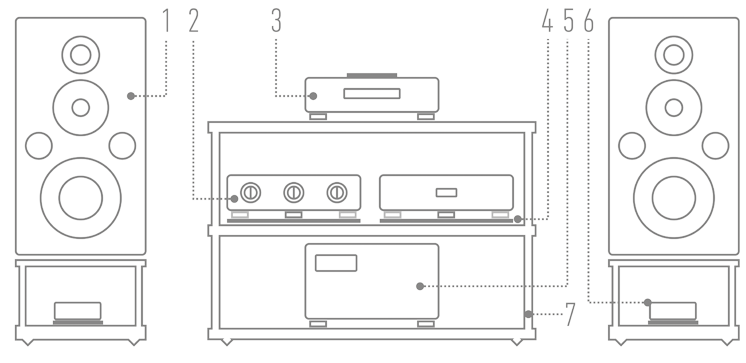 1) Loudspeakers: HARBETH M40.1 |REVIEW| 2) Line preamplifier: AYON AUDIO Spheris III Linestage |REVIEW| 3) Super Audio CD Player: AYON AUDIO CD-35 HF Edition No. 01/50 |REVIEW| 4) Stands (loudspeakers): ACOUSTIC REVIVE (custom) |ABOUT| 5) Power amplifier: SOULUTION 710 6) Loudspeaker filter: SPEC REAL-SOUND PROCESSOR RSP-AZ9EX (prototype) |REVIEW| 7) Hi-Fi rack: Hi-Fi rack: finite elemente MASTER REFERENCE PAGODE EDITION Mk II, more → HERE |
|

|
Cables Analog interconnect SACD Player - Line preamplifier: SILTECH Triple Crown (1 m) |ABOUT|» ANALOG INTERCONNECT Line preamplifier → Power amplifier: Siltech ROYAL SINLGE CROWN RCA; review → HERE Speaker cable: SILTECH Triple Crown (2.5 m) |ABOUT| |

|
AC Power Power cable | Mains Power Distribution Block - SACD Player: SILTECH Triple CrownPower (2 m) |ARTICLE| » POWER CABLE Mains Power Distribution Block → Line preamplifier: Acoustic Revive ABSOLUTE-POWER CORD, review → HERE » POWER CABLE Mains Power Distribution Block → Power amplifier: Acoustic Revive ABSOLUTE-POWER CORD, review → HERE Power cable | Power Receptacle - Mains Power Distribution Block: ACROLINK Mexcel 7N-PC9500 (2 m) |ARTICLE| Power Receptacle: Acoustic Revive RTP-4eu ULTIMATE |REVIEW| » ANTI-VIBRATION PLATFORM under Acoustic Revive RTP-4eu ULTIMATE: Graphite Audio CLASSIC 100 ULTRA, review → HERE Power Supply Conditioner: Acoustic Revive RPC-1 |REVIEW| Power Supply Conditioner: Acoustic Revive RAS-14 Triple-C |REVIEW| Passive filter EMI/RFI: VERICTUM Block |REVIEW| |

|
Anti-vibration Speaker stands: ACOUSTIC REVIVE (custom)Hi-Fi rack: finite elemente MASTER REFERENCE PAGODE EDITION Mk II, more → HERE Anti-vibration platforms: ACOUSTIC REVIVE RAF-48H |ARTICLE| » ANTI-VIBRATIONAL FEET: |

|
Analogue Phono preamplifier: Phono cartridges:
Clamp: PATHE WINGS Titanium PW-Ti 770 | Limited Edition Record mats:
|

|
Headphones » HEADPHONE AMPLIFIER: Leben CS-600X, review → HEREHeadphones: Headphone Cables: Forza AudioWorks NOIR HYBRID HPC |