


|
STREAMING PRE-AMPLIFIER & POWER AMPLIFIER ROKSAN
Manufacturer: MONITOR AUDIO GROUP |

 |
 |
 |
 |
|
Review
text by WOJCIECH PACUŁA |

|
No 263 April 1, 2026 |
|
˻ FIRST TEST ˼
ONE OF THE THINGS that irritate salespeople representing various manufacturers the most is pointing out the inconspicuous ‘Made in China’ label on products. As it turns out, symbols have power. No wonder, then, that the British company Roksan is so proud that all its products are still manufactured at its own factory in Essex, UK. The footer of its website reads: Today, our Caspian 4G Series amplifiers are proudly designed and manufactured in Britain, with all operations based at Monitor Audio Group’s headquarters in Rayleigh, Essex. The team of Roksan engineers and designers continues to honour our legacy while looking ahead - embracing modern technologies that meet the needs of a new generation of listeners. 
Roksan is a British ‘third wave’ company, following in the footsteps of post-war audio pioneers and the boom of the 1970s. It was founded in 1985 and last year celebrated its 40th anniversary. It started with a flagship product right from the outset: the Xerxes turntable. Unlike the solution popular at the time, which involved suspending the base on a rigid decoupling system using springs, the Xerxes utilised a system of three bases separated from one another by special flexible elements (so-called ‘blobs’ – rubber mounts). The idea was so different from what Linn, Roksan's main competitor at the time, had to offer that it catapulted the company into the audiophile universe. It also created demand that temporarily blocked Roksan’s growth. The first in-house electronic devices were therefore not produced until 1989, when the Artaxerxes phono preamplifier was created, designed to be fitted into the Xerxes turntable. The first standalone amplifier was released a year later – it was a split amplifier from the ROK series (S1 and M1). Take a look at what the 1991 ROK DP1 CD player looked like, and you’ll long for the return of those good old days. In 1998 a cheaper Caspian series was created. ▓ Caspian G4 CASPIAN IS ONE of Roksan’s oldest product lines. In two years’ time, it will be turning thirty. Each successive generation – such as the Caspian M in 2004, the Caspian M2 in 2010 and the Caspian VCS in 2015 – has brought something new and refreshed to the range. However, it is only the G4 (Generation 4) series that seems to be something entirely different. Building on solutions previously introduced (in 2021) to the Atessa series, it aims to change the way audiophiles (and not only them) think about audio. Roksan’s first attempt to ‘adapt’ to the modern era – the 2012 B Oxygene series – was not entirely successful in commercial terms. Everything about it was just right, but it was simply ahead of its time. That was nothing compared to what we are getting now. The Caspian 4G system has a design that breaks with convention, is very user-friendly (hard to imagine in the high-end sector), offers a different way of interaction between the user and the equipment, and yet remains a ‘true’ audiophile product. The approach is communicated via the main slogan of the series: “Designed for the user”. I know – nowadays, every second company says something like that. Roksan, however, is consistent in it:
Caspian Series 4G is built around the concept of total high-fidelity performance. A classic range that never forgets it aims to deliver a breathtaking sonic performance, coupled with true flexibility and versatility.
⸜ Ibid. The new series now consists of four products: an integrated amplifier, a streaming integrated amplifier, a streaming preamplifier and a power amplifier. They all share the same chassis, which has allowed the savings to be put to better use. We are testing the latter two and are the first in the world to do it. They share control systems and the way the user interacts with them. ░ Streaming Preamplifier THE NEW ROKSAN PREAMPLIFIER is labelled as a ‘streaming’ device. In reality, however, it is a file player with a fully-fledged preamplifier. According to the manufacturer, it is intended to serve as a ‘hub’ for an audio system. We can use it to play files – it is Roon Ready certified and features a fully balanced analogue pre-amp section. Thanks to its built-in, specially designed Bluetooth and Wi-Fi antennas, it offers – as the manufacturer assures us – “seamless connectivity, whilst maintaining an elegant, slim profile”. DESIGN • The preamplifier features a superbly crafted, very comfortable knob (with a switch) and three buttons on the left-hand side. The knob adjusts the volume. When pressed and turned, it also switches between inputs. The buttons control file playback – just like CD playback. The menu is highly complex, and you can access it via the manufacturer’s MaestroSuite app. The knob is positioned in the centre of an elongated ‘window’ behind which there is a monochrome OLED display with an orange filter. To the left of the knob, the names of the inputs or the volume level are displayed; the names can be replaced with a corresponding icon or customised. To the right are vertical bars indicating the volume level. It looks impressive but is surprisingly subtle. You can be sure that the company hired a good industrial designer for the job. 
However, when we use the Caspian preamplifier with a power amplifier, the bars are only displayed on the latter, to avoid duplication. The system connects to itself in some way without our knowledge, as the preamp ‘knows’ whether it is working with the power amp. There are, in fact, more indicator lights, and these relate to file transfer operations. When connecting to a network, multi-coloured bars light up on both sides of the knob to indicate the connection status, just as they do next to the playback control buttons. When a track is playing, a circle that gradually closes is displayed around the knob – a visual equivalent of a progress bar. FUNCTIONALITY • The Caspian 4G offers as many as eleven inputs and three outputs. Two of the three line inputs are unbalanced, while one is a balanced XLR. There are also two phono inputs, separate for MM and MC cartridges. The MM and MC inputs feature adjustable gain in three steps and an activatable low-cut filter below 20 Hz. There is also a Bluetooth connection with an aptX codec. There are three outputs – one balanced XLR and two unbalanced RCA. The device can also act as a digital-to-analogue converter for CD transports (Roksan offers one), Blu-ray players, etc. It features five inputs: two RCA, two optical Toslink and an HDMI eARC. Using the latter, we can play audio from a TV set via the audio system. The DAC is based on a proprietary chip called the Rapture DAC, which utilises a discrete, differential current-to-voltage converter. However, a file player seems the most important source for this version of the Caspian 4G. It has been taken extremely seriously. Rather than reinventing the wheel, the British engineers have opted for a tried-and-tested solution – the file transfer section is based on the BluOS platform:
The Caspian 4G Streaming Pre-Amplifier is the control hub of any Caspian system. With BluOS built-in, it delivers premium streaming up to 24-bit/192kHz across as many as 64 zones of high-resolution audio. BluOS also provides effortless browsing and instant access to locally stored music as well as leading streaming and radio services. When paired with the Caspian 4G Power Amplifier, the result is exceptional resolution, scale, and musicality – allowing the full character of every performance to shine through.
⸜ Ibid. To do this, the user needs to download the BluOS app, where it needs to be set up. It’s not difficult. The device is also Roon Ready certified, so you can use that system as well. The Caspian 4G preamplifier can be controlled using the controls on the front panel, a remote control and the MaestroUnite Setup & Control App. TECHNOLOGY • The device features a very rigid chassis. It is made from aluminium sheets reinforced with rigid cast heat sinks of an unusual shape, as well as steel plates on the inside. Two separate power supplies are used – a switching and a linear one. It appears that the former powers the transport section and, presumably, the connectivity section. The latter, with a small toroidal transformer, powers the analogue section. I’m not entirely sure how the volume control section has been constructed, but the circuit board features a large board with an AKM AK5534 analogue-to-digital converter. Roksan refers to “innovative volume control,” which “encapsulates the best of both digital and analogue worlds”. As we read, a hybrid digital-analogue volume control algorithm leverages “powerful digital signal processing to facilitate tone controls”. An “intelligent DSP «engine»”, accessed through the MaestroUnite app, optimizes sound using four key technologies: Intelligent Tone, Intelligent Boundary, Intelligent Speaker and Intelligent Phono. As we read, “combining these technologies allows users to adjust sound to room acoustics”. The manufacturer mentions the following key features of this solution: Dual-mono topology: each channel is derived by the summation of two switched current sources to improve linearity with the current to voltage transform and filtering by the discrete current-conveyor. LVDS (low-voltage differential signalling) transfer of sensitive timing and digital audio information: time-aligned signals can corrupt the operation of adjacent analogue circuits and are themselves easily and irretrievably upset. Roksan also mentions an innovative source-switching circuit, in which the ground connection is also switched. It’s worth noting that the circuit features some fine passive components, and the power supply uses high-quality Rubycon capacitors. You’ll have to admit that it all makes quite an impression. After all, it caters to the needs of audiophiles, whilst also offering a way out of some old-fashioned models we’ve become so used to. ░ The Power Amplifier THE CASPIAN 4G STEREO POWER AMPLIFIER delivers 105 W at 8 Ω and 200 W at 4 Ω, making it highly current-efficient. If you want even more power, each amplifier channel can be bridged. This gives us two monoblocks delivering 420 W at 8 Ω and as much as 630 W at 4 Ω per channel. According to the manufacturer, the amplification circuit is fully balanced. The unit offers as many as three different line inputs: XLR and two RCA. There are also two RCA line outputs, two sockets for 12 V triggers and an input for an external infrared sensor. The speaker outputs are single. All the sockets are gold-plated. 
The XLR and RCA 1 inputs are standard line inputs. If the amplifier is used with a preamplifier other than the Caspian 4G, the signal can also be routed to the RCA 2 input. In the app, you can then enable the Music Sense function, so that the device switches on when signal is detected at the input. When used with the Caspian 4G preamplifier, this is not necessary; communication between the devices is established automatically. The amplifier is based on a very large toroidal transformer and a switching power supply. Its power amplifier operates in class AB, but in a circuit designed by Roksan, bearing its own name: Euphoria – not bad, is it? We read:
Roksan Euphoria amplifiers stand out for their power and finesse. In the Caspian 4G model, Roksan has refined class AB circuit topology by equipping the current and voltage amplifiers with separate power supplies. By reducing interaction, a cleaner, more detailed and clearer sound has been achieved (see: Manual, p. 6)
On the front panel there is a display showing the volume level, as well as two vertical red lines indicating that the unit is in standby mode. A small button is used to ‘wake up’ the amplifier and – at the same time – the preamplifier. ▓ THE LISTENING SESSION THE WAY WE LISTENED • The Roksan preamplifier and power amplifier were placed on the top shelf of the Finite Elemente Pagode Edition Mk II rack, standing on their own feet, one on top of the other. They were compared to the reference system, comprising the Ayon Audio Spheris Evo preamplifier and the Soulution 710 power amplifier, as well as to the Aurio Research LS-2 & S-200 system. They drove the Harbeth M40.1 speakers via a Crystal Cable Da Vinci cable. |
Signal between them was transmitted via a Siltech Single Crown unbalanced cable, whilst power was supplied via Acrolink Mexcel 7N-PC8500 and Harmonix X-DC350M2R Improved-Version cables, respectively. The main source was the BluOS player in the preamplifier, compared to the Sforato DSP-05 EX file player with the PMC-05EX clock. 
I compared the DAC to the output of the Ayon Audio CD-35 HF Edition player, which was also acting as a transport. Signal was transmitted via an Acrolink Mexcel 7N-D6100 Mk II RCA-to-RCA interconnect. I also listened to the phono preamplifier, using a Rega P8 turntable with a Denon DL-103R MC cartridge for this purpose. » ALBUMS USED IN THE TEST ⸜ a selection
→ FILES FREEDOM, FREEDOM, FREEDOM – yes, that’s the simplest way to sum up how Roksan’s system performs when using the BluOS system and Tidal service. And there is no exaggeration in this, nor any hidden agenda. Roksan sounds as though it doesn’t have to worry about power reserves, the current needed to drive the speakers, or anything at all. 
It is because the system under review delivers open, natural and dynamic sound. There is no emphasis on the lower midrange, so we wouldn’t describe it as ‘warm’. Unlike just a few years ago, however, this does not mean that the sound lacks richness or fullness. It is a quiet revolution that I have been observing for some time, which yields results in the form of an open soundstage, liveliness and energy, while maintaining very good tonal balance – as is the case with the Caspian 4G system. WES MONTGOMERY, in the recording from the Half Note club, from the album Smokin’ at the Half Note, already in its first track ˻ 1 ˺ No Blues, therefore demonstrated freedom in playing, with which he is rarely shown. It really was a gig in a medium-sized club, with people eating and drinking at tables, swaying to the beat of the music. Everything was clear, precise, but, above all, uncompressed. What caught my attention, apart from the energy and tone, was the resolution. Yes, it is very detailed sound. When the trio plays, the hum of conversation is still noticeable in the background. Quiet, but constant. The Roksan device revealed it and did it very well in the sense that on the listening axis, beneath the sound of Kelly’s piano, there was audible hum. It didn’t get in the way, it didn’t alter the perspective from which we were listening to the music, and yet – it was there. And that’s not at all obvious, regardless of the price of audio equipment. I mentioned that the Roksan system doesn’t emphasize the lower midrange. Listening to Montgomery’s performance, one might therefore think that perhaps it doesn’t go very low in the bass either. But let’s listen straight after to PETER GABRIEL'S new track Put the Bucket Down from his upcoming album, and you’ll hear a very low and meaty “vroom” when Tony Levin’s bass guitar kicks in and the sampled drums come in. It was sudden and surprising. So much so that I jumped – and I’m not exaggerating, that’s really how it was :) You could say that the bass is quite warm and rounded rather than precisely defined in time and space. It doesn’t linger or drag on, but you immediately sense that it’s playing on a grander scale, rather than delivering a precise and selective ‘shot’. This, I must say, fits in very well with what I wrote above. It’s all about energy and dynamics. From the upper bass right up to the high treble, it is selective and well-defined. And so much so that we can listen to music without feeling overwhelmed, while at the same time be drawn into listening by a wealth of nuances and details. And again – ten years ago, this would have been a description of a rather dry device. But not with Roksan, oh no… It’s the opposite of dryness and thinness. The sound of the Caspian 4G system is just as I remember it from its ‘classic’ years, but ‘more so’: more saturated, more detailed, cleaner. Perhaps I haven’t said it outright yet but listening to tracks such as ˻ 1 ˺ Isfahan by BILL FRISELL, we get the impression that some curtain has been removed. It might not have been there before, and other systems might not be ‘sluggish’, but Roksan suggests something like that. The cymbal hits from this live recording were rendered with precision, sounding clear and crisp. Yet they also possessed the right weight, density and substance. The British system therefore had no trouble delivering a great performance of such demanding recordings, as well as pop tracks like Sensu kęs. This song, sung by MARIA PESZEK and written by SMOLIK, was created for the film Psoty. And it is superbly produced. There’s a slight emphasis on the lower midrange in Marysia’s voice, as if she were singing quite close to the microphone, which the Caspian reproduced clearly without overemphasising this element. And when the sampled drums and bass suddenly kick in, there’s a sudden ‘boom’ right at the bottom of the frequency range. Roksan played it with great feeling and that ease I mentioned earlier. The track by TYMEK, URBAŃSKI and SZATT sounded just as low; dense, energetic and melancholic all at once. THE DAC • The system under review does not reproduce sound in a one-dimensional way. It offers an excellent dynamic range. It is simply very faithful to whatever we feed it. Faithful both to the spirit of the music and to its form. The Caspian 4G combines, in a truly brilliant way, two qualities that are usually incompatible: energy and richness. 
The same applies to CDs when we send signal to the digital-to-analogue converter in the Roksan preamplifier. The sound will also be rich on the one hand, and powerful, fast and precise on the other. To tell the truth, I listened to one album after another – whether it was Coltrane’s Ballads or Oasis’s reissue of What’s The Story (Morning Glory) – with growing admiration. And with curiosity too, because this wasn’t one-dimensional, but varied sound. But I did mostly feel respect. And I never reached a point where the Roksan device sounded unpleasant. Perhaps because there is certain inner sweetness to its sound. I didn’t pick up on it straight away because – as I mentioned – the system doesn’t add any warmth to the musical message. And yet, as soon as I heard the first drumbeats from DIANA KRALL’s The Look of Love, when I heard her vocals in˻ 1 ˺ S’Wonderful, when her piano began to play, I knew very well why this particular version, the 2005 XRCD24 release, is so superb. It was sound dense on the inside, but also open, dynamic and free of nervousness, well-defined but not overly selective, detailed but not overly fussy. And when, at the beginning of ˻ 2 ˺ Love Letters Russell Malone’s electric guitar came in, I knew that clarity and saturation were perfectly combined in the sound. THE TURNTABLE • What surprised me about the Roksan device was how similar the sound from the digital files and the CDs was, in the sense that they shared the same tonal character, dynamics and expressiveness. The CDs sounded slightly better than the digital files, mainly in terms of resolution, but it wasn’t a ‘significant’ difference. In the sense that you could easily get by without a CD transport. If you want something more – then yes, you really must have one. But still no pressure, because files sound simply superb on it. It was no different with the phono input. Historically speaking, Roksan is a manufacturer of both turntables and electronics, particularly in recent years. But it was those black discs that the company really made its name on. This can be heard in how the phono stage has been integrated into the Caspian 4G preamplifier. This is a system designed for file playback; I have no doubt about that. However, just as with CDs, with vinyl we get something ‘extra’. Diana Krall, this time from the album All for You (A Dedication to the Nat King Cole Trio), in the version released on two LPs in 2009 by Original Recordings Group, had the power and energy for which this album is renowned. But that wasn’t all. There was also warmth we expect from vinyl. The same goes for resolution and selectivity – the sound is surprisingly good for a built-in preamplifier, and a standalone unit. There was minimal crackling, as well as very little noise, despite the open sound. The bass went deep, and, with LPs specifically, the lower midrange was subtly emphasised. The low end had a soft and smooth character, perhaps even more so than with files. I suspect, however, that this was the designers’ intention; that's how I interpret it. There is nothing accidental about this sound; everything is well thought out and perfectly matched. ▒ Conclusions IT'S BEEN A VERY LONG TIME since I last listened to Roksan equipment. But perhaps that’s why the Caspian 4G system made such a big impression on me. The company has changed its approach and is now thinking more broadly, without abandoning its audiophile ethos – that’s how I see it. The sound it offered previously was very good – rich, warm and low. It is only now, however, that I can also hear resolution and selectivity in it. And energy, too. The preamplifier and power amplifier we are testing therefore turn out to be more than just another audio system from a well-known manufacturer. They offer a wealth of useful features, and their user interface is unique. These devices are a pleasure to look at, a pleasure to operate, and an even greater pleasure to listen to music through them. 
They deliver saturated and nuanced sound. Every album will have its own character with these devices, but all will be presented in a pleasing way. It’s as though there’s an underlying sweetness that ‘smooths out’ the sounds that are sharper inside. The low, soft bass pulses, but it can also suddenly strike and take us by surprise. And everything is open and transparent. The system plays files, CDs and vinyl records equally well. That’s rare and valuable. Listen for yourselves, and you’ll see that progress in our industry is real, and that modern audio doesn’t have to be boring, sad and confined to the world of ‘hi-fi’. It can also be joyful and positive – just like the Caspian 4G. ‖ WP 
THIS TEST HAS BEEN DESIGNED ACCORDING TO THE GUIDELINES adopted by the Association of International Audiophile Publications, an international audio press association concerned with ethical and professional standards in our industry, of which HIGH FIDELITY is a founding member. More about the association and its constituent titles → HERE. |
 |



|
Reference system 2026 |
|
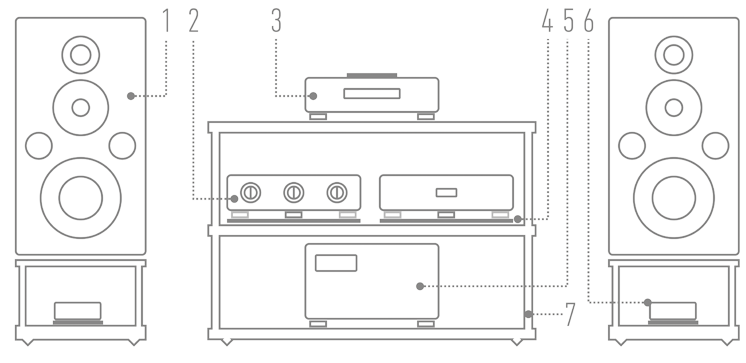 1) Loudspeakers: HARBETH M40.1 |REVIEW| 2) Line preamplifier: AYON AUDIO Spheris III Linestage |REVIEW| 3) Super Audio CD Player: AYON AUDIO CD-35 HF Edition No. 01/50 |REVIEW| 4) Stands (loudspeakers): ACOUSTIC REVIVE (custom) |ABOUT| 5) Power amplifier: SOULUTION 710 6) Loudspeaker filter: SPEC REAL-SOUND PROCESSOR RSP-AZ9EX (prototype) |REVIEW| 7) Hi-Fi rack: Hi-Fi rack: finite elemente MASTER REFERENCE PAGODE EDITION Mk II, more → HERE |
|

|
Cables Analog interconnect SACD Player - Line preamplifier: SILTECH Triple Crown (1 m) |ABOUT|» ANALOG INTERCONNECT Line preamplifier → Power amplifier: Siltech ROYAL SINLGE CROWN RCA; review → HERE Speaker cable: SILTECH Triple Crown (2.5 m) |ABOUT| |

|
AC Power Power cable | Mains Power Distribution Block - SACD Player: SILTECH Triple CrownPower (2 m) |ARTICLE| » POWER CABLE Mains Power Distribution Block → Line preamplifier: Acoustic Revive ABSOLUTE-POWER CORD, review → HERE » POWER CABLE Mains Power Distribution Block → Power amplifier: Acoustic Revive ABSOLUTE-POWER CORD, review → HERE Power cable | Power Receptacle - Mains Power Distribution Block: ACROLINK Mexcel 7N-PC9500 (2 m) |ARTICLE| Power Receptacle: Acoustic Revive RTP-4eu ULTIMATE |REVIEW| » ANTI-VIBRATION PLATFORM under Acoustic Revive RTP-4eu ULTIMATE: Graphite Audio CLASSIC 100 ULTRA, review → HERE Power Supply Conditioner: Acoustic Revive RPC-1 |REVIEW| Power Supply Conditioner: Acoustic Revive RAS-14 Triple-C |REVIEW| Passive filter EMI/RFI: VERICTUM Block |REVIEW| |

|
Anti-vibration Speaker stands: ACOUSTIC REVIVE (custom)Hi-Fi rack: finite elemente MASTER REFERENCE PAGODE EDITION Mk II, more → HERE Anti-vibration platforms: ACOUSTIC REVIVE RAF-48H |ARTICLE| » ANTI-VIBRATIONAL FEET: |

|
Analogue Phono preamplifier: Phono cartridges:
Clamp: PATHE WINGS Titanium PW-Ti 770 | Limited Edition Record mats:
|

|
Headphones » HEADPHONE AMPLIFIER: Leben CS-600X, review → HEREHeadphones: Headphone Cables: Forza AudioWorks NOIR HYBRID HPC |